

Matina Loukea discusses the transformative impact of Connected, Cooperative, and Automated Mobility (CCAM) on European transportation and the vital need for workforce adaptation and skill development
Not long ago, the future of transport was framed in bold, futuristic terms. Today, that future is unfolding in a different – yet still transformative – way, with Connected, Cooperative and Automated Mobility (CCAM) reshaping not only how we move, but how the transport system operates across Europe.
Transport represents around 5% of the European Union’s GDP and employs more than ten million people. As the sector evolves, its success will depend not only on technological progress, but – crucially – on people: their skills, adaptability, and willingness to embrace change.
CCAM can create new opportunities, improve job quality, and introduce new roles, making the sector more accessible and attractive to a broader audience of users and workers. At the same time, it raises important questions around data governance, ethics, and trust in automated systems.
Yet, one issue remains central: will people embrace this transformation?
Public acceptance is not guaranteed. Communities often approach change with caution, and even advanced technologies will struggle to deliver value if not widely adopted. The same applies to the workforce. If CCAM is perceived as a threat to jobs, resistance will grow; if experienced as an opportunity – offering clear pathways for reskilling and career development, it can foster acceptance, trust and engagement.
Putting people at the centre: The RESKILLING approach
This is where RESKILLING comes in. Funded under Horizon Europe, RESKILLING is a three-year project now approaching its mid-term phase, taking a social innovation-driven approach to the CCAM transition and placing workforce adaptation at the heart of innovation.
Through its Co-Innovation Framework and Stakeholder Forum, RESKILLING brings together policymakers, industry, workers and end users to co-create solutions. This is not about designing mobility systems in isolation – it is about shaping them with those who will use, operate, and be affected by them. The result is a more grounded, inclusive, and socially sustainable approach to change.
From mapping to action: Understanding jobs, skills and impacts
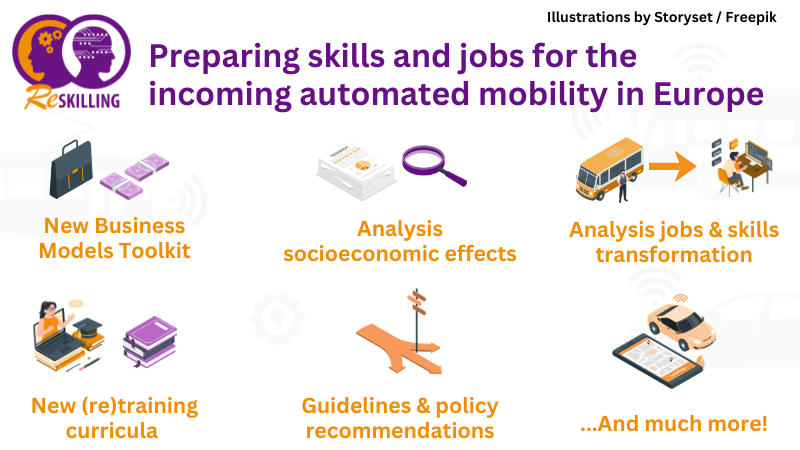
Turning vision into action requires clarity. RESKILLING delivers this through a comprehensive mapping of the CCAM value chain, identifying how jobs are evolving, which roles are emerging, and where risks may arise.
By consolidating 110 job profiles into 33 strategic job families, the project offers a comprehensive overview of the mobility workforce and goes beyond the obvious, highlighting roles often overlooked – such as mobility assistants or toll operators – that remain essential for accessibility, service continuity, and user trust.
Alongside this, a dedicated skills taxonomy connects these roles to evolving competencies across different automation levels. From cybersecurity and AI literacy to communication and system maintenance, the mobility skills landscape is being redefined.
These insights do not remain theoretical – they directly inform the development of targeted training modules, designed to equip current and future professionals with the skills they need to thrive in a changing environment.
Beyond skills, RESKILLING captures the broader transformation of the sector, examining how CCAM reshapes employment structures, affects different regions and fields, and where it offers opportunities for social innovation – providing a robust evidence base for informed decision-making.
From skills to systems: enabling workforce development
Understanding change is only the first step—supporting it is what truly matters. RESKILLING develops practical reskilling pathways and training profiles grounded in real-life career journeys. Using human-centred approaches, such as personas and learning journeys, the project captures how workers and organisations experience transition and where support is most needed.
These insights directly inform training programmes, education schemes, and co-creation activities, ensuring workforce development is both effective and inclusive. A key legacy is the CCAM Employment & Skills Observatory, a knowledge hub bringing together data on jobs, skills, and emerging roles, offering tailored insights to policymakers, industry, and training providers.
From innovation to impact: Scaling solutions and shaping policy
For CCAM to succeed, innovation must scale and deliver real value. RESKILLING supports this by focusing on business models, scalability, and policy alignment, enabling CCAM services to move from pilots to widespread adoption. At the same time, it explores transferability across transport modes and European regions, recognising their heterogeneity. Scenario-based analyses and stakeholder input help identify realistic pathways for economic growth, job creation, and an inclusive CCAM transition.
These insights are translated into guidelines and policy recommendations, with a focus on skills and jobs, supporting decision-makers in navigating the transition. Looking ahead, a roadmap to 2050 provides a structured vision for aligning technological progress with workforce development and inclusive growth.
Measuring impact, shaping the future of mobility
What does success look like? While RESKILLING defines clear indicators to track progress and guide action, the success of the CCAM transition goes beyond metrics and technology: It will be shaped by people – by their skills, their choices, and their ability to embrace and lead change.
