

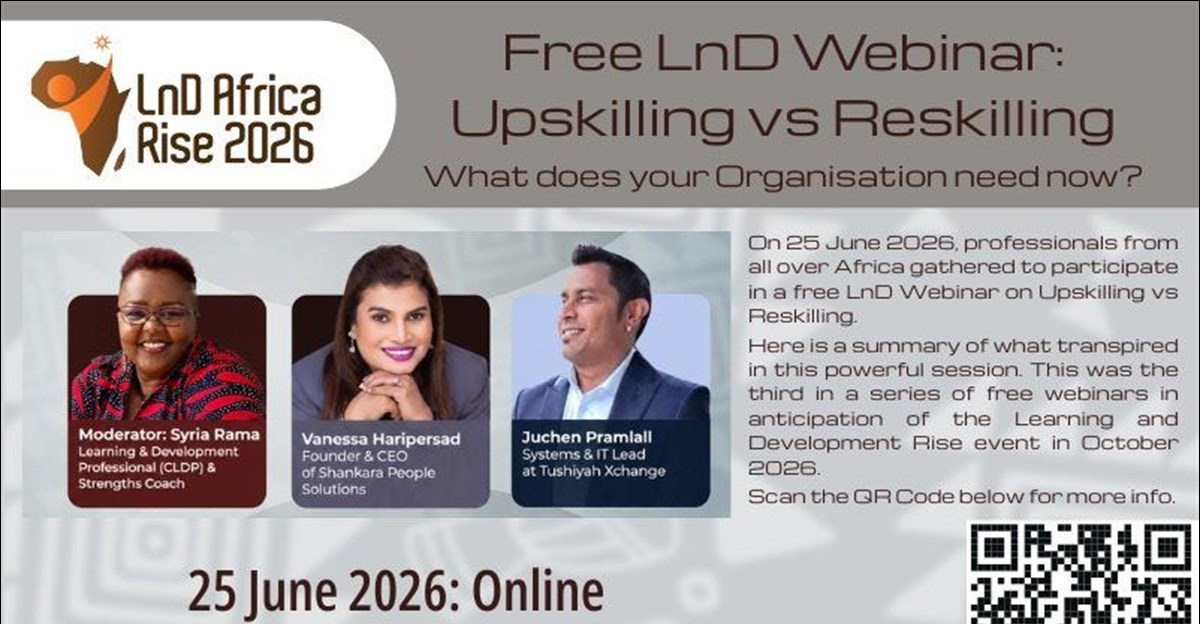
The landscape of corporate learning and development (L&D) is shifting beneath our feet. Driven by technological disruption and rapidly changing demographic realities, organisations are realising that traditional training methodologies are no longer enough to support a volatile corporate market. In a recent, highly engaging panel session, industry professionals gathered to unpack what it takes to build a future-ready workforce. The session challenged traditional corporate paradigms, offering attendees a profound exploration of human potential. It bridged the gap between building deeply rooted personal resilience and leveraging the massive, community-driven talent across the African continent.
Part 1: Reskilling to resilience
Introducing Vanessa Haripersad
As an award-winning transformational leadership coach and the founder and CEO of Shankara People Solutions, Vanessa Haripersad brings a wealth of expertise in organisational development, neuroscience-based coaching, and holistic wellness. Known for her ability to guide leaders through highly complex organisational shifts, Vanessa has dedicated her career to unlocking human potential. Her work focuses heavily on building sustainable cognitive and emotional resilience to counter modern corporate challenges like burnout.
Moving beyond the technical “update”
During the session, Vanessa clarified a critical distinction often lost in corporate HR departments: the difference between upskilling and reskilling. While upskilling polishes existing capabilities for an evolving current role, reskilling is a deliberate, intentional pivot – the acquisition of entirely new skill sets to transition into fundamentally different functions.
According to Vanessa, organisations are currently navigating a dangerous “dual crisis”:
- The Skills Crisis: The shrinking shelf life of technical competence means hard skills erode faster than ever.
- The Resilience Crisis: Leaders are consistently promoted based on technical merit alone, without the adaptive capacity to handle pressure, leading to rampant organisational burnout.
Rather than running siloed technical bootcamps and wellness workshops, Vanessa argued that reskilling programs should serve as the training ground for resilient leadership. Stepping into a completely new domain creates a state of “structured discomfort.” In this safe-to-fail environment, leaders can practice being beginners, cultivate curiosity, and build emotional stamina.
To guide this transformation, Vanessa highlighted her proprietary SCCR Framework, which anchors sustainable leadership culture on four distinct pillars:
- Self-awareness
- Compassion
- Curiosity
- Resourcefulness
Part 2: Activating African talent via upskilling
Introducing Juchen Pramlall
Bringing a highly strategic, localised lens to the discussion was Juchen Pramlall, an experienced L&D strategist and professional business moderator. Juchen has been deeply involved in shaping pan-African talent conversations, championing approaches that align educational outcomes with industry needs while remaining heavily attuned to the unique cultural and socioeconomic nuances of the African continent.
The communal power of African L&D
Juchen shifted the lens to the massive scale of the African continent, asserting that upskilling in this context cannot be treated as a cold, individualistic corporate task. Instead, it must be viewed as an engine for inclusive economic growth—where elevating one professional inherently lifts families, communities, and entire regional economies.
The continent faces a massive demographic challenge: while Africa’s youth population is projected to boom by 132 million this decade, youth underemployment and unemployment hover stubbornly around 45%. Traditional academic curricula simply cannot adapt quickly enough, leaving an immense digital skills deficit.
To bridge this gap, Juchen advocated for moving away from isolated, individual e-learning modules in favor of tapping into ancestral wisdom and community cohesion – the spirit of Ubuntu. He emphasised a three-pronged strategy for high-impact talent activation:
- Communal Learning Circles: Shifting training into peer-to-peer, collaborative spaces.
- Localised Storytelling: Replacing Eurocentric case studies with authentic, relatable African corporate success stories.
- The Mobile Leapfrog: Recognising that smartphones are the primary access point for the workforce, L&D frameworks must be data-light, mobile-first, and delivered in micro-learning bursts of 3 to 10 minutes to maximise retention and ensure immediate on-the-job application.
Conclusion
The intersection of Vanessa’s internal resilience framework and Juchen’s community-driven, mobile-first talent strategies highlights a powerful truth: the future of work requires organisations to be as invested in human adaptability as they are in technological integration.
The session was exceptionally well received by attendees, who lauded the speakers for moving past standard corporate jargon to provide deeply actionable, culturally resonant frameworks. By successfully blending cognitive resilience with localised, accessible training methodologies, this panel provided a powerful blueprint for cultivating a workforce that is not only highly skilled but deeply sustainable for the future.
