

Key Takeaways
- The investment multiplier amplifies economic impacts from increased investment spending.
- Government projects, like road building, exemplify the multiplier’s economic effects.
- MPC and MPS are crucial in determining the investment multiplier’s strength.
- A higher MPC leads to a more significant economic stimulus effect.
Get personalized, AI-powered answers built on 27+ years of trusted expertise.
What Is the Investment Multiplier?
The investment multiplier is a critical economic concept rooted in the theories of John Maynard Keynes. It suggests that increases in investment spending can have profound effects on the overall economy, triggering a cycle of increased income and consumption.
By understanding the investment multiplier, rooted in marginal propensity to consume (MPC) and save (MPS), one can grasp its far-reaching impact, exemplified in scenarios like government spending on infrastructure projects. This concept underscores how investments are not isolated financial actions but catalyze widespread economic activity.
Economic Impact of the Investment Multiplier
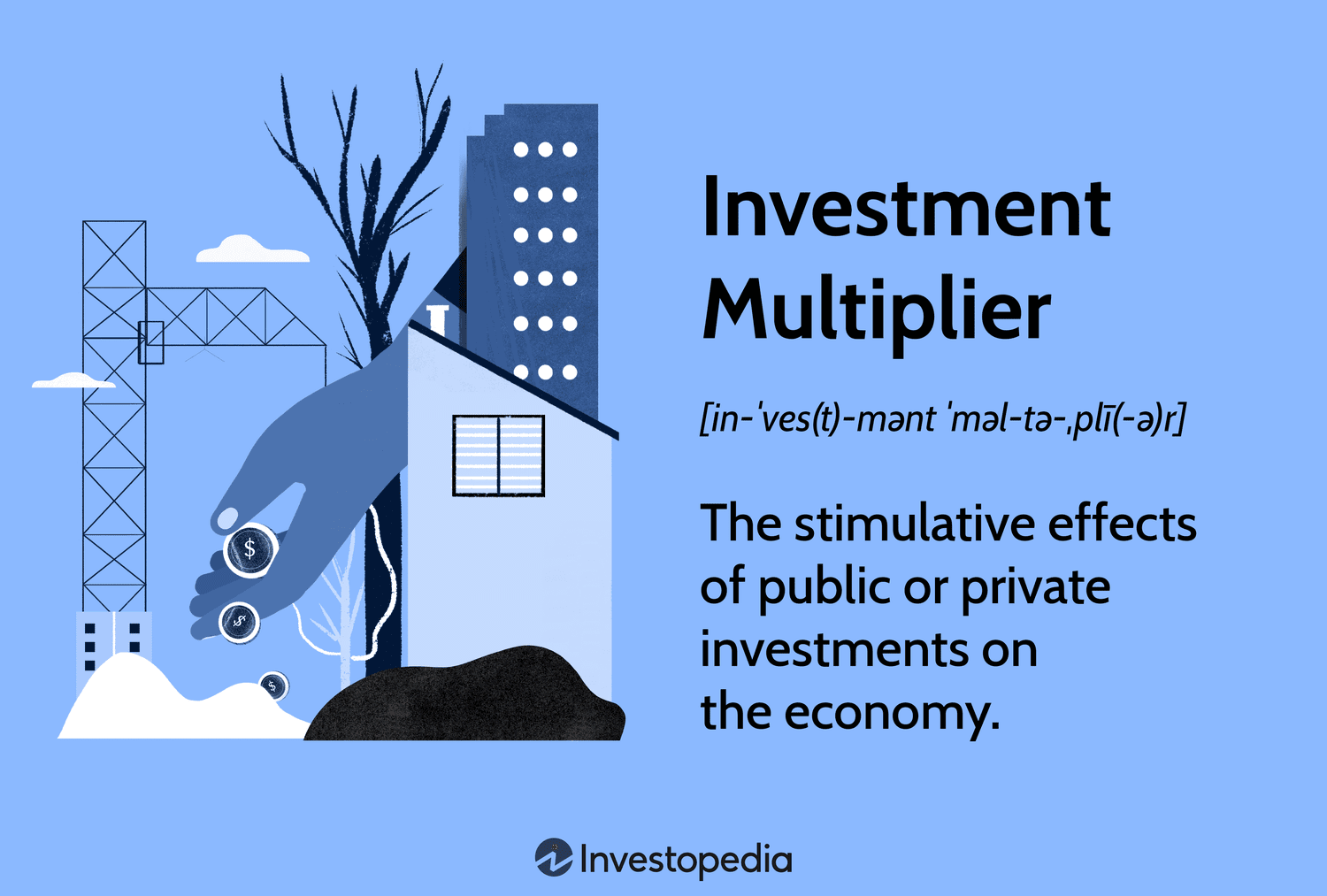
The investment multiplier tries to determine the economic impact of public or private investment. For example, more government spending on roads can boost the income of both construction workers and materials suppliers. These people may spend the extra income in the retail, consumer goods, or service industries, boosting the income of workers in those sectors.
This cycle can repeat multiple times, turning road investments into economic stimulus that helps workers in many industries.
Mathematically, the investment multiplier is a function of two main factors: the marginal propensity to consume (MPC) and the marginal propensity to save (MPS).
Fast Fact
John Maynard Keynes was among the first economists to illustrate how governments can use multipliers, such as the investment multiplier, to stimulate economic growth through spending.
Real-World Examples of the Investment Multiplier
Consider the road-construction workers in our previous example. If the average worker has an MPC of 70%, that means they consume $0.70 out of every dollar they earn, on average. In practice, they might spend that $0.70 on items such as rent, gasoline, groceries, and entertainment. If that same worker has an MPS of 30%, that means they would save $0.30 out of every dollar earned, on average.
Businesses, like individuals, also spend a large part of their income on expenses like wages, rent, and equipment repairs. A typical company might spend 90% of its income on these costs, leaving 10% as profits for shareholders.
Investment Multiplier Calculation: Formula and Explanation
Calculating a project’s investment multiplier is simple:
1/(1−MPC)
In our above examples, the investment multipliers would be 3.33 and 10 for the workers and the businesses, respectively. The reason the businesses are associated with a higher investment multiple is that their MPC is higher than that of the workers. In other words, they spend a greater percentage of their income on other parts of the economy, thereby spreading the economic stimulus caused by the initial investment more widely.
What Is the Investment Multiplier Formula?
To calculate the investment multiplier for a project the following formula can be used:
1/(1−MPC)
MPC is the acronym for marginal propensity to consume.
Who Was John Maynard Keynes?
John Maynard Keynes was a ground-breaking British economist who is considered the father of modern macroeconomics. His book, The General Theory of Unemployment, Interest, and Money, was published in 1936 and is the foundation for Keynesian economics.
What Are Examples of Multipliers?
The Bottom Line
The investment multiplier measures how increases in public or private investments can amplify positive impacts on aggregate income and the broader economy, as illustrated by John Maynard Keynes’ economic theories. It quantifies additional effects beyond initial measurable spending, with a higher multiplier indicating a more pronounced stimulative effect.
Understanding the marginal propensity to consume and save is key, as they determine the extent of this multiplier effect. This concept is just one of many economic multipliers that help assess the distribution of wealth and potential economic growth.
