Bank of the James Financial Group, Inc. BOTJ and C&F Financial Corporation CFFI are well-known regional banking institutions, but they differ in the breadth of their operations. Bank of the James primarily serves retail and commercial customers through community banking, mortgage lending and wealth management services. C&F Financial, meanwhile, operates a diversified financial service platform that includes commercial and consumer banking, mortgage lending, consumer finance and wealth management through its banking subsidiaries.
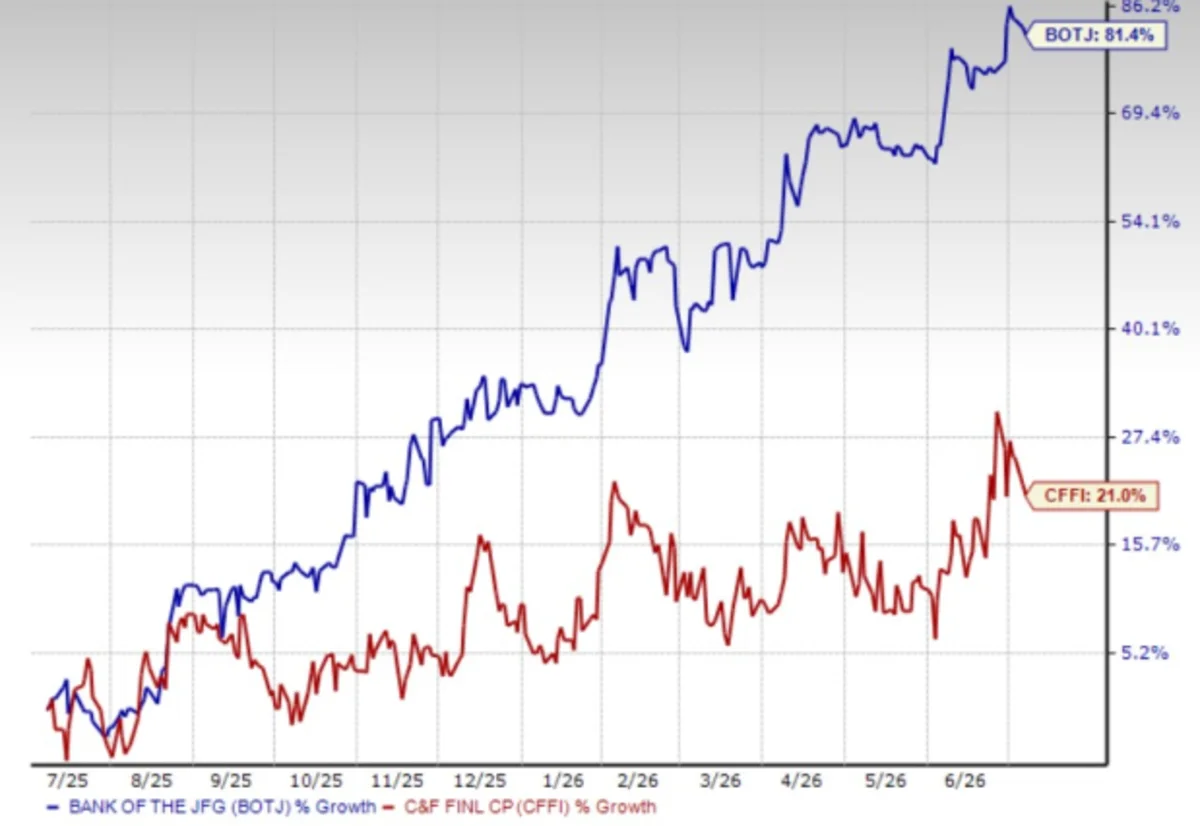
Both stocks have generated strong returns over the past year. Shares of Bank of the James have rallied 81.4%, significantly outperforming C&F Financial’s 21% gain.
1-Year Price Chart
Zacks Investment Research
Image Source: Zacks Investment Research
While the recent share price performance has been impressive, evaluating each company’s operating fundamentals provides a better perspective on their long-term investment potential.
BOTJ Continues to Deliver Strong Operating Momentum
Bank of the James reported an impressive first-quarter fiscal 2026 performance, with net income more than tripling year over year to $2.77 million from $842,000 in the prior-year quarter. Higher net interest income and non-interest income, lower operating expenses, and an improvement in credit costs drove earnings growth.
The bank also expanded its net interest margin to 3.57% from 3.25% in the prior-year quarter, benefiting from lower funding costs following the retirement of capital notes and declining deposit costs. Net interest income increased 13.2%, while wealth management fees and mortgage banking gains continued to diversify revenue streams beyond traditional lending activities.
Operational efficiency also improved considerably. BOTJ’s efficiency ratio declined to 73.75% from 89.31%, reflecting disciplined expense management, including reduced data-processing and professional service costs following the renegotiation of its core processing contract.
Asset quality remained healthy as non-performing loans declined to $1.45 million from $1.70 million at the end of year 2025. The allowance for credit losses covered non-performing loans by 4.28 times, underscoring the strength of the bank’s reserve position. Deposits increased to $956.6 million, shareholders’ equity continued to grow and management reaffirmed its commitment to shareholder returns by declaring another quarterly dividend of 10 cents per share.
CFFI Benefits From Diversified Revenue Streams
C&F Financial also delivered a solid quarterly performance. Net income increased 26% year over year to $6.8 million, while earnings per share improved to $2.08 from $1.66. The improvement reflected strong contributions from its community banking and mortgage banking businesses.
Net interest income rose nearly 11%, supported by higher loan yields and a wider net interest margin of 4.27%. Non-interest income also strengthened, driven by higher loan sale gains, mortgage banking fees, interchange income and wealth management revenues.
The company continued to build balance sheet strength during the quarter. Community banking loans increased 9% year over year, deposits grew 8.2% and mortgage loan originations surged nearly 58%, benefiting from improving mortgage market conditions.
One of C&F Financial’s key competitive advantages remains its diversified operating model. The company generates earnings from community banking, mortgage banking, consumer finance and wealth management, providing multiple growth avenues. Management also highlighted its expansion into Southwest Virginia, while investor materials emphasized solid capital levels, healthy asset quality and a long-term growth strategy, supported by 31 banking branches across Virginia.
Nevertheless, certain risks remain concerning. The consumer finance segment posted a modest quarterly loss as higher credit costs, rising net charge-offs and elevated collection expenses offset improved loan yields. Provision for credit losses increased to $3.6 million from $3 million a year earlier, reflecting management’s cautious view of the credit environment.
Like many regional banks, C&F continues to report unrealized losses on its securities portfolio due to higher interest rates. In addition, macroeconomic uncertainty, including geopolitical risks and interest-rate volatility, could pressure future operating performance.
Dividend Comparison
For income-focused investors, C&F Financial currently offers the stronger dividend profile. The stock carries a dividend yield of 2.4%, comfortably above Bank of the James’ yield of 1.6%. At the same time, CFFI maintains a conservative payout ratio of around 22%, providing ample flexibility for future dividend growth.
Bank of the James, however, boasts an even lower payout ratio of approximately 17%, indicating that its dividend remains exceptionally well-covered by earnings. The company’s lower yield primarily reflects its stronger share price appreciation rather than weaker dividend sustainability. BOTJ has also increased its dividend consistently over the past several years.
Zacks Investment Research
Image Source: Zacks Investment Research
Bank of the James Trades at More Attractive Valuation
From a valuation standpoint, Bank of the James appears significantly cheaper than C&F Financial. BOTJ currently trades at a trailing 12-month enterprise value-to-EBITDA (EV/EBITDA) multiple of 1.65X, well below CFFI’s 6.02X. This lower valuation suggests that investors are paying a considerably smaller premium for BOTJ’s earnings potential.
Zacks Investment Research
Image Source: Zacks Investment Research
BOTJ vs. CFFI: Which Stock Looks More Attractive?
Both Bank of the James and C&F Financial have delivered solid operating performances and remain fundamentally healthy regional banking franchises. C&F Financial stands out for its diversified business model, stronger dividend yield and balanced earnings drivers across community banking, mortgage banking and consumer finance. However, rising credit costs within its consumer finance segment and a richer valuation temper some of its appeal.
Bank of the James, meanwhile, combines accelerating earnings growth, improving operating efficiency, strengthening asset quality and a substantially more attractive valuation. Its conservative payout ratio also provides ample room for continued dividend growth, while recent operational improvements position the company well for future profitability.
Given its stronger earnings momentum, improving fundamentals and significantly lower valuation, Bank of the James appears to be the more attractive investment at the current levels and looks like the better stock for investors seeking long-term capital appreciation.
Want the latest recommendations from Zacks Investment Research? Today, you can download 7 Best Stocks for the Next 30 Days. Click to get this free report