

Investment Banking Market

Dublin, May 19, 2026 (GLOBE NEWSWIRE) — The “Investment Banking – Global Strategic Business Report” has been added to ResearchAndMarkets.com’s offering.
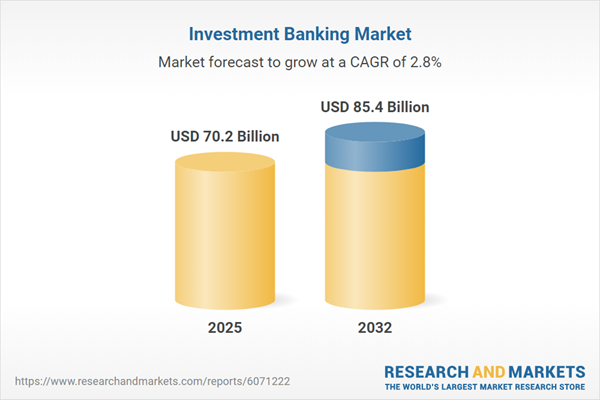
The global market for Investment Banking was estimated at US$70.2 Billion in 2025 and is projected to reach US$85.4 Billion by 2032, growing at a CAGR of 2.8% from 2025 to 2032. This comprehensive report provides an in-depth analysis of market trends, drivers, and forecasts, helping you make informed business decisions.
How Is Technology Reshaping Investment Banking Services?
The investment banking industry is undergoing a rapid technological transformation, significantly enhancing operational efficiency and client engagement. One of the most prominent innovations is artificial intelligence (AI) and machine learning (ML), which are increasingly being used for data analytics, risk assessment, and algorithmic trading. AI-powered predictive analytics enable investment banks to identify market trends, assess credit risk, and optimize trading strategies with greater accuracy, reducing human error and improving decision-making.
Another key technological shift is the rise of blockchain and decentralized finance (DeFi) solutions. Investment banks are exploring blockchain technology for faster and more secure cross-border transactions, smart contract execution, and fraud prevention. By leveraging tokenization of assets, financial institutions can create digital representations of securities, improving liquidity and accessibility for a broader range of investors. Additionally, the adoption of robo-advisory services and automated trading platforms is enhancing efficiency in wealth management and institutional trading, offering clients real-time portfolio optimization and investment recommendations.
Cybersecurity has also become a critical focus for investment banks, given the rising threat of cyberattacks on financial institutions. Firms are investing in advanced encryption protocols, biometric authentication, and AI-driven fraud detection systems to safeguard sensitive financial data and maintain regulatory compliance. Moreover, cloud computing and big data analytics are revolutionizing investment banking workflows, enabling firms to process vast amounts of financial information, streamline operations, and provide personalized investment solutions to clients.
What Market Trends Are Driving the Evolution of Investment Banking?
Several key trends are reshaping the investment banking landscape, influencing strategies and service offerings. One of the most notable trends is the growth of sustainable finance and Environmental, Social, and Governance (ESG) investing. With increasing regulatory and investor pressure to address climate change and corporate responsibility, investment banks are prioritizing green finance initiatives, such as green bonds, ESG-focused M&A, and impact investing. Many firms are incorporating ESG criteria into their risk assessments, advisory services, and capital-raising strategies to align with the shifting preferences of institutional investors and policymakers.
Another major trend is the rise of private capital markets and alternative investments. Traditional equity and debt markets are facing competition from private equity (PE), venture capital (VC), and hedge funds, which are increasingly attracting capital from institutional investors and high-net-worth individuals. Investment banks are expanding their advisory services to cater to private market transactions, facilitating direct investments, private placements, and structured financing deals for growth-stage companies and startups.
Globalization continues to influence investment banking, with cross-border M&A activity on the rise. Emerging markets, particularly in Asia-Pacific, the Middle East, and Africa, are witnessing increased investment banking activity as multinational corporations seek expansion opportunities in high-growth economies. Additionally, de-SPAC (Special Purpose Acquisition Companies) transactions and alternative deal structures have gained traction, offering innovative ways for companies to go public without traditional IPOs. The shifting regulatory landscape, particularly in the U.S. and Europe, is also shaping how investment banks approach capital markets and corporate finance transactions.
What Is Driving the Growth of the Investment Banking Industry?
The growth in the investment banking industry is driven by several factors, including strong corporate dealmaking, technological advancements, and the evolving financial needs of businesses and investors. A key driver is the resurgence of M&A activity, fueled by corporate restructuring, industry consolidation, and increased private equity involvement. As companies seek strategic partnerships, market expansion, and operational synergies, investment banks play a pivotal role in structuring, negotiating, and financing these high-value transactions.
The expanding digital economy and fintech sector are also accelerating investment banking growth. The rise of fintech startups and digital-first financial services has created opportunities for investment banks to provide capital-raising advisory, underwriting services, and strategic partnerships to technology-driven firms. Furthermore, the increasing adoption of digital payment solutions, cryptocurrency investments, and decentralized finance (DeFi) is prompting investment banks to explore new financial instruments and investment opportunities.
Another crucial factor is the rising demand for wealth management and capital markets advisory services. With growing global wealth, investment banks are expanding their private banking and asset management divisions to cater to ultra-high-net-worth individuals and institutional investors seeking diversified portfolios and alternative investment strategies. Additionally, the low-interest-rate environment and access to cheap capital in many economies have encouraged debt financing and leveraged buyouts (LBOs), further driving demand for investment banking services.
The integration of AI, big data, and automation in financial analysis and trading is also fueling industry expansion, allowing investment banks to enhance market intelligence, optimize trade execution, and improve regulatory compliance. Lastly, emerging markets and frontier economies present significant growth opportunities, as governments and corporations in developing regions seek access to international capital markets, infrastructure financing, and foreign direct investment (FDI), reinforcing the indispensable role of investment banks in global financial markets.
Report Scope
The report analyzes the Investment Banking market, presented in terms of market value (US$). The analysis covers the key segments and geographic regions outlined below:
