

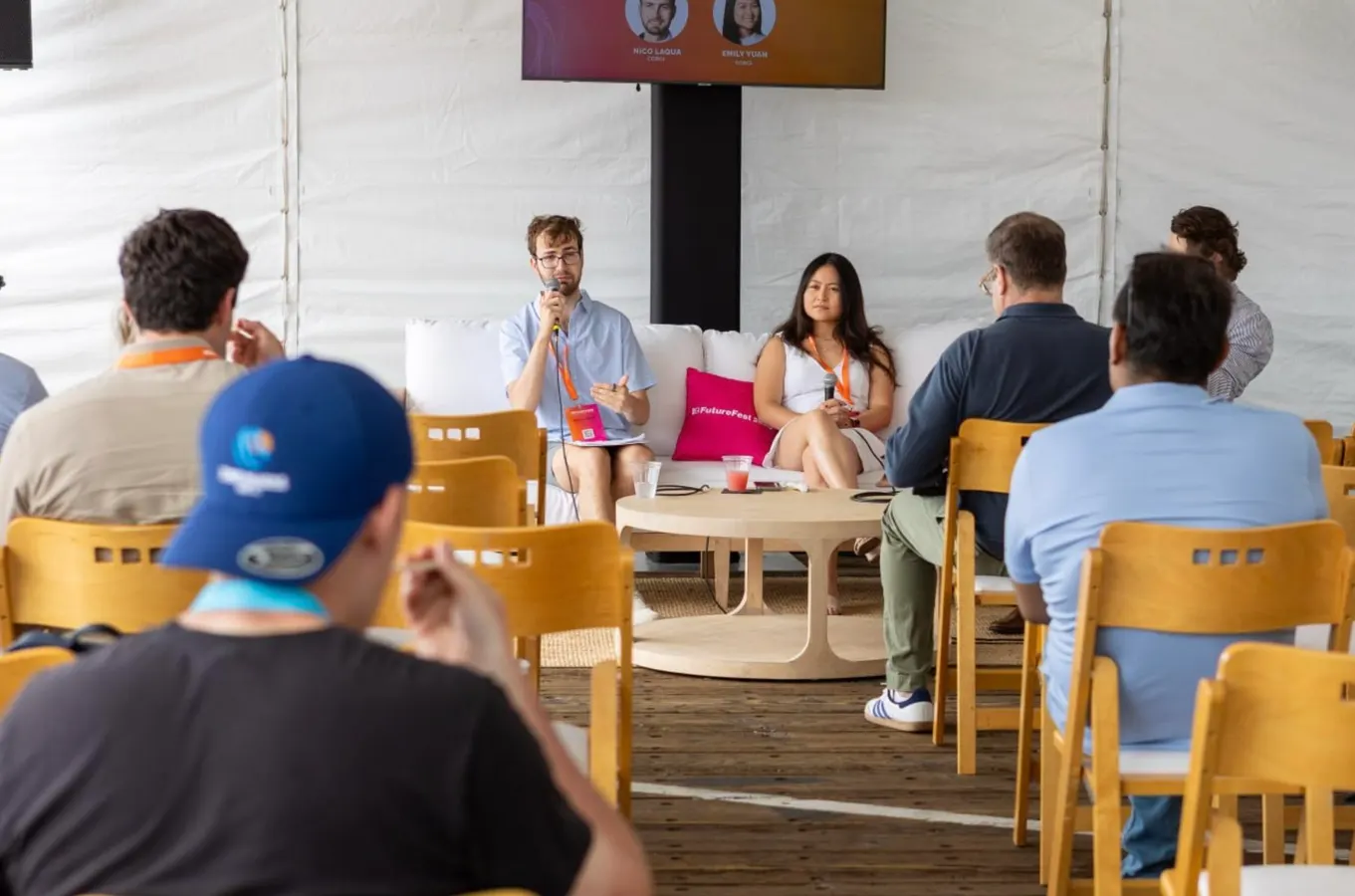
Corgi founders Nico Laqua and Emily Yuan
Courtesy Corgi
Just weeks after Corgi, an AI insurance startup, announced a fundraise that vaulted the fledgling startup to unicorn status, the company has raised another round of $106 million that doubles its valuation to $2.6 billion, CEO Nico Laqua tells Forbes.
The new round, announced on Thursday, was only open to existing investors, and was led by the growth equity firm TCV, with participation from VC firms including Kindred Ventures and Prime Capital, according to Corgi, which says it is considering this new round a Series B1. It follows a $160 million Series B that closed in late April and valued the company at $1.3 billion. “We weren’t planning on doing it,” says Laqua. “It wasn’t something that we went out and solicited.”
Instead, existing backers reached out to Corgi seeking to invest more money, he insists. “We didn’t want to take too much, but I think the company is clearly worth a lot more than it was even a couple weeks ago,” Laqua says. “It’s important that we have a lot of financial strength as a financial institution.”
The fast follow-on round illustrates the relentless frenzy to fund AI companies, as investors clamor to throw money at startups. On the high end, companies like OpenAI and Anthropic have raised unprecedented rounds of $122 billion and $65 billion at once unimaginable valuations of $852 billion and $965 billion, respectively. Meanwhile, young founders are raising triple-digit millions without breaking a sweat. Laqua, who is 26, compares the current atmosphere to the Web 2.0 era of Google and Facebook, then the mobile era of Uber and Airbnb. “This moment to me feels even bigger than either of those in terms of the potential, he says.” Never mind that he wasn’t born when Google was founded and he was just not even a teenager when any of the others started up.
Corgi, for its part, embodies the absurdity of the moment. Founded just two years ago, it uses AI to generate quotes for clients, evaluating their workflows, then pricing its insurance policies. It also uses AI to manage claims, instead of sending them to teams of human evaluators that are often working overseas. In addition to providing insurance for startups like HR and payroll company Deel, it also allows startups to sell insurance to their own customers. What really makes Corgi stand out, though, is its unusual workplace. Employees collectively own a two-year-old corgi named Trudy, who they feed, walk and bathe with the help of an AI bot on Telegram that reminds employees to carry out the tasks. The startup owns and operates the Corgi Cafe, an all-night coffee house that’s open to the public. And its founder CEO sleeps on a mattress in the office, thanks to the company’s policy to work 7 days a week in person.
In fact, one of the things that attracted Kindred Ventures partner Kanyi Maqubela to the company was visiting the office for the first time and seeing the mattress in a conference room. “I was like, ‘Wait, do you live here?” he recalls. When Laqua said yes, Maqubela asked how many of them live there. “There’s a mattress in the other room,” he replied.
“It was a little dingy, and honestly, a little bit of body odor,” Maqubela says. “But it gave me the OG vibes” of classic startups founded in an apartment or garage. He calls it “work-life integration” over work-life balance, adding that Kindred Ventures invested again because he thought Corgi could move fast in the traditionally slow-evolving world of insurance.
Laqua concedes that not all of his backers are crazy about Corgi’s workday policy. “Maybe the most requested thing by investors is to, you know, chill out. Or maybe go to six or five [days a week], or whatnot.” Still, he believes it’s the right move for a fast-growing company like Corgi, and it’s not changing anytime soon, adding that his “only regret is that there’s not eight days in a week.”
