

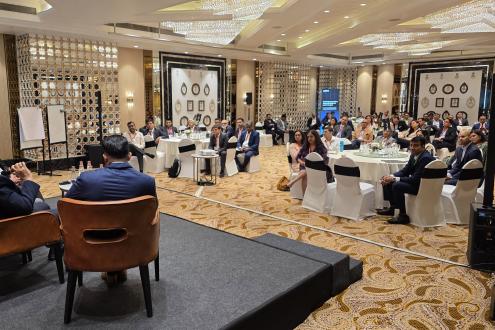
India’s private wealth industry is entering a more demanding phase. The growth story remains powerful, driven by entrepreneurial wealth creation, rising family office activity, increasing global exposure and a more sophisticated client base. But the conversations at WealthTHINK India 2026 made clear that growth alone is no longer the central test. The harder question is whether the industry can build the advice, infrastructure, talent and governance needed to support that growth properly.
Across the opening discussion, panel session and interactive table debates, the message was consistent: India is not short of opportunity. It is short of institutional depth. Clients are becoming more global, families are becoming more complex, the next generation is asking sharper questions, and technology is beginning to reset what advisers can reasonably claim as value.
The tone of the day was not negative. India’s wealth management market remains one of Asia’s most important long-term opportunities. But its next phase will be defined less by client acquisition and more by capability. The firms best positioned for that phase will be those that can move beyond product access, RM-led portability and fragmented service models towards deeper advice, stronger platforms and more disciplined execution.
Key Takeaways
- Growth Is No Longer Enough: India’s private wealth market is expanding quickly, but scale without institutional depth creates strain. Firms need stronger platforms, better training, clearer advisory propositions and more resilient business models.
- Advice Must Move Beyond Product Distribution: Families increasingly want advisers who understand values, governance, succession, risk appetite and long-term objectives. Product access remains useful, but it is no longer enough to sustain trust.
- The Next Generation Wants Participation: Younger wealth owners do not want to inherit relationships passively. They expect to be engaged directly, treated as decision-makers, given access to ideas and included in the family capital conversation earlier.
- Family Offices Need Operating Discipline: India’s family office market is growing, but the label is used unevenly. The next phase will require clean data, consolidated reporting, governance, professional teams, secure systems and a clearer source of truth.
- Globalisation Is Becoming A Capability Question: Indian clients are asking for offshore diversification, international products, global managers and cross-border structures. Firms need regulated routes, tax and estate awareness, adviser training and partnerships that can support this responsibly.
- AI Must Sit Inside Governance, Not Outside It: AI is now an immediate operating priority, but its value depends on data quality, controlled environments, platform architecture and human judgement. Public tools and isolated pilots are not enough.
- Talent Scarcity Is A Structural Constraint: Client supply is expanding faster than the supply of capable advisers. RM churn, salary inflation and weak training pipelines are forcing firms to rethink how they build and retain capability.
- Wealth Planning Is Becoming More International: Mobility, foreign beneficiaries, offshore assets, insurance-based liquidity planning and succession across jurisdictions are moving closer to the advisory core. These areas require specialist coordination and disciplined execution.
India’s Wealth Story Is Maturing, But Unevenly
One of the clearest themes from WealthTHINK India 2026 was that the market is developing quickly, but not uniformly. India has created significant new private wealth through operating businesses, listed market participation, liquidity events, technology entrepreneurship, healthcare, promoter holdings and family-controlled enterprises. But many families are still in the early stages of formalising how that wealth should be managed across generations.
That matters because India’s private wealth industry cannot simply import a fully formed model from older markets. Some families remain focused on growth and control. Others are beginning to think about perpetuity, succession, governance and the professionalisation of family capital. Some are building family offices in substance. Others are still operating through informal arrangements, multiple bank relationships and principal-led decision-making.
The opportunity for advisers is therefore substantial, but it is also more complex than product distribution. Families need help defining what wealth is for, how it should be governed, who should be involved, where assets should sit, and how the next generation should be prepared. The adviser who can support that evolution will have a deeper role than the adviser who appears only with a product to sell.
This is why the day’s discussions returned repeatedly to substance. India does not need a dramatic reset in every part of wealth management, but it does need disciplined evolution. As families grow, globalise and institutionalise, expectations will rise. Firms that rely on legacy relationships, information advantage or individual RM charisma may find that those assets are less durable than they once appeared.
Trust Is Built Through Listening, Alignment And Time
The opening panel framed trust not as a marketing claim, but as an earned position. Indian families do not need advisers to arrive with pre-packaged answers before understanding the family’s circumstances, values and long-term objectives. They need advisers who listen carefully enough to understand what the family is trying to preserve, what it is trying to build, and what it does not want to compromise.
That distinction between listening and selling became one of the day’s most important themes. Wealthy families may accept technical input, investment views and product access, but they are unlikely to share deeper concerns unless they believe the adviser is aligned with them. Confidentiality, consistency, independence of judgement and the ability to say no all matter.
The trusted adviser role is also becoming harder because families are more informed. They can compare products, test advice, read market views and use digital tools before entering a meeting. That does not remove the need for advice, but it does reduce the value of simple information delivery. Trust now depends more on diagnosis, judgement and coordination.
For Indian private wealth firms, this creates a commercial challenge. Target-driven models can encourage short-term product conversations, but families with serious capital often need slower, deeper engagement. The relationship may not produce immediate revenue, but it may become more valuable over time if the adviser earns access to broader issues such as governance, succession, family education, philanthropy, reputation and cross-border structuring.
The Next Generation Wants To Be Involved Earlier
The next-generation theme ran through the day, beginning with the opening discussion. Younger wealth owners are not simply waiting to inherit existing mandates or preserve the same relationships on the same terms. Many are more globally exposed, more digitally fluent, more interested in direct investing and more willing to question inherited assumptions.
This has direct implications for the advisory model. It is not enough to maintain a strong relationship with the patriarch, principal or current decision-maker and assume the relationship will transfer automatically. The next generation may influence decisions long before formal control passes. If advisers ignore them, speak around them or treat them as peripheral, they weaken the relationship they are trying to protect.
The stronger approach is direct engagement. Next-generation clients want focused dialogue, access to thinking, relevant data points, and the opportunity to participate in decisions rather than receive long-form material at a distance. They may be interested in private markets, AI infrastructure, technology, global opportunities, startups, digital assets or values-led capital deployment. But the important point is not the asset class. It is the expectation of involvement.
That involvement also needs discipline. Several discussions recognised that younger wealth owners may have grown up during a long period of liquidity-supported market expansion and may not have experienced severe drawdowns directly. Advisers and families therefore need to create structures that allow learning, experimentation and participation without placing the broader family balance sheet at unnecessary risk.
Family Offices Need Infrastructure Behind The Label
Family offices were discussed less as a status symbol and more as an operating challenge. India’s family office market is expanding rapidly, but the term itself is still used unevenly. Some families have genuine institutional platforms, while others have sophisticated private banking relationships, informal internal teams or a collection of advisers around the principal.
The distinction matters. A real family office is not only an investment account. It is an operating structure that supports reporting, governance, decision-making, risk management, succession, tax coordination, documentation, family communication and, increasingly, global assets. It needs processes and infrastructure, not only access to products.
Many families are now dealing with portfolios that span listed markets, private equity, real estate, direct deals, operating companies, offshore accounts, family entities and multiple custodians. Without clean data and consolidated reporting, decision-making becomes reactive. Without defined governance, operational issues can quickly become family issues. Without secure systems, the use of AI or automation may create more risk than value.
The next phase of Indian family office development will therefore be defined by institutional discipline. Families need a single source of truth, reliable reconciliation, secure document management, clear decision rights and professional teams that can focus on oversight rather than constant administration. Private banks, MFOs and wealth technology platforms have an opportunity here, but only if they help families reduce complexity rather than simply add another product channel.
Global Diversification Has Become A Practical Priority
Global diversification was another central theme. For many years, strong domestic returns made offshore investing less urgent for Indian clients. That is changing. Clients are increasingly asking for overseas exposure, currency diversification, access to international managers, global sectors and structures that can support family members or assets across jurisdictions.
The issue is no longer only whether Indian clients should diversify globally. It is whether firms have the capability to help them do so properly. Demand is rising faster than product architecture in many parts of the market. Wealth firms may speak about global allocation, but clients need suitable routes, credible partners, tax and estate awareness, reporting infrastructure and advisers who understand the difference between a simple investment discussion and a cross-border planning problem.
Routes such as LRS, GIFT City, Singapore vehicles, feeder structures, offshore partnerships and referral models can each have a role, but they are not interchangeable. Suitability depends on the client’s profile, residency, ticket size, purpose, tax position and regulatory context. A family office with existing offshore assets needs a different conversation from a domestic HNW client making an initial global allocation.
This is where global diversification becomes a broader advisory capability. Advisers need to understand not only the asset being recommended, but also the holding route, ownership implications, estate consequences, reporting obligations and liquidity needs. Firms that can combine domestic client insight with global access and disciplined execution will be better placed as Indian families become more international.
Insurance And Structuring Are Moving Into Family Planning
Insurance-based wealth structuring was discussed as part of this broader cross-border planning agenda. As Indian families become more internationally connected through education, migration, foreign beneficiaries and overseas assets, advisers are being asked to think more carefully about protection, liquidity and succession across jurisdictions.
The important shift is that insurance is being reframed as a planning instrument, not simply as a return product. For the right client, life insurance may support estate liquidity, business continuity, family provision, shareholder planning or protection for beneficiaries outside the home jurisdiction. For entrepreneurs with wealth concentrated in companies, real estate or private assets, liquidity planning can be as important as investment performance.
However, the discussions also made clear that insurance is not a shortcut. Policy ownership, residency, premium funding, beneficiary location, remittance route, tax treatment and licensing all matter. An instrument that is commercially available is not automatically suitable. Advisers need to understand whether they are identifying a planning need, referring to a specialist, discussing product information or giving advice.
This is another example of the advisory role moving up the chain. Cross-border families need diagnosis before product selection. Some clients may need estate liquidity. Some may need business continuity funding. Some may need critical illness or incapacity-related planning. Some may need help reviewing foreign assets before a transfer or death creates administrative problems. Others may not need insurance at all. The value lies in knowing the difference.
AI Is Becoming An Operating Model Question
AI was discussed throughout the day as a practical business issue rather than a distant technology theme. The question is no longer whether AI will affect wealth management. It is how firms can use it safely, commercially and at scale.
The most immediate use case is RM productivity. AI can help advisers prepare for meetings, analyse portfolios, identify concentration risk, summarise market events, generate talking points, prepare follow-up notes and respond more quickly to client questions. In a market where adviser quality is uneven and client expectations are rising, that can improve consistency across large teams.
But the larger opportunity is front-to-back transformation. Wealth management depends on onboarding, documentation, compliance, operations, reporting, settlement, product administration and service workflows. If AI is used only to generate better client text or presentation material, firms will miss the deeper opportunity to redesign how work moves through the organisation.
Data governance is the hard boundary. Client statements, portfolio information and personal data cannot be pushed into uncontrolled public tools. Firms need private environments, controlled architecture, clear usage rules and human accountability. AI also depends on clean data. If information is fragmented across systems, platforms, spreadsheets and product silos, automation may amplify disorder rather than resolve it.
The adviser role will not disappear, especially in HNW and UHNW segments where trust, judgement and touch-and-feel engagement remain important. But weak advisers will be more exposed. Clients are already using AI tools to test recommendations and challenge portfolio advice. Advisers will need to explain reasoning, context and suitability more clearly than before.
Scale Requires Institutions, Not Just RM Networks
The talent and business model discussions made clear that India’s private wealth industry cannot scale sustainably by adding more RMs alone. Client supply is expanding, but the supply of capable advisers, investment counsellors and specialist support remains constrained. Experienced RMs are expensive, churn is damaging unit economics, and firms are often competing for the same narrow talent pool.
This creates a structural problem. If a firm’s primary asset is the individual RM’s relationship, the business remains vulnerable when that RM moves. If the client is also connected to a CIO office, investment specialists, estate planners, tax advisers, discretionary managers, product teams and a stronger institutional platform, the relationship becomes more durable.
Scale therefore needs to be measured by depth, not only headcount. Firms need training, accreditation, product architecture, research support, technology, compliance, investment governance, specialist teams and a clearer house proposition. The RM of the future may be less of a lone rainmaker and more of an orchestrator of firm-wide capability.
Business models will also need to mature. Distribution, advisory and discretionary models may coexist, but firms will need to be clearer about what value they deliver and how that value is paid for. Fee models require confidence. Discretionary models require investment discipline and trust. Product-led revenue requires careful governance if firms want to avoid conflicts and preserve credibility.
Professional standards are likely to rise as the market matures. Whether change comes through regulation, self-regulation, firm-level discipline or client pressure, the direction is clear. A more sophisticated client base will expect more sophisticated advice.
What WealthTHINK India 2026 Ultimately Signalled
The broad conclusion from WealthTHINK India 2026 is that India’s private wealth industry is not facing a shortage of opportunity. It is facing a higher standard of execution.
Clients still want access, performance and trusted relationships. But they also want advisers who understand family values, next-generation influence, global exposure, cross-border structuring, tax and estate implications, technology, reporting, risk and governance. Product availability, while still necessary, is no longer sufficient as a standalone proposition.
For private banks, wealth managers, MFOs, family offices, advisers and specialist platforms, the task ahead is therefore practical. They need to build deeper institutions, not just larger networks. They need to professionalise talent, use AI within controlled infrastructure, develop global capability, support family office institutionalisation and engage younger wealth owners before transition events force the issue.
India remains one of Asia’s most compelling private wealth markets because of its entrepreneurial depth, family-controlled businesses, rising capital formation and increasing global connectivity. But the firms that thrive in its next phase will be those that move beyond being present in the growth story. They will be those that can prove, repeatedly and concretely, that they can help Indian families manage wealth with discipline, continuity and purpose.
