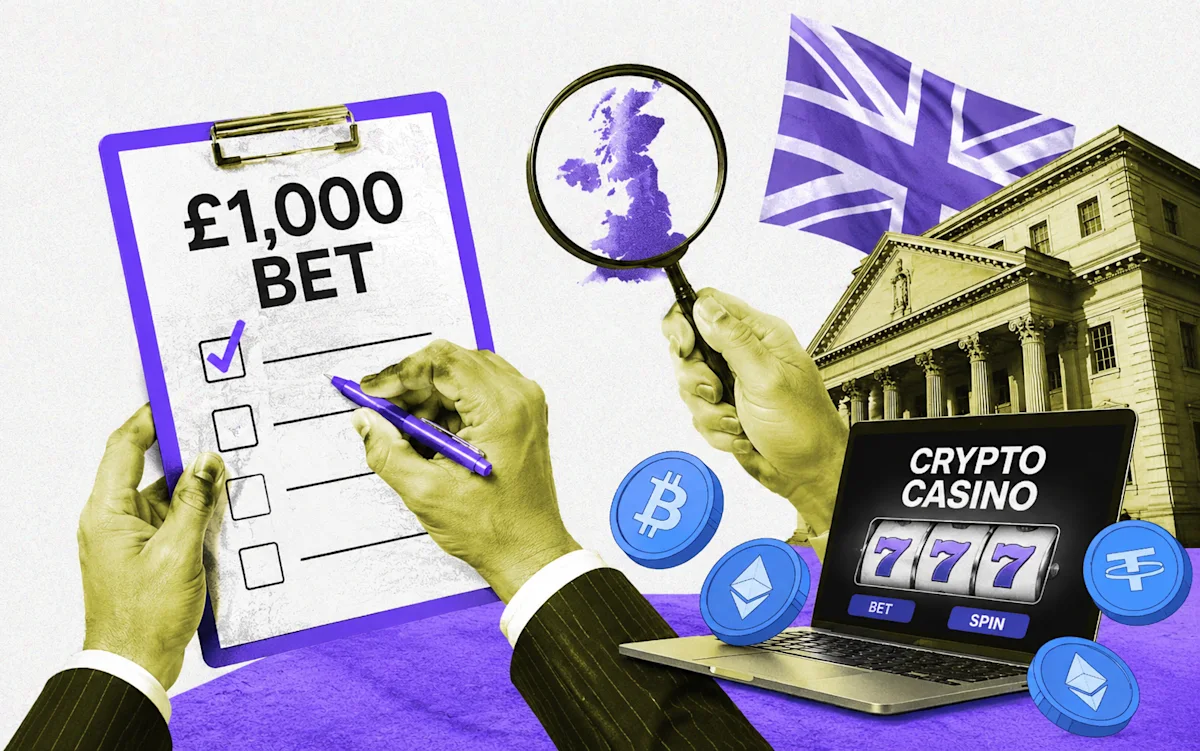
The UK has placed strict new rules on large bets — the industry is pushing back. How does this impact crypto gambling?
Key Takeaways
The UK’s new affordability checks could push some higher-stakes bettors toward offshore crypto gambling platforms.
Crypto gambling combines fewer regulatory safeguards with unique psychological drivers.
While crypto casinos may benefit from increased demand, users face significant trade-offs.
The UK Gambling Commission is introducing new financial risk assessments that will trigger credit checks for bettors placing £750 (under-25s) or £1,000 (over-25s) within 24 hours.
The goal is to protect consumers from problem gambling, but the UK’s new policy could potentially accelerate the shift toward unregulated crypto-powered gambling.
More Surveillance, Less Privacy
The UK Gambling Commission’s plan effectively brings third-party credit data into everyday betting decisions.
Operators will be able to flag individuals showing signs of financial distress, such as arrears or high debt, before allowing them to place larger wagers.
Critics argue this represents a slippery slope.
Some industry figures have claimed that governments normalizing credit checks for recreational spending can easily expand to other areas.
The British Horseracing Authority (BHA) has strongly criticized the Gambling Commission’s decision, arguing that the affordability checks will damage the racing industry while driving more gamblers toward unregulated operators.
BHA Chief Executive Brant Dunshea said the organization was “hugely disappointed” by the decision, warning the checks would have “severe financial implications for British racing and the UK economy.”
Dunshea argued the policy would fail to achieve its stated goal of protecting consumers and subject them to “unwarranted levels of intrusion.”
“Rather than protecting consumers, these checks will have the opposite effect: driving more customers to the illegal market – which puts them at much greater risk of gambling-related harm – and starving the Treasury of much-needed tax revenue.”
He also criticized the Gambling Commission for moving ahead before publishing the full findings of its pilot program.
“Perhaps most concerningly, this policy has now been signed off for implementation without key stakeholders in racing and betting being able to see vital evidence such as the NatCen’s independent review of the pilot.”
The BHA added that unresolved issues remain, including inconsistent results from different credit reference agencies.
Dunshea concluded by calling for an independent review once the checks are introduced.
He said this would help determine whether the policy delivers its intended consumer protection benefits or accelerates migration to unregulated gambling markets.
Increased Migration to Offshore Crypto Platforms?
Crypto gambling has already been expanding rapidly worldwide.
The new UK rules, including the integration of credit reference data into their systems, could support further growth by making regulated fiat options less convenient.
Many UK bettors, particularly frequent or higher-volume users, could be tempted to migrate to unregulated or offshore crypto gambling platforms that accept Bitcoin, Ethereum, and stablecoins.
These sites generally offer instant deposits and withdrawals with minimal or no KYC requirements.
Crypto’s ability to transact without credit scores and third-party financial surveillance is in direct opposition to the UK’s latest rules.
In an environment of growing regulatory oversight, this could potentially become more attractive to users who value personal privacy.
The affordability checks also widen the gap between regulated and unregulated markets.
UK-licensed operators will face higher compliance costs and stricter rules, while many crypto-focused platforms can operate in jurisdictions with lighter regulatory frameworks.
This could further tilt the competitive landscape in favor of the crypto sector, potentially drawing more UK players away from domestic licensed sites.
Risks and Potential Drawbacks
Despite the benefits of crypto gambling, a number of significant risks remain.
Offshore platforms often lack the robust consumer protections mandated in the UK, exposing users to higher chances of scams or unfair game mechanics.
Licensed operators in Britain are required to offer tools such as deposit limits, cooling-off periods, self-exclusion schemes, and reality checks.
Many crypto gambling platforms operate under different regulatory frameworks and may not provide the same level of intervention.
The ability to deposit funds instantly and gamble 24 hours a day can make it easier for vulnerable users to develop compulsive gambling habits.
There is also the possibility of future regulatory scrutiny if the British government notices large-scale movement into unlicensed crypto gambling sites.
UK Puts Psychology of Crypto Gambling In Focus
The shift also raises broader questions about the psychological risks associated with these services.
Much like traditional gambling, crypto casinos rely on well-established behavioral mechanisms that encourage repeated play.
However, features unique to the crypto ecosystem, including anonymity and always-on access, can amplify some of those effects.
At the heart of gambling psychology is a variable-ratio reinforcement schedule.
These rewards arrive unpredictably rather than at fixed intervals.
As psychology writer Annabelle G.Y. Lim explains:
“This type of schedule produces very consistent and high rates of responding, as the organism never knows exactly when reinforcement will occur.”
Crypto gambling can introduce another layer of unpredictability, as players often bet with assets whose prices are constantly fluctuating.
Greater Privacy May Also Lower Psychological Barriers
The very features that could attract users away from UK bookmakers, such as fewer identity checks, may also influence gambling behavior.
Many offshore crypto casinos allow users to wager with little more than a crypto wallet, avoiding the financial assessments and identity verification increasingly common on regulated platforms.
Behavioral psychology research suggests people often take greater risks when they feel less observed or personally identifiable.
While many users view anonymity as a legitimate privacy benefit, critics argue it removes the piece of friction that encourages gamblers to reconsider before placing larger bets.
For users who gamble responsibly, these features will represent greater flexibility and financial privacy.
However, as affordability checks encourage some bettors to explore alternative platforms, the debate is likely to shift beyond regulation alone to crypto gambling’s unique set of psychological risks.