

The practices that help neurodiverse students thrive may be the reforms education has been searching for all along, and AI may finally make them scalable.
For years, education leaders have searched for the next breakthrough. We’ve adopted new standards, purchased new technology, redesigned assessments, and launched countless initiatives intended to improve outcomes. Yet many of the challenges schools face today—student disengagement, widening achievement gaps, and the demand for more personalized learning—remain stubbornly persistent.
What if the answer isn’t something new at all?
For decades, special education has been solving a problem the rest of education is only now beginning to confront: students do not learn in the same way, at the same pace, or through the same methods. The practices developed to support students with dyslexia, ADHD, autism, and other learning differences hold important lessons for every school seeking better outcomes.
The irony is that the education system was never intentionally designed around how most students learn. It was designed for efficiency. Age-based grade levels, standardized pacing, large-group instruction, and one-size-fits-all assessments emerged from an industrial-era model built to educate large numbers of students at scale. While that model succeeded in expanding access, it was never particularly effective at responding to the reality that human beings learn differently.
Today, roughly one in five students has a learning or attention difference. But anyone who has spent time in a classroom knows that learning variability extends far beyond formal diagnoses. Some students need more structure. Others thrive with movement and hands-on experiences. Some require additional time to process information, while others are ready to move ahead long before a lesson ends.
Neurodiversity simply acknowledges what teachers have always known: there is no such thing as a truly “typical” learner.
When schools serve students in the middle of a continuum, students on both ends often pay the price. Those who need additional support struggle to keep up. Those who need greater challenge or alternative pathways frequently disengage. The result is a system optimized for standardization rather than learning.
Long before personalized learning became a popular educational buzzword, special educators were building systems around individual student needs. Structured literacy, multisensory instruction, progress monitoring, differentiated pathways, and project-based learning were not innovative programs. They were practical responses to students who learned differently.
Orton-Gillingham methods and other structured literacy approaches have transformed literacy instruction for students with dyslexia. Multisensory mathematics practices improve conceptual understanding for students who struggle with traditional approaches. Frequent progress monitoring allows educators to adjust instruction based on growth rather than waiting for annual assessments to reveal a problem.
At Trinity School, students who once avoided reading have become confident classroom leaders after receiving targeted intervention. Their growth serves as a reminder that many learning challenges do not reflect a student’s potential. More often, they reflect a mismatch between the learner and the instructional approach.
What many educators are now discovering is that these approaches don’t simply work for students with diagnosed learning differences. They work for all students.
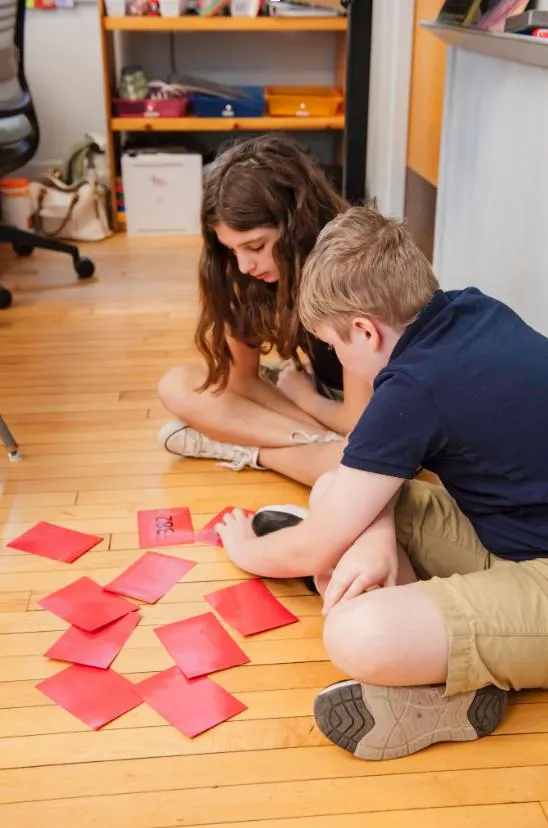
Fifth-grade students at Trinity School use Marilyn Zecher’s multisensory math manipulatives.
Marshall Hawkins
This idea is reflected in Universal Design for Learning, a framework built on a simple premise: when you design for learners at the edges, everyone benefits. The same instructional practices that make learning more accessible for neurodiverse students often create stronger outcomes for all learners.
In many ways, neurodiverse students highlight the gaps in traditional systems. Their challenges exposed limitations that existed throughout the system long before most educators recognized them. As educators worked to support these learners, they developed instructional practices that may ultimately prove valuable for everyone.
The schools making the strongest gains today increasingly share a common characteristic: they are moving away from standardization and toward personalization. They are incorporating structured literacy. They are using multisensory approaches. They are monitoring student growth continuously rather than relying exclusively on periodic testing. Most importantly, they recognize that effective instruction is not about delivering the same experience to every student. It is about helping every student achieve the same high expectations through pathways that reflect how they learn best.
The challenge with personalization has always been scalability. Educators understand that students learn differently, but delivering individualized instruction across classrooms, schools, and districts requires significant time and resources. Even the most talented teacher can only personalize so much in a classroom of twenty-five students.
For the first time, educators may have a practical way to scale what special education has long understood.
Artificial intelligence has the potential to become one of the most significant catalysts for personalized learning in modern education—not because it replaces teachers, but because it amplifies their capacity.
AI can help identify learning gaps, adjust instructional materials, provide immediate feedback, generate differentiated resources, and support individualized pathways in ways that were previously unattainable at scale. As access to these tools expands, schools may be able to offer levels of personalization that were once available only through specialized intervention programs.
This is already happening. Companies such as Boddle are demonstrating how adaptive learning technology can support individualized learning pathways through game-based experiences that adapt to student performance in real time. Rather than replacing teachers, these tools extend their ability to personalize instruction and keep students engaged.
Edna Martinson, co-founder of Boddle, created a game-based adaptive learning platform with more than 10 million users, demonstrating how technology can make math and literacy more engaging and effective for learners across a wide range of abilities. “The future of learning isn’t one-size-fits-all. Boddle uses adaptive technology to meet students where they are, personalize educational content, and help them progress at their own pace.”
Students using Boddle’s adaptive learning platform.
Boddle
For the first time, the gap between what educators know students need and what schools can realistically provide may begin to narrow.
The implications extend far beyond students with diagnosed learning differences. The future of education is likely to be more tailored, more responsive, and more individualized. Students will move through content at different rates. Instruction will adapt more dynamically to strengths and challenges. Assessment will become more continuous and informative rather than episodic and punitive.
Ironically, this future may look remarkably familiar to educators who have spent years working with neurodiverse learners. Many of the practices education leaders are now seeking to scale through technology have existed in special education classrooms for decades.
The conversation about the future of education often focuses on what comes next—new technologies, new instructional models, and new systems. Yet some of the most promising solutions are not new at all.
Special educators have spent decades refining approaches that recognize a simple reality: students learn differently, and effective instruction should reflect that reality. As AI makes individualized learning more achievable at scale, schools have an opportunity to bring those practices to far more students than ever before.
The future of education may be less about reinventing learning and more about scaling what already works.
