
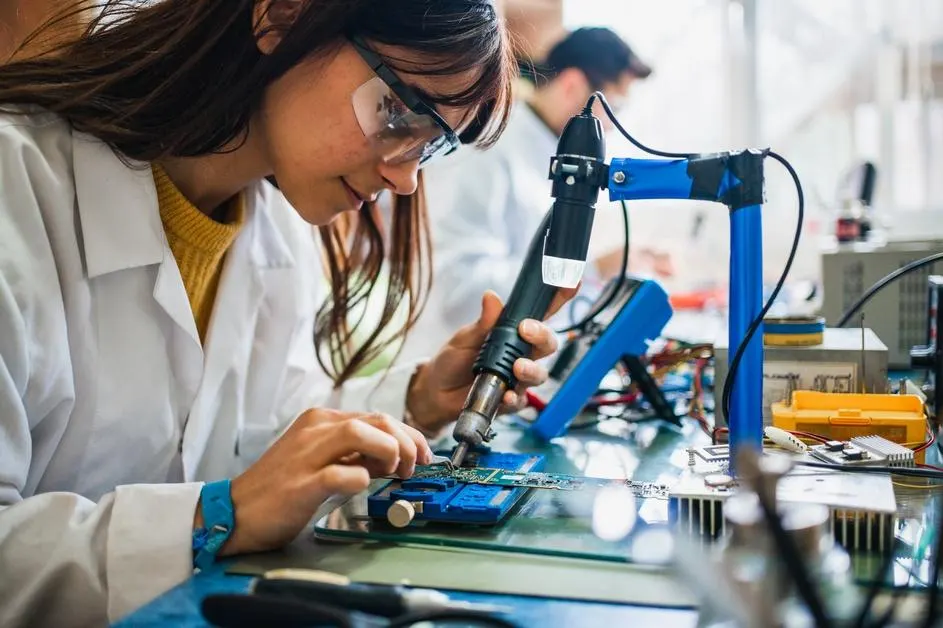
Female electrician at work on an electrical panel
getty
As Small Business Month comes to a close, it’s worth reflecting on the vital role small businesses play, accounting for 44% of the nation’s GDP and employing nearly half of Americans working in the private sector. But this year, the celebration comes with a more urgent question underneath it: as AI reshapes the job market, could small businesses become not just a cornerstone of our economy, but its primary engine of opportunity?
We’ve seen this before: When big companies pull back, small businesses have historically stepped forward. After the Great Recession, businesses with fewer than 500 employees created an estimated 62% of all new private-sector jobs. And following the pandemic, small and medium-sized businesses were responsible for more than 70% of private-sector job growth.
The same trend seems to be holding true in the AI era. Half of all Americans say there will be a good time to start a new business in their area in the next six months, according to the Global Entrepreneurship Monitor 2025/26 Global Report, and the same report found nearly 1 in 5 Americans are already building something of their own. And 67% of young people (Gen Z and Millennials) in a 2025 survey said they are pursuing entrepreneurship. Data from LinkedIn bears this out: the number of members with “founder” as a title has tripled since 2022, and strategic advisors and independent consultants and founders both are among the top 10 fastest-growing roles.
We may be witnessing what could be called “the great unbossing”: A structural shift in which AI, rather than simply eliminating opportunity, is also catalyzing a new wave of entrepreneurship.
Last year, we teamed up with Google.org to create a playbook for small employers — the kind of businesses that don’t have HR departments or general counsel — to show how AI tools can help their talent build the skills and systems they need to grow and compete.
But AI’s role in supporting entrepreneurship goes beyond using LLMs to write marketing copy or make an ad on social media. Sarah Horn, founder of Toledo, Ohio-based Manifest, told me that from pet care to beauty, AI is “unlocking really unprecedented levels of productivity for small business entrepreneurs.” Her team is building a platform that provides SMB founders with access to the sort of insights and support they need to make good on the promise of not just greater independence, but also the prospect of economic mobility. “Having the skills to do the job is just a piece of the puzzle,” Horn explained. “The hair stylists, pet resort owners, and funeral directors we serve are exceptional at their craft. What they’ve never had is access to the kind of business intelligence that lets bigger companies make smarter decisions. AI changes that. Manifest gives a main street operator the same caliber of insight a 500-person company would pay a consultant for, and that’s what turns skill into a thriving business, and a thriving business into generational wealth.”
This is what the “AI takes jobs” narrative misses. The same technology driving disruption is also making it easier for ordinary people to build something of their own.
Just as importantly, for many Americans, going out on their own isn’t a fallback; it’s an upgrade. According to the 2025 American Job Quality Study — a collaboration between Jobs for the Future, the Families & Workers Fund, and Gallup — self-employment can mean higher quality jobs. The survey found that nearly half of non-W-2 workers (46%) hold quality jobs, compared to just 39% of traditional W-2 employees. Self-employed workers report greater say over how and when they complete their work, factors that, for many, offset trade-offs like longer hours or fewer benefits. Similarly, Pew Research Center found that 60% of self-employed workers report being satisfied with their jobs, compared to just 49% of those who are not self-employed.
Of course, entrepreneurship isn’t an easy button to guarantee economic opportunity: it comes with inherent risk, and requires access to capital that is often unequal and may deepen existing economic gaps. (Even “self-made” billionaires often start from upper-middle-class upbringings). Small business owners or solopreneurs may also need support to set up health care or retirement plans, given that many benefits currently run through employers, as well as to manage the ongoing AI transformation.
Entrepreneurship isn’t a panacea, but for millions of Americans, the future of work isn’t a corporate campus. It’s a facility with 84 dogs or a beauty suite with a growing clientele. The question isn’t whether more Americans will choose to launch small businesses in the AI-era, it’s how AI will fuel the sort of support systems that they need to thrive.
