

The platform’s first set of indicators is live at indicators.stanford.edu, offering frequently updated data on AI’s effects on labor markets, economic growth, and technology adoption
STANFORD, Calif., June 10, 2026 /PRNewswire/ — The Stanford Digital Economy Lab, part of the Stanford Institute for Human-Centered Artificial Intelligence (HAI), today announced the launch of the AI Economic Indicators, a freely accessible platform to track how artificial intelligence is reshaping work, productivity, and value creation in the economy.
The AI Economic Indicators presents regularly updated data, interactive dashboards, and research-based methods in one place, giving policymakers, researchers, employers, and workers tools and information to help them make sense of a powerful new technology.
“We are flying blind into one of the most consequential periods in world history. We cannot afford to rely on anecdotes or lagging indicators of AI’s effects,” said Erik Brynjolfsson, Professor at Stanford University and Director of the Stanford Digital Economy Lab (DEL). “We need timely, trusted evidence to understand where AI is creating value and where it is disrupting work.”
Closing the gap
Traditional economic statistics weren’t built for a technology that can fundamentally change work down to the task level or deliver value to consumers in ways that conventional price measures can’t capture. That can lead to real shifts, positive or negative, being missed or recognized well after they occur.
The Indicators is meant to close that gap as an accessible source of curated information meant to empower policymakers, business executives, and individual workers to make better-informed decisions.
Phase one
The AI Economic Indicators launches with three dashboards, regularly updated at their own frequencies based on their distinct datasets.
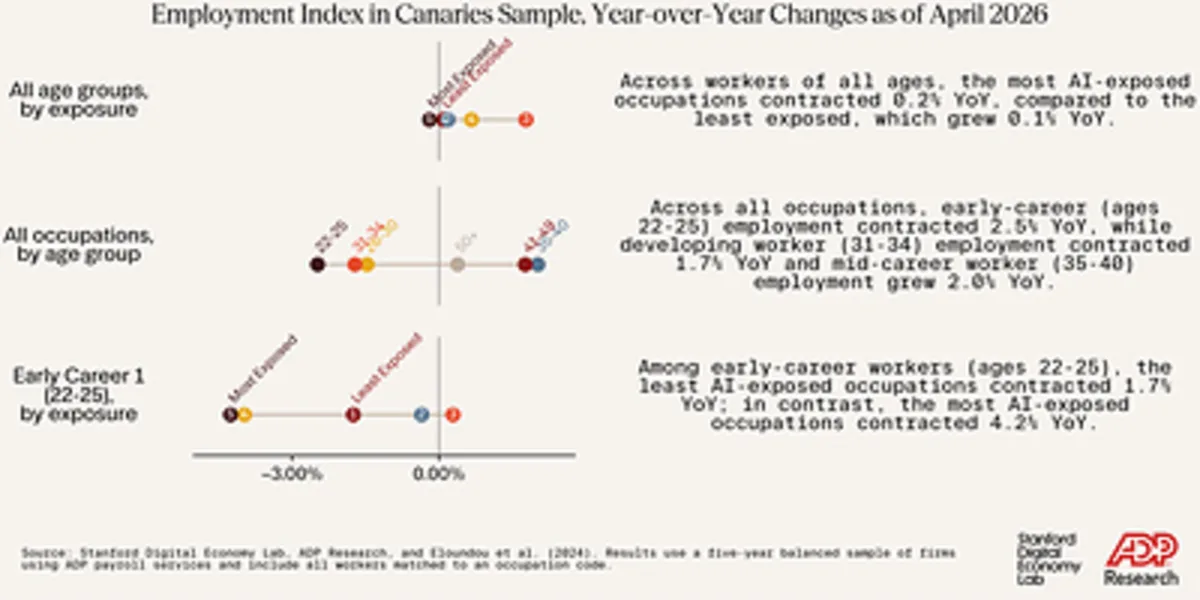
The Canaries Dashboard. A collaboration between ADP Research and the Stanford Digital Economy Lab, this dashboard draws on DEL’s access to anonymized ADP payroll data to track labor market outcomes on a monthly basis. It builds on the study Canaries in the Coal Mine: Six Facts about the Recent Employment Effects of Artificial Intelligence (Brynjolfsson, Chandar, and Chen, 2025), focusing on AI-exposed occupations and industries as potential early signals for broader employment and wage trends.
“This data set is a breakthrough for the AI economy, giving economists, business leaders, and policymakers something they have long needed: a near real-time view of how AI is reshaping work,” ADP chief economist Dr. Nela Richardson said. “By analyzing the millions of jobs represented by ADP payroll data, we can track wages, hiring patterns, career mobility, and more to see how technological change is affecting the labor market.”

