

This article adheres to strict editorial standards. Some or all links may be monetized.
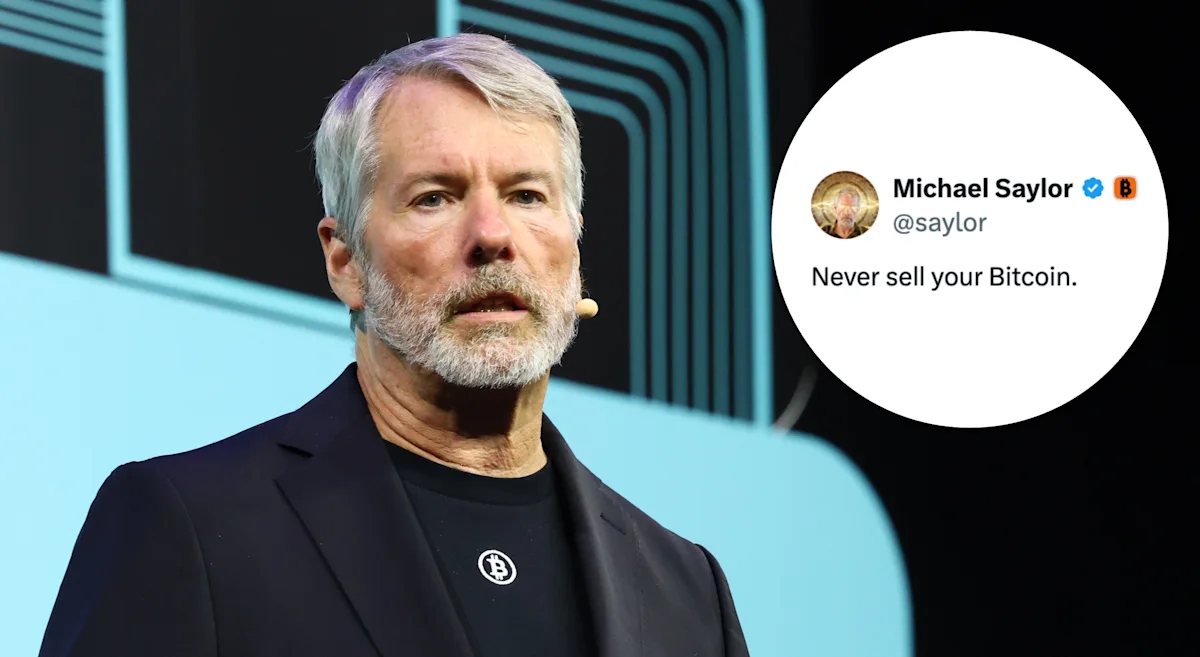
“Never sell your Bitcoin.” Michael Saylor posted those exact words on X in February 2025 (1). It’s about as close to scripture as crypto gets and the people who follow him built a creed around it to hold through every crash and treat selling as a sign of weak hands.
But in late June, the company he co-founded gave itself written permission to do exactly that.
Top Picks
-
JP Morgan sees gold hitting $6,000/oz before 2027 — and a gold IRA lets you hold the physical metal while deferring the tax bill. Get your free guide from Goldco
Strategy [NASDAQ:MSTR], the enterprise-software firm turned Bitcoin vault and the biggest corporate holder of the cryptocurrency on earth, authorized a program to sell up to $1.25 billion of its Bitcoin (2) to fund its USD reserve.
It’s the first time the firm has formally explained how and when it might sell. And the move also clashes with the “never-sell” identity built by Saylor, the company’s executive chairman (3).
But authorizing a sale isn’t the same as selling it. The program doesn’t obligate Strategy to sell anything; it just gives them the option to do so and any sale would depend on the market (2). Still, now that the option exists on paper, the company can actually legally proceed with one and that’s a notable shift in strategy.
What Strategy actually authorized
Strategy folded the $1.25 billion cap into a broader plan called the Digital Credit Capital Framework.
As of June 28, the company set aside about $2.55 billion in cash — enough to cover roughly 17.4 months of the dividends and interest it pays (about $1.76 billion a year). The framework also requires keeping at least 12 months of that coverage on hand at all times (2).
If the cash reserve runs low, Strategy can top it up by selling Bitcoin — up to $1.25 billion worth.
That cap applies just to refilling the reserve; the program doesn’t set an overall limit and also allows the company to sell coins to cover dividends, interest, or buybacks (3). At current prices, $1.25 billion is about 21,300 BTC, roughly 2.5% of the company’s 847,363 BTC holdings (3). The framework also authorizes up to $1 billion for common-stock buybacks and up to $1 billion for preferred shares.
“Strategy remains committed to Bitcoin as its primary treasury reserve asset,” Saylor said in the announcement. Chief Financial Officer Andrew Kang added that: “Bitcoin is capital” (2).
Why the funding model stopped working
For years, Strategy had a setup that only worked one way.
Its stock traded well above the value of the Bitcoin it held, so the company could sell new shares at that premium, use the money to buy more Bitcoin and keep repeating the cycle. It never needed to sell Bitcoin because raising cash was easy.
That whole setup depends on the premium and that premium has mostly disappeared.
Bitcoin hit a record high near $126,000 (4) last October before falling below $60,000 (5) this June, while Strategy’s stock is down about 79% over the past year (6). With that drop, Strategy’s stock no longer commands the hefty premium to its Bitcoin holdings that it once did.
When the stock stops trading at premium, issuing new shares no longer feels like free money and the bills still come due. Strategy has to keep paying fixed dividends on its preferred stock and interest on its debt, whether Bitcoin is up or down. One of those preferred shares, its Stretch series [NASDAQ:STRC], was pitched by Saylor as something that should stay close to $100, but it closed last Friday around $74 (7). To help support it, Strategy is raising STRC’s dividend to 12%, starting July 1. (2)
In late May, the company sold 32 Bitcoin (its first sale since 2022) to pay a dividend. It was only a tiny slice of its holdings, but even that was enough to upset some of its supporters (8). This new framework is the company’s bigger attempt to deal with the same problem.
The distinction Saylor keeps drawing
Saylor keeps making one point. His “never sell your Bitcoin” line was always advice to individual holders, not as a promise about what the company would do with its own treasury.
“I said to you never sell your Bitcoin,” he told a crowd at the Bitcoin Prague conference (8). “I never said that the company wouldn’t sell its Bitcoin.”
The trouble is, he didn’t always limit that message to individual holders. For years, he said it about Strategy itself (8).
Just three months before the company’s first Bitcoin sale in years, he told CNBC that Strategy would keep buying instead of selling (9). It also said it would refinance debt before it ever touched its Bitcoin.
Furthermore, it isn’t clear why his “never sell” message wouldn’t apply universally.
And back in 2022, when he was asked directly whether the company would sell, he said, “We’re not sellers. We’re only acquiring and holding bitcoin” (8). That answer was about the company’s treasury, not a tip for retail investors.
His distinction now is real, but it’s also a little convenient.
Sure, Strategy’s filings always kept the option open. But Saylor also spent years saying the company would hold no matter what. That’s a tough line to keep when your brand, your stock and your followers were all built on the same four words.
Strategy did not immediately respond to Moneywise’s request for comment.
What this means for your Bitcoin
If you don’t own Bitcoin or Strategy stock, this is mostly a lesson in how leverage works. A strategy that looks unstoppable on the way up can get shaky fast when conditions turn.
If you own Bitcoin directly, Strategy’s move doesn’t force anything on you (your coins aren’t affected by what one company does with its own). What it can change is sentiment. Strategy is a big, visible holder, so if it ever sells into a weak market, that can add downward pressure on the price.
If you own Strategy stock or its preferred shares, the picture is different.
You’re not just betting on Bitcoin. You’re betting on a company that borrowed money and sold shares to buy Bitcoin and now still has fixed payments to make, no matter where the price goes. The premium that helped fuel the gains is gone for now and management is already planning for a longer slump. You should know that before you treat MSTR as a simple substitute for owning Bitcoin.
Want to invest in Bitcoin? Keep trading costs in mind
If you are thinking about buying Bitcoin, it is worth looking beyond the hype and paying attention to the fine print — especially trading costs. Cryptocurrencies have had a rough stretch so far in 2026, but President Trump’s recent comments gave Bitcoin a bit of a lift.
When asked about the possibility of adding Bitcoin to the newly launched Trump accounts, he responded positively, saying, “Well … I’ve become a big crypto guy,” during a news conference on July 6 (10).
If you’re looking to diversify beyond traditional stocks and ETFs, Robinhood Crypto lets you buy and sell cryptocurrencies with as little as $1.
With some of the lowest trading costs on average in the U.S., you could end up with up to 2.7% more crypto compared to other platforms.
Robinhood Crypto makes it easy to make investing a habit with recurring buys on a fixed schedule, while giving you access to all your favorite coins — from Bitcoin and Ethereum to Solana, Dogecoin, XRP and more.
You can also transfer crypto securely to other wallets, set custom price alerts, track market trends and manage your portfolio all in one place.
Robinhood ensures that the security of your cryptocurrency is a top priority, with the majority of coins held in offline cold storage. Robinhood also carries crime insurance against theft and cyber breaches and 24/7 customer support is available if you need help.
Stick to an index fund
Even after rising 1.8% on July 6 following the president’s endorsement, Bitcoin still remains far below its October 2025 high (11) and is still down more than 28% for the year as of July 9 (12). With inflation concerns still lingering, the near-term outlook for cryptocurrencies may remain bumpy.
For investors who would rather avoid that kind of volatility, a low-cost index fund might be a better option.
For those unwilling to take on the risks of investing in cryptocurrencies, sticking to a low-cost index fund might be a better option.
Apps like Acorns allow users to invest spare change from everyday purchases automatically into low-cost ETFs.
All you have to do is link your cards and Acorns will round up each purchase to the nearest dollar, investing the difference — your spare change — into a diversified portfolio of ETFs managed by experts at leading investment firms like Vanguard and BlackRock. Over a lifetime, a little bit of consistency can go a long way.
With Acorns, you can invest in an index ETF built and managed by experts with as little as $5 — and, if you sign up today and set up a recurring investment, Acorns will add a $20 bonus to help you begin your investment journey.
Add gold to the mix
Bitcoin may have once been called “digital gold,” but the comparison has been looking weak lately. Instead of acting like a reliable safe haven, the cryptocurrency has lost a large chunk of its value since its October 2025 peak.
Gold prices, on the other hand, have climbed about 23% over the past year (13) and more than doubled over the past five years.
That long-term track record is part of gold’s appeal.
It is not tied to any one country, currency, or central bank and unlike fiat money, it cannot simply be printed. Investors often turn to gold during periods of stress or uncertainty, which is one reason prices have continued to rise.
You can combine the recession-resistant properties of the precious metal with the tax advantages of an IRA by opening a gold IRA with the help of Priority Gold.
And with Priority Gold’s platinum package, you can even get free account setup and insured shipping and storage for up to five years. Plus, you can also roll over your existing IRA or 401(k) into a precious metals IRA with Priority Gold — tax and penalty-free.
The best part? You can download Priority Gold’s wealth preservation guide for free and receive up to $10,000 in complimentary silver when you make a qualifying purchase.
An easy alternative to precious metals
Real estate has long been another popular way to navigate market uncertainty.
Unlike cryptocurrencies and stocks, which can rise or fall dramatically as investor moods change, home prices are typically influenced by fundamentals such as supply, demand, interest rates and the strength of local economies.
And getting started is no longer limited to buying a property yourself.
Instead of saving for a large down payment, qualifying for a mortgage and managing tenants, you can now invest in fractional shares of single-family rental homes nationwide. Mogul is a platform that gives Americans this option.
Founded by former Goldman Sachs real estate investors, its team handpicks the top 1% of single-family rental homes nationwide for you. This way, you can invest in institutional-quality offerings for a fraction of the usual cost — while receiving monthly rental income, real-time appreciation and tax benefits.
Mogul carefully vets each property, requiring a minimum 12% return even in downside scenarios. Across the board, the platform features an average yearly return of 18.8%. Their cash-on-cash yields, meanwhile, average between 10% and 12% annually. With investments typically ranging between $15,000 and $40,000 per property, offerings often sell out in under three hours.
Getting started is a quick and easy process.
You can sign up for an account and thenbrowse available properties. Once you verify your information with their team, you can invest like a mogul in just a few clicks.
– With files from Godwin Oluponmile.
You May Also Like
Join 250,000+ readers and get Moneywise’s best stories and exclusive interviews first — clear insights curated and delivered weekly. Subscribe now.
Article Sources
We rely only on vetted sources and credible third-party reporting. For details, see ourethics and guidelines.
X (1); Strategy (2); Coindesk (3); Google (4); CNBC (5), (9), (10), (11); Cryptotimes (6); Fortune (7); Finance Yahoo (8); Binance (12); APMEX (13)
This article provides information only and should not be construed as advice. It is provided without warranty of any kind.
