


One of the most consequential transformations of the Narendra Modi era has taken place away from election rallies, highways and factories. It has unfolded in India’s financial markets.
Over the past decade, Indian households have steadily shifted a portion of their savings from traditional assets such as bank deposits, gold and real estate into equities and mutual funds.
The result has been the emergence of a far deeper capital market, a surge in retail participation and a growing pool of domestic capital capable of cushioning the impact of foreign investor volatility.
India’s stock market value has more than quadrupled since 2013
India’s stock market has undergone a dramatic expansion over the past decade, with total market capitalisation rising from just $1.14 trillion in 2013 to nearly $4.84 trillion currently, despite recent pressure from geopolitical tensions, elevated oil prices and global risk aversion.
The journey has not been linear. Markets navigated the taper tantrum years, the pandemic-induced shock of 2020, aggressive global monetary tightening and, more recently, uncertainty stemming from the West Asia conflict. Yet the broader trend points to a market that has become deeper, larger and increasingly supported by domestic capital.
After crossing the $5 trillion mark in both 2024 and 2025, India’s market capitalisation has moderated amid concerns surrounding oil prices, geopolitical tensions and foreign investor outflows. Even so, the market remains more than four times larger than it was in 2013.
The expansion reflects not only economic growth and rising corporate earnings but also a structural increase in household participation in financial assets.
(Source: Bloomberg)
SIP inflows surge nearly eightfold in nine years, setting fresh records
Perhaps no metric captures the financialisation of household savings better than the rise in SIP contributions.
Annual SIP inflows have climbed from ₹43,921 crore in FY17 to a record ₹3.50 lakh crore in FY26, marking an almost eightfold increase in just nine years. After reaching ₹2.89 lakh crore in FY25, SIP contributions crossed the ₹3 lakh crore mark for the first time in FY26.
The rise has been particularly pronounced since the pandemic, as millions of first-time investors embraced disciplined, long-term investing through mutual funds. Here is the annual SIP inflow data (AMFI) for the last 10 completed financial years available in the AMFI series, plus the latest FY26 figure. Amounts are in ₹ crore.
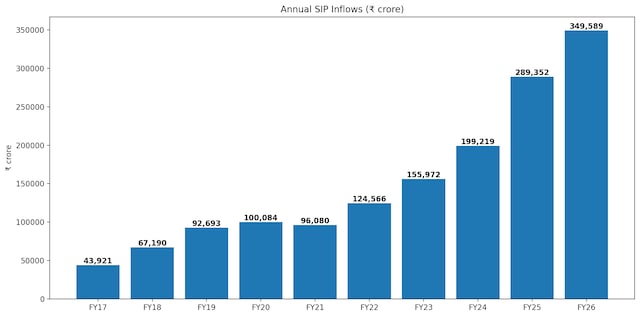
The sustained rise in SIP contributions has created a steady domestic flow into equities, helping cushion the impact of foreign portfolio investor outflows during periods of global volatility.
The demat revolution
A decade ago, stock market investing remained concentrated among a relatively small section of the population.
In March 2013, India had fewer than three crore demat accounts. Today, the number has crossed 22 crore, driven by digital onboarding, lower transaction costs, smartphone penetration and the rise of discount brokerages.
The Covid-19 period proved to be a turning point. Millions of first-time investors entered the market during and after the pandemic, accelerating a trend that has continued even as market conditions have become more challenging.
The expansion in demat accounts has widened market participation beyond traditional financial centres, bringing investors from smaller cities and towns into the capital market ecosystem.
