

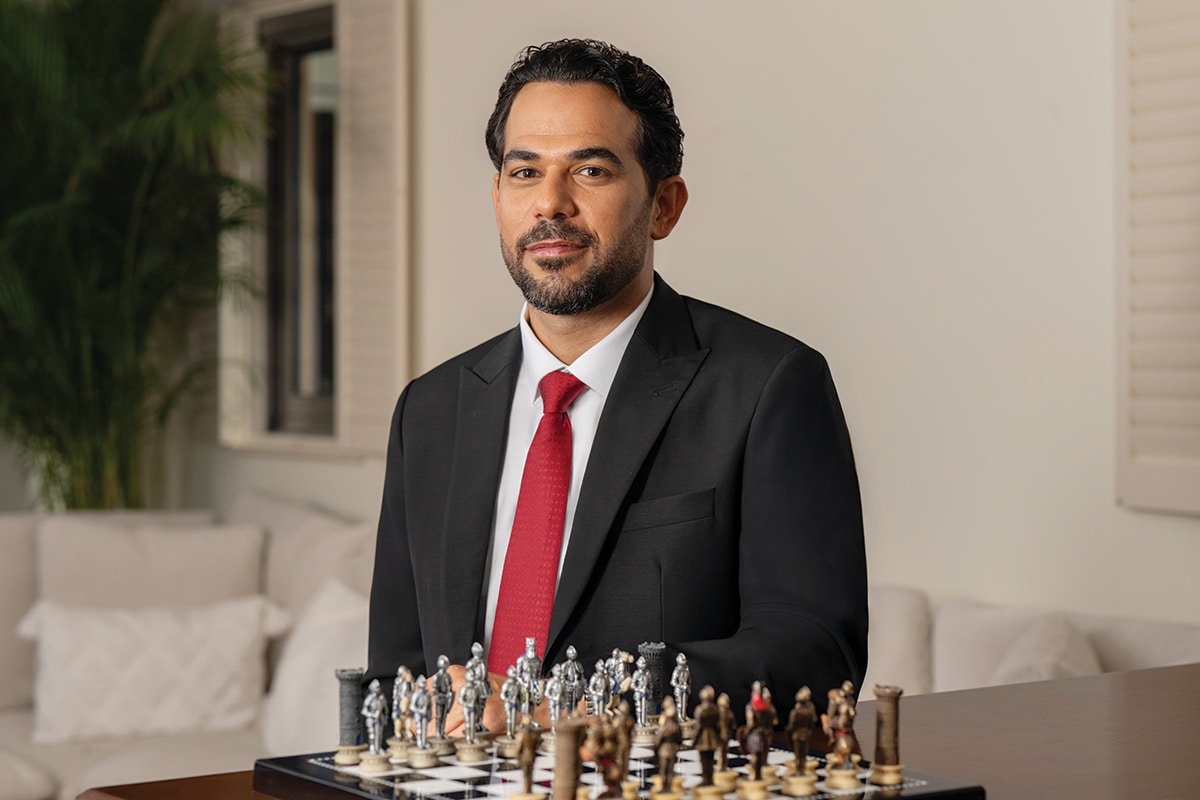
Born and raised in Barbados to a family with Syrian roots, Gabriel Abed grew up balancing two identities: the Caribbean nation that shaped him and the Middle Eastern heritage that connected him to a homeland he had never visited.
Today, the entrepreneur, diplomat and blockchain pioneer has become one of the most influential figures in global digital asset policy, serving as Chairman of Binance and helping shape conversations around the future of finance, technology and governance.
But for Abed, the journey has always been about something bigger than business.
“Our family found a welcoming home in Barbados, and the island gave us the foundation to grow, educate ourselves, and succeed,” he says.
“To be able to take those Barbadian-forged lessons and bring them to the global stage—and back to our ancestral roots—is a privilege.”
The Abed family story traces back to the early 20th century, when relatives left Syria as part of a wider wave of Levantine migration to the Americas and Caribbean.
Decades later, Abed’s father moved from Syria to Barbados, where the family eventually settled.
After studying information network systems and cryptography in Canada, Abed discovered Bitcoin at a time when few people understood its potential.
While many viewed the technology as a speculative experiment, he saw a solution to structural financial challenges facing smaller economies.
“In the Caribbean, we didn’t have sophisticated banking architecture,” he says. “Remittance fees were expensive and access was limited. Bitcoin allowed participation in the global financial system without asking permission.”
His conviction led him to become an early blockchain entrepreneur. In 2012, he helped build one of the world’s largest GPU-powered Bitcoin mining operations before launching Bitt, the Barbados fintech company credited with pioneering the concept of central bank digital currencies (CBDCs).
Years before governments began seriously exploring digital sovereign currencies, Abed was advocating for blockchain-powered financial infrastructure and meeting policymakers around the world to explain its potential.
A turning point came in 2019 when he moved to the UAE.
“I fell in love with the country,” he says. “It was safe, ambitious and future-focused. Everyone was thinking big.”

For Abed, the move also transformed his understanding of Arab identity.
Growing up in the West, he says perceptions of Arabs were often shaped by stereotypes. The UAE offered a different perspective: a modern, technologically advanced society leading major global conversations around innovation, investment and digital transformation.
“I came here and saw a highly sophisticated, forward-thinking society driving the global digital frontier,” he says.
That relationship deepened when he was appointed Barbados’ ambassador to the UAE in 2021. During his tenure, he helped strengthen ties between the two countries, opening Barbados’ first diplomatic mission in the Gulf and supporting growing economic and investment links.
Today, as Chairman of Binance, Abed believes blockchain’s greatest potential lies beyond cryptocurrency trading.
He envisions a future where blockchain underpins land registries, digital identities, health records and government services, creating more transparent and resilient public systems.
“The empowerment of people has always been the mission,” he says.
For Abed, technology is not simply about finance. It is about building bridges between nations, between communities and between people seeking greater opportunity.
In many ways, it is the same mission that has defined his own life journey—from Barbados to the Gulf, and from diaspora roots to the forefront of global innovation.
