

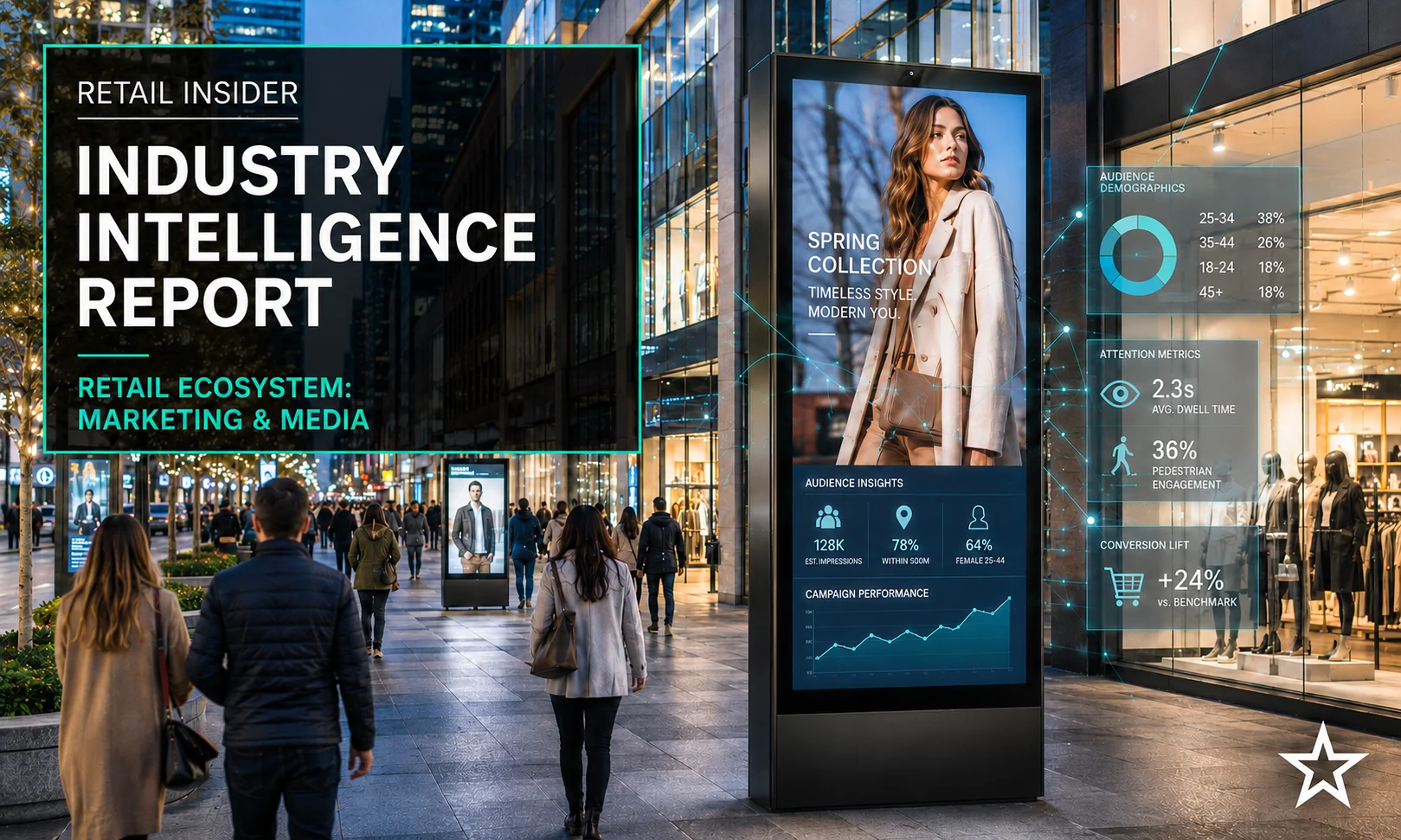
As part of Retail Insider Reports, this Q2 2026 Retail Marketing & Media Report analyzes Q2 2026 Canadian retail marketing trends. It draws on Retail Insider’s coverage and Canadian operator transcripts to identify key market dynamics around event-driven advertising, sustainability in marketing and packaging, and experiential retail activations. The full report series is available through the Report Hub.
This report examines retail marketing, advertising, branding, customer acquisition, loyalty, digital media, social commerce, PR, and consumer engagement strategies.
*****
In Q2 2026, Canadian retail marketing shifted notably as major cultural events like the FIFA World Cup intensified competition for consumer attention in physical spaces. Brands and landlords that harness dynamic digital out-of-home advertising, authentic local activations, and measurable sustainability practices are gaining ground. This period highlights the commercial importance of programmatic DOOH, loyalty program scale, and retail real estate health as platforms for engagement, signaling a more integrated and event-responsive marketing landscape for Canadian retailers.
Broad Overall Themes
Q2 2026 marked a decisive pivot in Canadian retail marketing toward leveraging major cultural events, sustainability, and experiential activations to engage consumers in physical environments. These trends are reshaping brand and landlord strategies across the country.
- Major events such as the FIFA World Cup are driving a surge in demand for dynamic, motion-based out-of-home (OOH) and digital out-of-home (DOOH) advertising, enabling brands to capture high foot traffic in key urban venues.
- Sustainability is increasingly influencing marketing and packaging decisions, with Canadian packaging recyclability metrics providing tangible evidence of environmental responsibility that resonates with consumers.
- Retail landlords are capitalizing on strong occupancy and urban acquisitions to embed experiential activations linked to local sports culture, reinforcing physical retail destinations as community hubs.
- Programmatic DOOH and real-time localized creative during major events are delivering competitive advantages by offering contextually relevant messaging in crowded media environments.
- Loyalty programs like PC Optimum are expanding as critical marketing infrastructure, supporting targeted consumer engagement across physical and digital channels.
Retail Insider Coverage
Event-Driven OOH/DOOH Advertising as a Strategic Priority
Canadian retail marketing in Q2 2026 was distinctly shaped by major events like the FIFA World Cup, which concentrated consumer attention in urban physical spaces. These events generated heightened foot traffic and public gatherings, creating prime opportunities for brands to deploy dynamic, localized OOH and DOOH advertising.
Research from Vistar Media Canada demonstrated that motion-based digital billboards deliver up to 67% higher brand awareness and stronger emotional engagement than static ads in event-driven settings. Programmatic DOOH campaigns optimized around fan zones and transit hubs in cities such as Toronto and Vancouver allowed brands to align messaging with live event activity effectively, even without official sponsorship. This approach helped brands break through digital clutter by leveraging physical presence and real-time creative adaptation.
Cineplex’s operational insights confirmed increased venue traffic and advertising spend during major events, validating the commercial significance of event-driven OOH strategies in Canada. While static DOOH remains effective, evidence suggests that incorporating motion and dynamic elements enhances impact in crowded, high-attention environments.
Sustainability’s Growing Role in Advertising and Packaging
Sustainability became a more prominent factor in Canadian retail marketing decisions, particularly in advertising formats and packaging. DOOH advertising offers environmental advantages over traditional OOH by reducing media waste, lowering carbon emissions, and eliminating physical production materials. Vistar Media highlighted DOOH’s low power consumption and programmatic buying efficiencies as key contributors to more sustainable advertising practices.
Packaging sustainability gained traction, especially among small businesses responding to consumer demand for eco-friendly products. Vistaprint coverage emphasized that sustainable packaging reflects brand values and environmental responsibility, influencing consumer preferences and first impressions. However, transcript evidence from George Weston Limited supports sustainability primarily through measurable packaging recyclability metrics rather than emotional branding benefits related to unboxing experiences.
These insights indicate Canadian retailers and marketers are increasingly integrating environmentally responsible practices into media planning and product presentation, aligning with evolving consumer expectations and corporate responsibility goals.
Experiential Retail Activations Amplify Physical Retail Ecosystems
Retail real estate operators leveraged strong occupancy rates and urban acquisitions to incorporate experiential activations tied to local sports culture, enhancing community engagement and driving foot traffic. CF Market Mall’s partnership with Calgary Wild FC featured soccer-themed interactive events and athlete appearances that foster authentic connections between retailers, brands, and local consumers.
The FIFA World Cup spurred landlords and mall operators to activate physical retail spaces with experiences resonating with fan enthusiasm. Transcript evidence from Choice Properties and Cineplex underscored the strategic role of these activations in reinforcing physical retail destinations as key platforms for brand engagement and community connection.
While quantitative commercial impact data remains limited, these experiential initiatives are increasingly recognized as valuable components of Canadian retail marketing strategies that differentiate physical retail environments and support community goodwill.
Broader Industry Coverage
Transcript evidence from Canadian operators adds depth to Retail Insider’s article-based analysis, sharpening the understanding of Q2 2026 retail marketing dynamics.
Event-Driven Demand and Media Spend Confirmed by Canadian Operators
Cineplex management explicitly linked the FIFA World Cup to increased demand in Canadian locations, validating event-driven traffic and activation potential. Advertising spend trends impacting Cineplex Media provide a Canada-specific signal of heightened media investment tied to major events, reinforcing the importance of venue-based advertising inventory during peak cultural moments.
Loyalty Programs as Core Marketing Infrastructure
George Weston Limited’s PC Optimum program, with over 18 million active Canadian members, underscores loyalty as a major marketing and retention channel. Cineplex’s Scene+ loyalty expansion further supports the growing role of owned audiences in complementing paid media, enabling more targeted and data-driven consumer engagement.
Sustainability Metrics Provide Tangible Brand Signals
George Weston’s disclosure that 98% of its controlled-brand plastic packaging in Canada is recyclable or reusable offers concrete evidence of sustainability commitments. This measurable packaging stewardship supports marketing narratives around environmental responsibility, though it does not extend to emotional branding claims for small business packaging.
Retail Real Estate Health Enables Activation Platforms
Choice Properties reported occupancy at 98.2% with strong tenant demand and ongoing urban retail acquisitions, signaling that Canadian retail destinations remain competitive platforms for brand activations and media placements. Cineplex’s new entertainment location at Vaughan Mills further links entertainment anchors to major retail hubs, reinforcing the physical ecosystem’s relevance for experiential marketing.
Editor’s Take
Q2 2026 confirms that Canadian retail marketing is increasingly anchored in the physical realm, with major cultural events like the FIFA World Cup serving as pivotal moments for brands and landlords to engage consumers through dynamic OOH and DOOH advertising. Cineplex’s confirmation of event-driven demand and media spend highlights that physical venues remain critical battlegrounds for consumer attention, challenging brands that rely solely on digital or static outdoor ads.
Retail landlords who embed experiential activations tied to local sports culture are leveraging strong occupancy and urban acquisitions to deepen community connections and sustain foot traffic. These activations are strategic investments, not mere promotions, and operators who neglect local culture risk losing relevance as physical retail competes with e-commerce on experience and engagement.
Sustainability has moved from a peripheral concern to a measurable factor shaping marketing and packaging decisions. The high recyclability rates reported by George Weston Limited provide a concrete benchmark for environmental responsibility in Canadian retail. However, claims about emotional branding through small business packaging lack solid Canadian evidence and should be approached cautiously.
The narrative of a wholesale shift from influencer marketing to peer recommendations is not supported by Canadian operator insights and should be treated skeptically. Instead, loyalty programs like PC Optimum and Scene+ are emerging as foundational marketing infrastructure, enabling precise, data-driven consumer engagement that complements event-driven paid media.
Looking forward, the market is dividing between those who can deliver real-time, localized, motion-based DOOH creative during major events and those who cannot. This capability will increasingly define competitive advantage in physical retail marketing. Executives should also monitor how experiential activations evolve from fan engagement to measurable commercial outcomes and expect sustainability metrics to become baseline expectations rather than differentiators.
Over the next 6 to 18 months, Canadian retail decision-makers must prioritize refining programmatic DOOH capabilities, integrating loyalty programs with physical activations, and embedding sustainability into core marketing and packaging strategies. Brands and operators that treat physical retail and event-driven marketing as secondary to digital-only approaches or fail to substantiate sustainability claims risk falling behind in a uniquely Canadian market that demands evidence-based, integrated marketing approaches.
