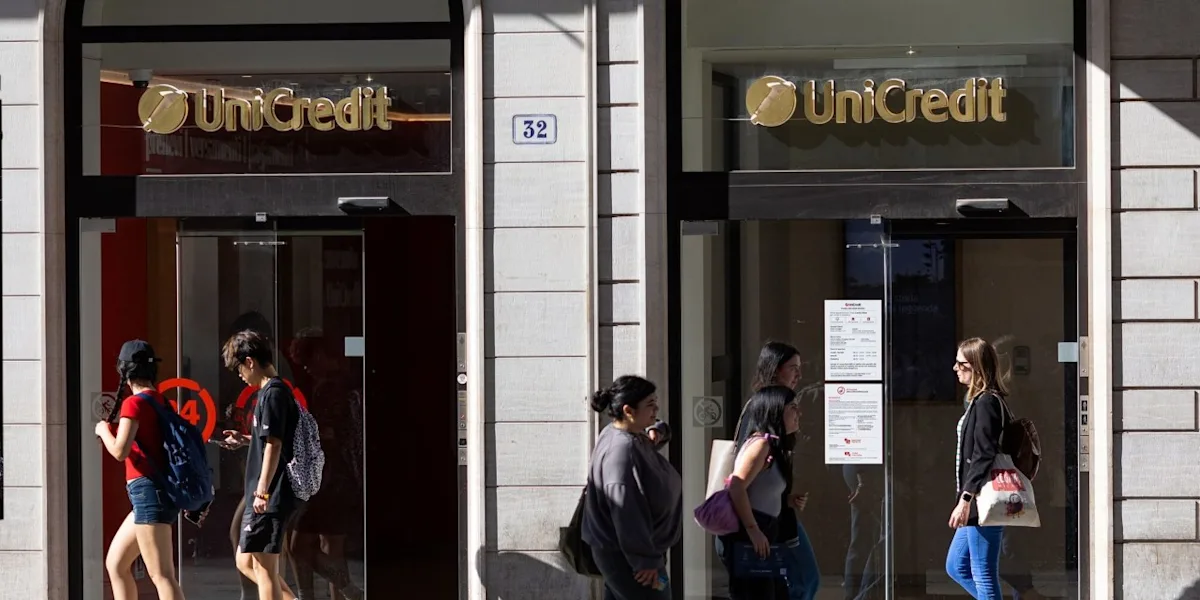
Italian lender UniCredit began circling Commerzbank in 2024. – Krisztian Bocsi/Bloomberg News
Italian bank UniCredit is edging closer to its longtime goal of taking over German rival Commerzbank, a landmark deal that would create a pan-European financial giant.
UniCredit now has control of around 42% of Commerzbank’s stock—and an economic interest in a further 13%—following its tender offer launched earlier this year. That should be enough to give the Italian lender control of its rival’s board and management.
Most Read from The Wall Street Journal
The all-stock offer currently values Commerzbank at around $50 billion, meaning a takeover would rank as Europe’s biggest banking deal since the 2008-9 financial crisis.
The tie-up is the brainchild of UniCredit Chief Executive Andrea Orcel, a former dealmaker best known for matchmaking among the world’s largest financial institutions.
For his own career-defining transaction, the Italian has drawn from his investment banking playbook. UniCredit has used derivatives to quietly build its position and brushed off repeated rejections of the deal from German bankers and officials.
The takeover battle has pitted the interests of the European Union against those of its most powerful member, Germany. More than three decades after EU members knitted together their economies into a single market, banking and financial systems remain fragmented. That has handicapped Europe’s ability to compete with the U.S. and China.
The UniCredit-Commerzbank deal, already two years in the making, still faces various obstacles.
The German government owns 12% of Commerzbank and has so far rejected UniCredit’s advances. Berlin doesn’t have any special powers to block the deal but could hold onto its stake and seek to counter UniCredit’s moves.
Other risks include all the likely complications of combining two lumbering banks with distinct cultures and clienteles in different geographies. There’s also Europe’s snarl of regulatory and accounting rules.
One potential hazard for UniCredit: It could win de facto control of Commerzbank without securing all the shares. European banking rules would force UniCredit to take Commerzbank’s assets onto its balance sheet but bar it from claiming all of the German lender’s capital. That would dent UniCredit’s own capital, a loss-absorbing buffer subject to minimum levels and closely watched by investors.
The final tender results aren’t due until early July and a deal could take until 2027 to finalize. Regardless, Orcel has all but won, said Filippo Alloatti of asset manager Federated Hermes, which owns bonds of both banks. “The takeover has happened,” he said.
UniCredit began circling Commerzbank in 2024, disclosing a 9% stake in September of that year. It bought financial contracts tied to the German bank’s shares and kept raising its holding.
It launched a tender offer to buy the rest of Commerzbank’s shares in March this year, stating that it was time for the two banks to hold constructive talks.
The Italian lender’s bid—and its claims that it could improve banking in Germany—has landed a blow to the corporate ego of a country that has typically had greater financial power than its smaller European neighbor.
Orcel has held up UniCredit’s German arm, HVB, as an example of its credentials. HVB has better returns on assets and a lower cost-to-income ratio than Commerzbank.
UniCredit has said a combined bank could offer more products, open up more markets and make it faster for businesses to borrow.
Since becoming UniCredit’s CEO in 2021, Orcel has restructured its operations and cut costs, prompting a surge in its share price. The bank has also benefited from Italy’s improving fortunes.
Commerzbank employees demonstrate against the deal in Wiesbaden, Germany. – Kirill Kudryavtsev/AFP/Getty Images
One point of tension in the takeover saga has been the unusually small premium offered by UniCredit in its tender offer.
Commerzbank CEO Bettina Orlopp on Monday said there could still be deal talks, but that UniCredit would at least have to offer a greater premium over its market price.
Germany’s finance agency has also criticized UniCredit’s offer price as too low and said it wants to keep Commerzbank independent. UniCredit has said its earlier swoop on the lender had already driven up its share price, reducing the premium it should offer.
Orcel’s maneuvering to take control has contributed to the sparring between the two banks.
Commerzbank has said the acceptance level of UniCredit’s offer is misleading because it includes stock pledged by financial companies with ties to the Italian bank, rather than its long-term shareholders. It asked Germany’s financial regulator to probe the deals.
UniCredit said tendered shares are tendered shares and that Commerzbank is creating a misleading narrative. It also asked for a probe.
The debate stems from a complicated derivative strategy UniCredit deployed to build its stake. UniCredit entered into so-called total return swaps with banks including Nomura Holdings and Jefferies Financial Group that track Commerzbank stock’s performance, according to people familiar with the matter. Those instruments have allowed UniCredit to increase its exposure to Commerzbank without owning all of the underlying stock.
In the derivatives deals, the banks bought stock to hedge their exposure to the swaps. That stock was then tendered in UniCredit’s offer for Commerzbank, some of the people familiar with the matter said.
In some cases, tendered stock was sold on to hedge funds, the people added. Those funds bought shares at a discount to the offer value so they could profit when the takeover deal completes.
Write to Ben Dummett at ben.dummett@wsj.com, Joe Wallace at joe.wallace@wsj.com and Margot Patrick at margot.patrick@wsj.com