

• Young firms — not small, not big, but NEW — account for virtually all net new job creation, plus a disproportionate share of breakthrough ideas and economic dynamism, according to foundational research.
• 6.6 million Americans launched businesses last year, with immigrants starting companies at twice the rate. But even as entrepreneurship has surged, the economic benefits have lagged in the face of industry consolidation.
• Former Fed official John Dearie founded the Center for American Entrepreneurship to advocate for pro-entrepreneurship policy in the name of economic development.
John Dearie was raised in tiny Stone Mountain, GA, east of Atlanta. He grew up to tend to the giants of the American economy.
He led for 17 years an organization representing the CEOs of the United States’ 20 largest financial institutions. Before that, he spent a decade at New York’s Federal Reserve Bank. In the wreckage of the 2008 financial crisis, Dearie came across the mounting research that new business creation was central to the American economy — yet entrepreneurship was in terminal decline. In 2011, he co-led a series of roundtables nationwide.
“People are piecing together income from multiple kinds of work… and entrepreneurship is becoming part of that mix.”
John Dearie, Center for American Entrepreneurship
“Sitting across the table from hundreds of entrepreneurs over that summer, hearing their stories, hearing about their businesses, and the problems in their way was the most fascinating professional experience of my life,” Dearie told me.
He wrote a book, and changed the course of his career on this discovery: “Startups, new businesses, are the disproportionate source of innovation in the economy,” he said.
Not small business. Not big business. New business.
It’s a distinction that sounds semantic but carries enormous policy weight. Dearie now leads the Center for American Entrepreneurship, a Washington DC-based organization he founded to educate policymakers about what his research revealed: For four decades before the pandemic, American entrepreneurship was in decline — and almost nobody in power understood why that mattered.
As Technical.ly has reported exhaustively these last five years, that decline reversed into a boom. Entrepreneurship is not just another special interest, but the very start of the economy. Tomorrow’s social ills, from wealth inequality to homelessness, are downstream of entrepreneurship and its present surge.
A new Kauffman Foundation analysis suggests this is not a post-pandemic fluke but a new paradigm. The foundation’s 2025 Early-Stage Entrepreneurship report, a 30-year longitudinal analysis released this month, shows 6.6 million Americans started a business last year, well above the pre-pandemic trends of decline.
Immigrants accounted for 2.3 million of those businesses — a formation rate twice that of people born in the United States. Hispanic and Black entrepreneurship rates have remained elevated for years now. (Gender disparity has remained nearly unchanged since 1996.)
Consolidation is the trend, crushing the dynamism that leads to equitable growth
The Kauffman report also surfaces troubling structural gaps.
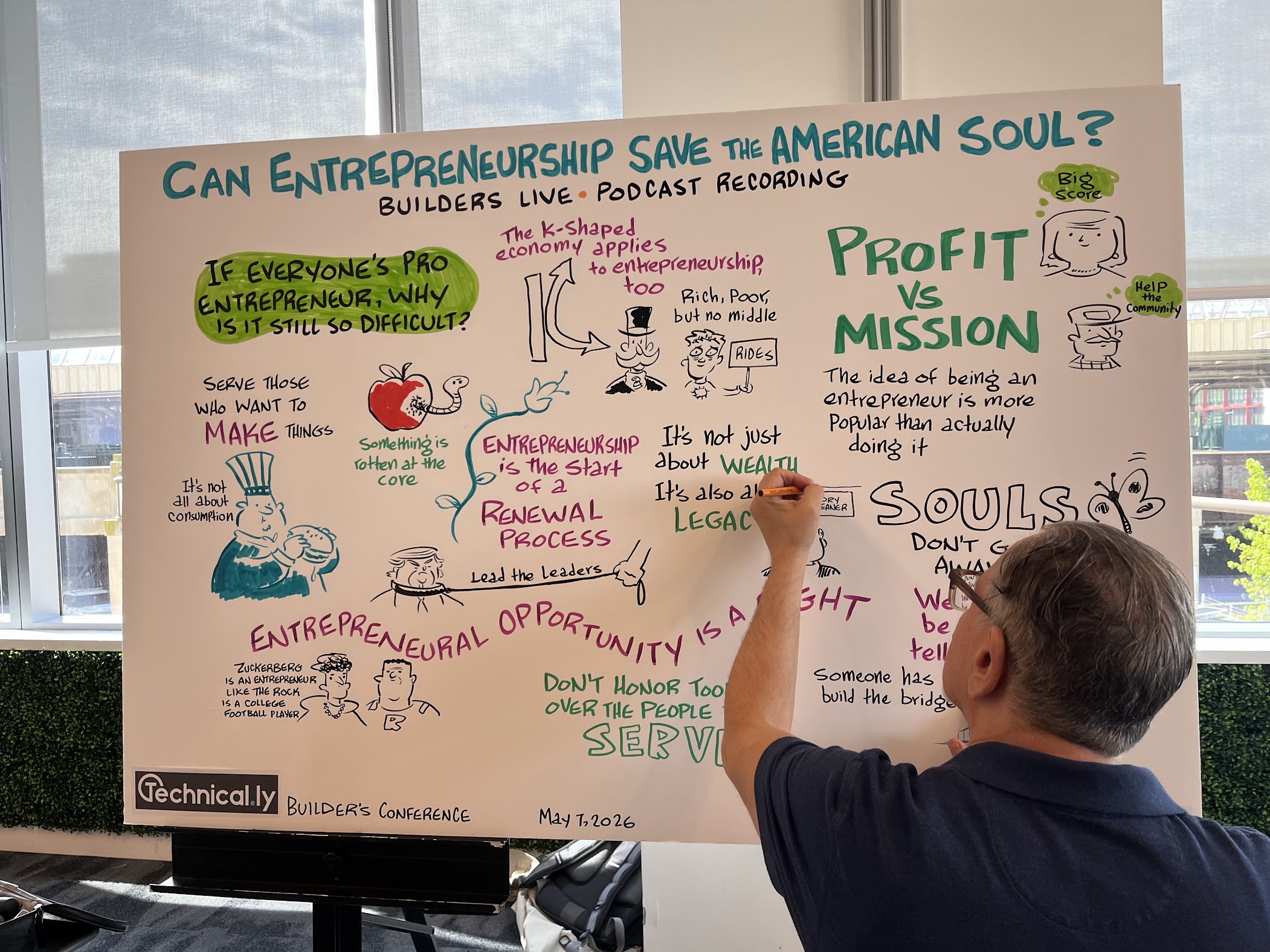
A larger share of new entrepreneurs are launching out of necessity rather than opportunity compared to 2019 levels. As Technical.ly has reported, there’s a K-shaped entrepreneurial economy: a shrinking number of middle-sized firms; concentration of high-growth startups (fewer, bigger ones); a growing count of underperforming “necessity entrepreneurs.”
“Maybe it’s not just one job anymore,” Kauffman researcher Robert Fairlie said of the findings. “People are piecing together income from multiple kinds of work… and entrepreneurship is becoming part of that mix.”
This creates risks and opportunities. Dearie and I discussed three big contributions entrepreneurship makes that may be under threat.
- New firms bring solutions to market. Innovation may begin in universities or corporate R&D labs, but commercialization happens disproportionately through startups. Patents held by startups are about 40% more likely to produce “outlier innovations” — defined as the top 5% by citation count — compared to incumbent firms, according to research from MIT, the University of Colorado and the National Bureau of Economic Research. Startup patents also generate nearly twice as many citations over 11 to 15 years.
- New firms create net new jobs. The small business job creation narrative that policymakers love? It falls apart when you separate old small businesses from young ones. The foundational research here comes from economists John Haltiwanger, Ron Jarmin and Javier Miranda, who showed in a 2013 Review of Economics and Statistics paper that once you control for firm age, there is no systematic relationship between firm size and employment growth. “Existing firms do innovate and they do create jobs,” Dearie acknowledged, “but they also shed jobs as they get better at what they do, as they incorporate capital and technology. On a net basis, firms older than 5 years old in aggregate shed about a million jobs a year.”
- Entrepreneurship sparks follow-on dynamism. It’s a positive feedback loop. Across all 50 states, for every 1% increase in the rate of entrepreneurship there was a corresponding 2% decline in the poverty rate, a 2012 Goldwater Institute analysis found. Small business generally is an economic predictor. Better yet, entrepreneurship is contagious: People who know or are near new-firm creators are more likely to follow.
Every Technical.ly reporter works with the understanding that wealth creation is an outcome of entrepreneurship, not a primary goal. Entrepreneurs who contribute to these three societal goals — new products and services, new jobs, dynamism — get a fair shot at a payday. But helping the rich get richer isn’t the point.
Worryingly, we seem too focused on creating wealth for a few, not the shared prosperity for most. All three entrepreneurial contributions are under strain.
My pro-entrepreneurship writing peers, like Paul O’Brien and Donna Harris, regularly make a similar case.
Encouraging high-growth businesses in the age of AI
So will AI be better for newcomers, or incumbents?
Dearie sees it as potentially transformative for entrepreneurs, as a tool that helps people launch businesses. “It’s the best time ever to start a company,” he said. “AI is dramatically reducing the cost and difficulty and obstacles.”
Last year, the Center for American Entrepreneurship conducted roundtables with AI-focused entrepreneurs in Houston, Miami, Atlanta and Milwaukee. What Dearie heard was more sophisticated than simple automation stories.
“They’re using AI to analyze the businesses of their clients, to identify problems, inefficiencies, obstacles that those business clients may not even be aware of on their own,” he said. That analysis creates opportunities for consulting, and can lead to new hires.
Still, Dearie acknowledged a tension that echoes findings from the Kauffman report: If AI makes it possible to build billion-dollar companies with skeleton crews, “I worry that new companies are going to be hiring and creating fewer jobs because of AI,” he said. “That implies to me that we need many, many, many more startups.”
The challenge is that entrepreneurship still gets treated as one interest group among many, slotted alongside small business advocacy or tech industry lobbying. Dearie founded CAE precisely because no organization in Washington was educating policymakers about the economic research showing new businesses occupy a unique position.
“New businesses have unique policy needs,” he said. “Problems and frustrations that can be a pain in the neck to existing small businesses can be fatal to new businesses.”
The Kauffman data suggests progress is possible. After four decades of decline, business formation has rebounded. But that rebound is uneven, driven disproportionately by immigrants and concentrated in necessity rather than opportunity. Policymakers, and the general public, need a pro-entrepreneurship message, making economic development a storytelling strategy. Doubters are widespread.
“The great merit of the capitalist system,” wrote British economist E. A. G. Robinson in his 1941 book “Monopoly,” “is that it succeeds in using the nastiest motives of nasty people for the ultimate benefit of society.”
Increasingly, Americans hate AI, and its infrastructure. This, too, requires communication — to find signal in the noise. Dearie remains optimistic, with caveats.
“Technology is always scary,” he said. “What makes AI different is the speed with which it’s developing and rolling out. Policymakers are behind the eight-ball.”
The race is whether cheery public perception of entrepreneurship can make something good despite dismal regard for today’s most prominent emerging technology. Once a big-business champion, John Dearie defected to the new business camp.
His career consistency is in public policy, which Dearie said comes from his childhood in Georgia.
“My parents raised my three brothers and me with a deep sense of responsibility to our community and the country,” Dearie said, “to be of service in some way.”
