The Electric Vehicle Finance market is booming with opportunities, driven by evolving financing models like battery leasing, government incentives, and innovative financial products. Key growth is expected in the consumer and commercial sectors, with tailored financing for fleets and increased accessibility due to subsidies.
Electric Vehicle Finance Market
Electric Vehicle Finance Market ·GlobeNewswire Inc.
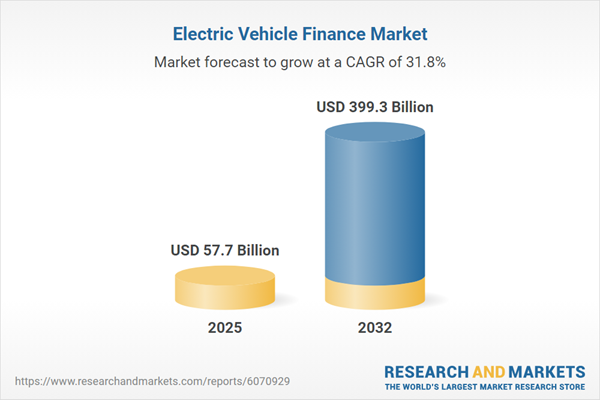
The global market for Electric Vehicle Finance was estimated at US$57.7 Billion in 2025 and is projected to reach US$399.3 Billion by 2032, growing at a CAGR of 31.8% from 2025 to 2032. This comprehensive report provides an in-depth analysis of market trends, drivers, and forecasts, helping you make informed business decisions.
The financing landscape for electric vehicles (EVs) is evolving rapidly as the global transition to electric mobility accelerates. As EVs are typically more expensive than traditional internal combustion engine (ICE) vehicles, innovative financing models are becoming critical to overcoming the affordability barrier for consumers and businesses. Traditional car loans and leases are being adapted to cater to the unique aspects of EV ownership, including longer vehicle lifecycles, battery warranties, and the availability of incentives.
For consumers, government-backed subsidies and tax incentives are helping to offset the upfront cost of EVs, while private financial institutions are offering tailored loans and lease options with competitive interest rates. Additionally, the growing popularity of subscription models, where users pay a fixed monthly fee for vehicle access, is becoming increasingly common in urban areas. This model allows customers to avoid the large initial cost of purchasing an EV and provides the flexibility to upgrade to newer models as technology improves.
On the commercial side, fleet operators are exploring tailored financing solutions for electric trucks, buses, and delivery vehicles, which include options for battery leasing, which separates the cost of the vehicle from the battery, providing a more affordable and flexible approach to fleet electrification.
What Are the Key Drivers of Growth in the Electric Vehicle Finance Market?
The growth in the electric vehicle finance market is driven by several key factors, including technological advancements, shifting consumer behavior, and the global push toward sustainability. As EV technology continues to improve, with longer battery life, increased range, and reduced charging times, consumers are becoming more comfortable with the idea of owning an electric vehicle, which is in turn driving demand. Furthermore, as more affordable EV models enter the market, the potential customer base is widening, especially as middle-class consumers in emerging markets begin to consider EVs as a viable option.
The expansion of charging infrastructure is another critical driver, addressing one of the main barriers to EV adoption – range anxiety. This growing network of charging stations further enhances the convenience and practicality of EV ownership. Financial institutions are responding to these changes by introducing more personalized and flexible financing solutions that meet the specific needs of a diverse customer base, including lower interest rates, more accessible terms, and greater availability of EV-specific financial products.
Moreover, the ongoing efforts by governments to set stricter environmental regulations, such as carbon emissions reduction goals, are pushing businesses to invest in electric fleets, further driving demand for financing options tailored to fleet operators. Finally, growing consumer awareness and preference for environmentally responsible choices are influencing purchasing decisions, increasing the demand for EVs and supporting the growth of the electric vehicle finance market. These combined factors are creating a strong, sustainable market for EV financing that will continue to evolve as the electric vehicle industry matures.
How Are Financial Institutions Innovating in EV Financing Models?
Financial institutions are stepping up their innovation efforts to create financing products that meet the unique needs of electric vehicle buyers. Beyond traditional loans and leases, banks and specialized lenders are now offering new, flexible financing options that cater specifically to the EV market. One significant innovation is the concept of battery leasing, which allows consumers to lease the battery separately from the vehicle itself. This model helps reduce the upfront cost of the vehicle, as the battery is often one of the most expensive components.
Additionally, financial institutions are adopting performance-based financing, where loans and leases are structured based on the EV’s expected range, battery life, and long-term reliability, aligning payments with the vehicle’s long-term value proposition. Digital platforms and fintech companies are also introducing peer-to-peer lending and crowdfunding opportunities, allowing individuals or small investors to directly fund EV purchases, further democratizing access to EVs.
For businesses, financiers are designing tailored fleet financing solutions that include bundled maintenance, insurance, and charging infrastructure costs, providing a more comprehensive approach to managing the total cost of ownership. These innovative models are not only making EVs more accessible but also enhancing consumer confidence and fostering the growth of electric mobility.
Report Features:
Comprehensive Market Data: Independent analysis of annual sales and market forecasts in US$ Million from 2025 to 2032.
In-Depth Regional Analysis: Detailed insights into key markets, including the U.S., China, Japan, Canada, Europe, Asia-Pacific, Latin America, Middle East, and Africa.
Company Profiles: Coverage of players such as Ally Financial Inc., Bank of America Corporation, BNP Paribas Personal Finance, Capital One Auto Finance, Citizens Financial Group, Inc. and more.
Complimentary Updates: Receive free report updates for one year to keep you informed of the latest market developments.
Key Insights:
Market Growth: Understand the significant growth trajectory of the Bank segment, which is expected to reach US$261.3 Billion by 2032 with a CAGR of 35.4%. The Non-Banking Financial Company segment is also set to grow at 25.9% CAGR over the analysis period.
Regional Analysis: Gain insights into the U.S. market, valued at $17.8 Billion in 2025, and China, forecasted to grow at an impressive 41.5% CAGR to reach $125.2 Billion by 2032. Discover growth trends in other key regions, including Japan, Canada, Germany, and the Asia-Pacific.
Geographic Regions/Countries: World; United States; Canada; Japan; China; Europe (France; Germany; Italy; United Kingdom; Spain; Russia; and Rest of Europe); Asia-Pacific (Australia; India; South Korea; and Rest of Asia-Pacific); Latin America (Argentina; Brazil; Mexico; and Rest of Latin America); Middle East (Iran; Israel; Saudi Arabia; United Arab Emirates; and Rest of Middle East); and Africa.
Key Attributes:
Report Attribute
Details
No. of Pages
284
Forecast Period
2025 – 2032
Estimated Market Value (USD) in 2025
$57.7 Billion
Forecasted Market Value (USD) by 2032
$399.3 Billion
Compound Annual Growth Rate
31.8%
Regions Covered
Global
Key Topics Covered:
MARKET OVERVIEW
Trade Shocks, Uncertainty, and the Structural Rewiring of the Global Economy
How Trump’s Tariffs Impact the Market? The Big Question on Everyone’s Mind
Electric Vehicle Finance – Global Key Competitors Percentage Market Share in 2026 (E)
Competitive Market Presence – Strong/Active/Niche/Trivial for Players Worldwide in 2026 (E)
MARKET TRENDS & DRIVERS
High Upfront Costs of EVs Throw the Spotlight on the Growing Importance of Flexible Financing Solutions
Emergence of Green Financing Models Strengthens the Business Case for Sustainable Vehicle Ownership
Rising Adoption of Battery Leasing and Subscription Services Expands Affordable Access to EVs
Financial Institutions and OEM Tie-Ups Generate Customized Financing Plans and Captive Lending Programs
Growth in Commercial EV Fleets Drives Demand for Fleet Leasing, Operating Lease, and Pay-Per-Use Models
Increased Consumer Awareness of TCO Benefits Over ICE Vehicles Enhances Willingness to Finance EV Purchases
Digital Lending Platforms and Fintech Integration Propel Accessibility to Instant EV Credit and Pre-Approvals
Expansion of Used EV Market Accelerates Need for Certified Pre-Owned Vehicle Financing Ecosystems
Battery Residual Value Uncertainty and Depreciation Trends Drive Innovation in Risk-Based Loan Structuring
E-Commerce and Online Dealership Channels Strengthen the Demand for Integrated Digital Financing Options
Subscription-Based Ownership Models and Flexible Tenures Gain Popularity Among Young Urban Consumers
Data-Driven Credit Scoring and Telematics Integration Enhance Underwriting for Usage-Based EV Financing Solutions
FOCUS ON SELECT PLAYERS: Some of the Companies Featured in This Electric Vehicle Finance Market Report
About ResearchAndMarkets.com ResearchAndMarkets.com is the world’s leading source for international market research reports and market data. We provide you with the latest data on international and regional markets, key industries, the top companies, new products and the latest trends.
Attachment
CONTACT: CONTACT: ResearchAndMarkets.com Laura Wood,Senior Press Manager press@researchandmarkets.com For E.S.T Office Hours Call 1-917-300-0470 For U.S./ CAN Toll Free Call 1-800-526-8630 For GMT Office Hours Call +353-1-416-8900