

For many inside and outside Silicon Valley, artificial intelligence development means working on giant all-purpose tools like Anthropic’s Claude and OpenAI’s GPT family of models.
But investors continue to pour money into more specialized applications, including A.I. focused on designing breakthrough drugs.
A fast-growing player in that industry, Chai Discovery, plans to announce on Tuesday that it has raised $400 million in new funding that values the company at $3.8 billion.
The round was led by Index Ventures alongside Kleiner Perkins, Sequoia Capital and Dimension. Other participants included Bain Capital Ventures, Thrive Capital, OpenAI and Yosemite, the firm founded by Reed Jobs, the son of Steve Jobs.
The funding is the latest sign of interest in A.I. meant to help pioneer new drugs. “I believe that life sciences is going to be one of the most consequential and biggest-impact applications of A.I.,” Nina Achadjian, a partner at Index, said in an interview.
Chai Discovery isn’t the only company in the field: Among the most prominent is Isomorphic Labs, a spinoff from Google that draws on the technology giant’s Nobel-winning work. Isomorphic has also attracted plenty of venture capital money, raising $2.7 billion from investors since March 2025.
Both start-ups have teamed up with pharmaceutical giants, including Eli Lilly. (On Monday, Chai announced that it would also collaborate with Novartis.)
While Isomorphic is essentially a biotech company focused on developing its own drug candidates, Chai provides its models as a more open-ended kind of A.I. infrastructure for pharmaceutical companies.
“We work with some of the top pharma companies to help them make the transition from pre-A.I. companies to post-A.I. companies,” Jack Dent, a Chai founder and its president, said in an interview.
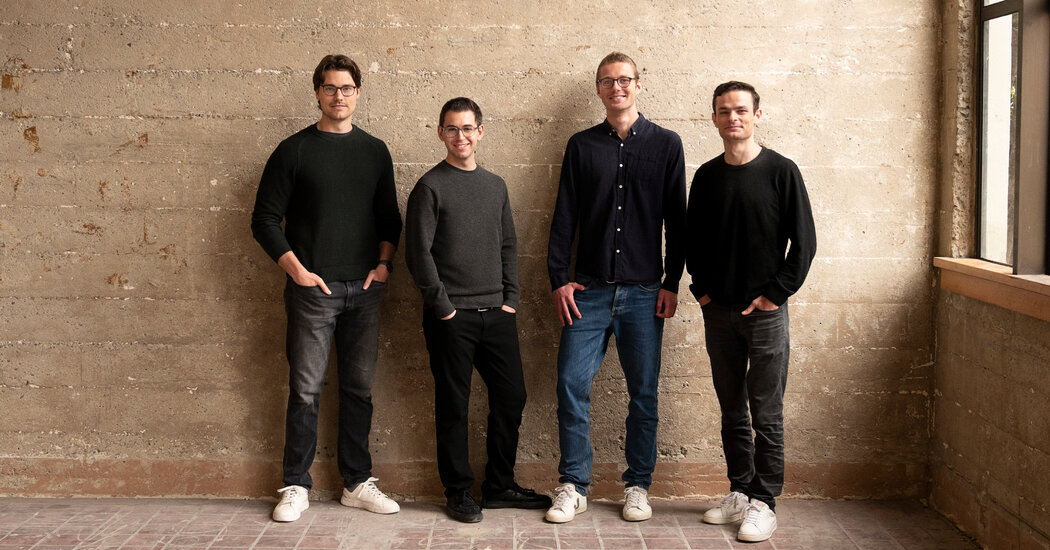
Chai was founded in 2024 by Mr. Dent, a former engineer at the fintech giant Stripe, and three others, including Joshua Meier, Chai’s chief executive, who was an early employee at OpenAI.
In an interview, Mr. Meier said he had long been interested in developing A.I. models that could speak “DNA and protein” and develop drug treatments, a focus that also took his career to Meta and then the biotech company Absci.
He eventually teamed up with Mr. Dent, a classmate from Harvard, and two other executives, Matthew McPartlon and Jacques Boitreaud, to create a business focused on drug discovery.
The company has concentrated on developing antibodies, with its executives promoting its Chai 2 model’s ability to design potential therapies from scratch. (Its Chai 3 model, executives say, has designed antibodies that appear to be even more effective.)
“We can go after the most challenging molecules that pharma hasn’t been able to crack,” Mr. Meier said.
Chai’s business revolves around working with drugmakers and giving them access to its models that it can further train with those companies’ proprietary data. The model is meant to be less capital intensive and risky for Chai because its future doesn’t depend on the success of the drugs it’s developing on its own.
Chai’s progress has drawn the attention of big tech investors. Although Chai raised $130 million in December and hadn’t planned to seek more funds soon, venture capitalists began courting the start-up around February.
When Chai started seriously pursuing a new fund-raising round, it lined up the financing in a matter of weeks, according to Mr. Dent.
Mr. Meier and Mr. Dent said the new capital would go toward acquiring more data and computing power to train Chai’s models and hiring more engineers.
Chai’s backers have high hopes for the company.
“I think they have a chance to be on the order of magnitude of the biggest pharma companies,” Pat Grady, a partner at Sequoia, said in an interview.
Chai executives played down the prospect of competition, including from life science offerings from Anthropic and OpenAI. “Our models are much more domain specific” than all-purpose ones like Claude or ChatGPT, Mr. Dent said. (Mr. Meier noted that OpenAI was also an investor.)
The bigger question is whether advanced A.I. drug design can translate to real-world success.
“We’re not competing with anyone apart from nature,” Mr. Meier said.
