
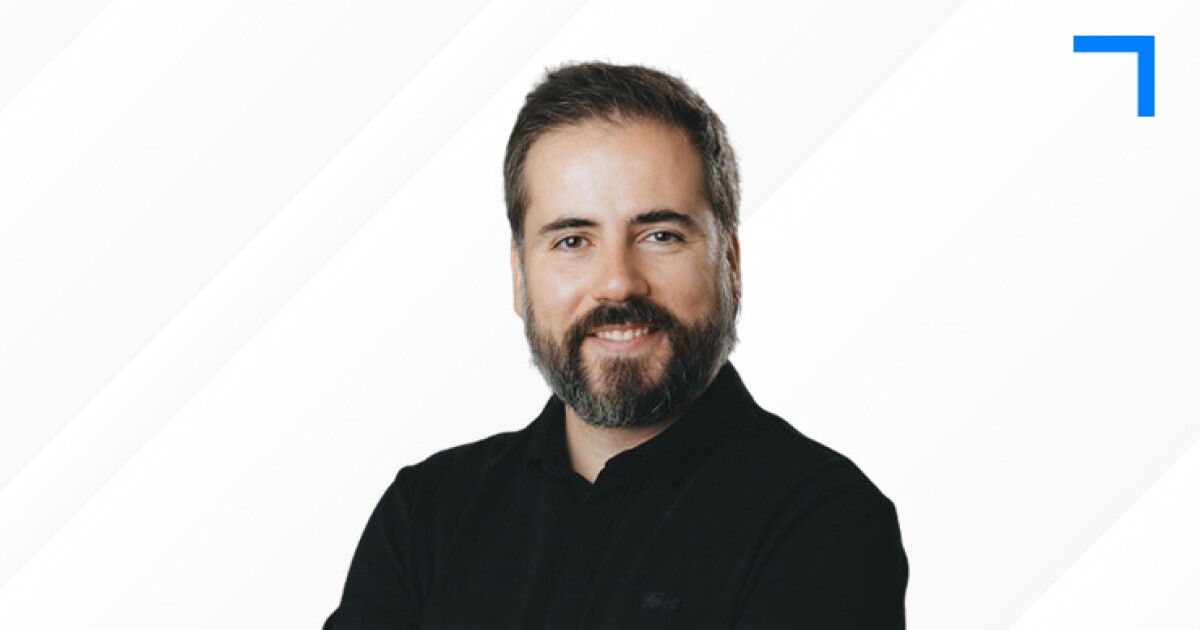
The advent of blockchain technology is coming in waves, argues Andrés Fondevila Maron, the head of digital assets at BBVA Asset Management & Global Wealth. The first wave focused on crypto assets and cryptocurrencies. The second, current wave focuses on stablecoins and the infrastructure creation. And the third wave will be the real world assets move from traditional rails to digital rails.
Transcription:
Transcripts are generated using a combination of speech recognition software and human transcribers, and may contain errors. Please check the corresponding audio for the authoritative record.
Paul Vigna (00:11):
Hello, I’m Paul Vigna. I’m managing editor at American Banker. We’re here at the On Chain Executive Summit in Midtown Manhattan, and I am joined by Andres Fondebila Maron. Did I get it right? Right.
Andrés Fondevila Maron (00:22):
Did I get
Paul Vigna (00:23):
It close?
Andrés Fondevila Maron (00:23):
Right.
Paul Vigna (00:24):
Okay.
Andrés Fondevila Maron (00:24):
Pretty close.
Paul Vigna (00:25):
Okay. Who is the head of digital assets at BBVA?
Andrés Fondevila Maron (00:30):
Yes. BBVA Asset Management that is belong to BBVA Financial Group.
Paul Vigna (00:34):
Great.
Andrés Fondevila Maron (00:34):
So thank you very much for having me
Paul Vigna (00:36):
Today. Thanks for being here. So I have three questions for you. The first question is when you look at the sort of evolution of on – chain finance and digital assets, what are you most bullish about?
Andrés Fondevila Maron (00:49):
I think that there’s happen exciting things around digital asset ecosystem. We can split it into three different waves. The first one was the wave about crypto assets, cryptocurrencies. That’s over. That’s an illegal assets and we, the banks and the financial institutions, we are offering access to that asset class. The second wave that is the one that we are living today is the stablecoin and the infrastructure, the creation of the new infrastructure of liquidity based on blockchain technology and is amazing and very exciting. And the third wave will be the real world assets that we have to create and move from traditional rails to those rails that we are creating with the stable coins. We need the stable coins, we need the cash leg first and then move to the real world assets to bring the opportunity to our clients to this new infrastructure.
Paul Vigna (01:49):
It’s a lot.
Andrés Fondevila Maron (01:50):
It’s amazing. It’s very exciting.
Paul Vigna (01:54):
There’s been a lot of activity recently, last year or two, whatever though, probably be more in the next couple of years. What is one obstacle that you are maybe seeing now or maybe anticipating now that might crop up and create problems in the next year or two or three? I
Andrés Fondevila Maron (02:10):
Think that the main challenge that is understopable, but we have to face with is the fragmentation and fragmentation into two verticals, two different verticals or two different angles that we have to cover. The first angle is the fragmentation of technology. We have the opportunity to start ESON thins, vehicles, money, securities, equities. Wherever you want to think we can represent it by tokens, could be represented by tokens, but there are too many protocols, too many networks, too many different technologies and we want to be technology agnostic. So technology should be a commodity for us in order to tokenize. Secondly is that the other angle to cover in terms of fragmentation is the fragmentation of the regulation. We are a very large traditional financial institution that operates worldwide and there are different regulators with different spit of abduction of technology, of different spit of adoption of the new representation of traditional assets in blockchain technology in public blockchains or even private blockchains.
(03:18):
So my feeling is that regulator and banks, we are at least in Europe and I think that in the US too, we are rowing in the same direction in order to find the same goal, but the fragmentation and the spit of adoptions for us that we have to comply with different regulation in different jurisdictions is a barrier that we have to comply with. We have to comply with regulation and this a barrier that we have to broke with them.
Paul Vigna (03:50):
And if you were to make one prediction for this field, I know predictions are, it’s a hard thing to ask people to do, but we’re going to ask you to do it. Make one prediction for us.
Andrés Fondevila Maron (04:01):
I have no crystal ball in order to make a great prediction, but I think that the thing that I’m sure that will happen in the future and in the short term or in the midterm from three to five years is that every single portfolio of our clients will be represented by tokens and managed through wallets. That means that the borders between countries and the borders between jurisdictions could be a little bit blurred in the future. And the ecosystem will be the same. We are not working in different bubbles. The tokens could, you can transfer, you will be able to transfer value because of the representation of tokens in real time twenty four seven with atomic settlements. Is the same thing that I used to say that nobody is thinking nowadays about sending an international email. Just send an email. But when you talk about the transfer of value, you think about, okay, I have to transfer the value from point A to point B, but there are different regions.
(05:12):
I don’t know how it works perfectly or very, very close. So the problem is that let’s move the email model to the transfer of value and that could be with tokens. So I think that will be a very most effective model managed by wallets and represented by tokens.
Paul Vigna (05:30):
Thank you Andres.
Andrés Fondevila Maron (05:31):
Thank you both. Yeah.
