

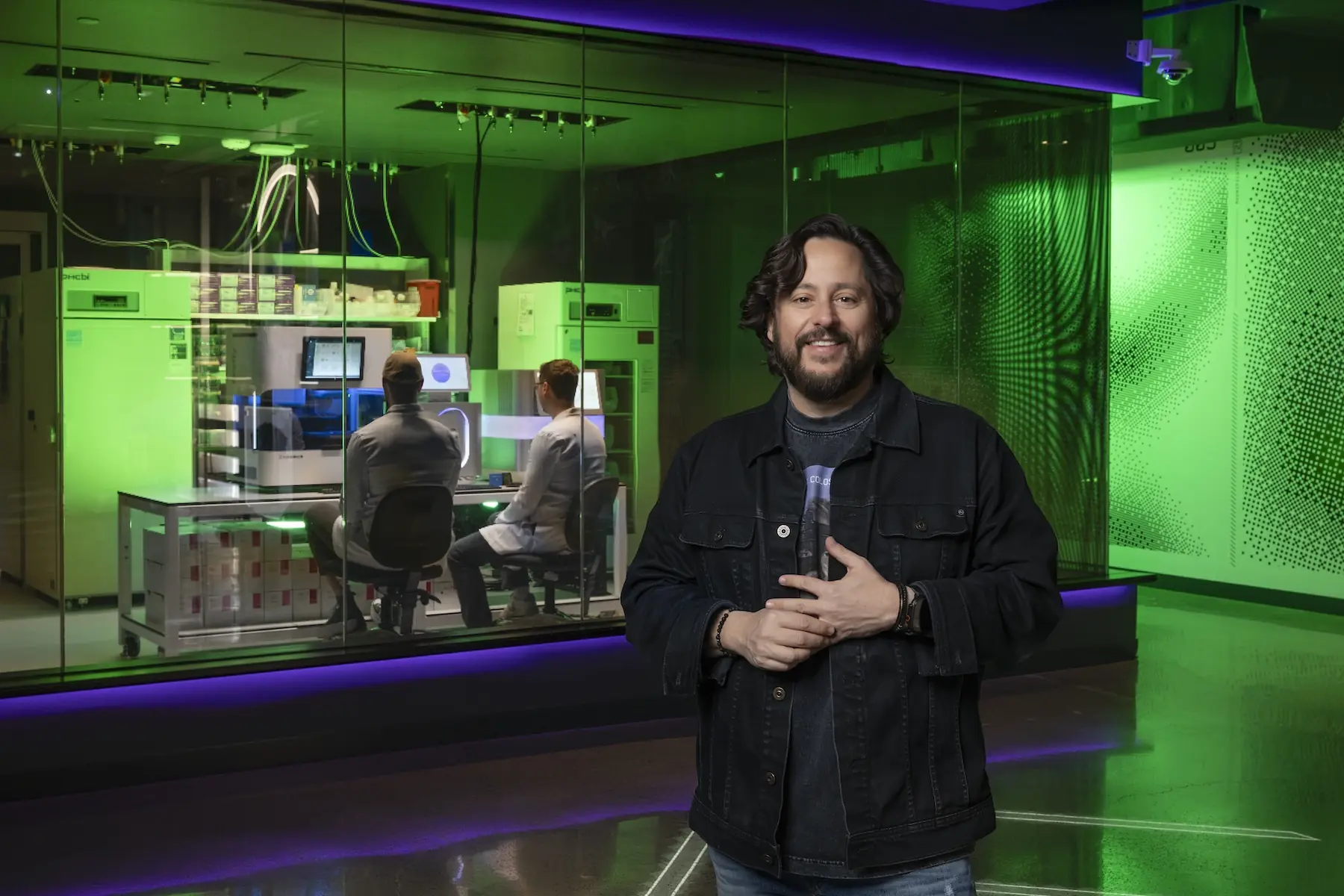
Amid his quest to bring back the woolly mammoth, dodo bird, and Tasmanian tiger, Dallas billionaire Ben Lamm has also been building a new AI startup in stealth mode. Spun out of Colossal Biosciences, Astromech is building a predictive engine for biology—one that aims to forecast evolution, disease risk, and system vulnerabilities before they happen.
According to its latest Form D filing, the startup recently closed a $10.5 million fundraise, bringing its total funding to $40.5 million. The pre-revenue firm has now reached a valuation of $2 billion just nine months after being spun out of Colossal. Lamm, despite still working in “deep research and validation mode” is aiming for more. “I think it is massively undervalued given the scope of what the model hopes to answer,” the entrepreneur told D CEO.
That scope?
“The platform integrates two complementary capabilities: deep learning algorithms that identify biological patterns across species, and Bayesian ancestral reconstruction methods that model evolutionary trajectories,” Lamm said. “Together, these form a unified biological intelligence architecture, combining genomic, evolutionary, and functional data to predict biological outcomes and uncover the regulatory mechanisms that shape them over time—a significant step toward modeling how living systems evolve, including key susceptibility points.”
Strip away the technical language, and Astromech is essentially building a forecasting engine for biology—one that aims to see where living systems are headed before they get there. And the bet investors are making is straightforward: If you can predict how biology evolves, you can get ahead of disease—not just react to it.
“If the model works the way we anticipate, it will be transformative for prediction modeling that will impact vulnerability and resilience that will be applicable to microbes, human healthcare, disease, livestock, and wildlife,” Lamm said.
Lamm co-founded the firm alongside George Church, Colossal’s co-founder and lead geneticist. Incorporated in Delaware, the company’s office, according to the Form D, is in Austin.
This isn’t Colossal’s first spin-off. In 2022, the startup launched Form Bio, a computational life sciences software platform working to accelerate genetic medicine and synthetic biology research.
“Colossal is focused on de-extinction and species preservation,” Lamm said. “When new ideas and technologies arise that have other applications outside of de-extinction and species preservation, we spin them out or license the technology so our core teams can focus on Colossal’s mission.”
