

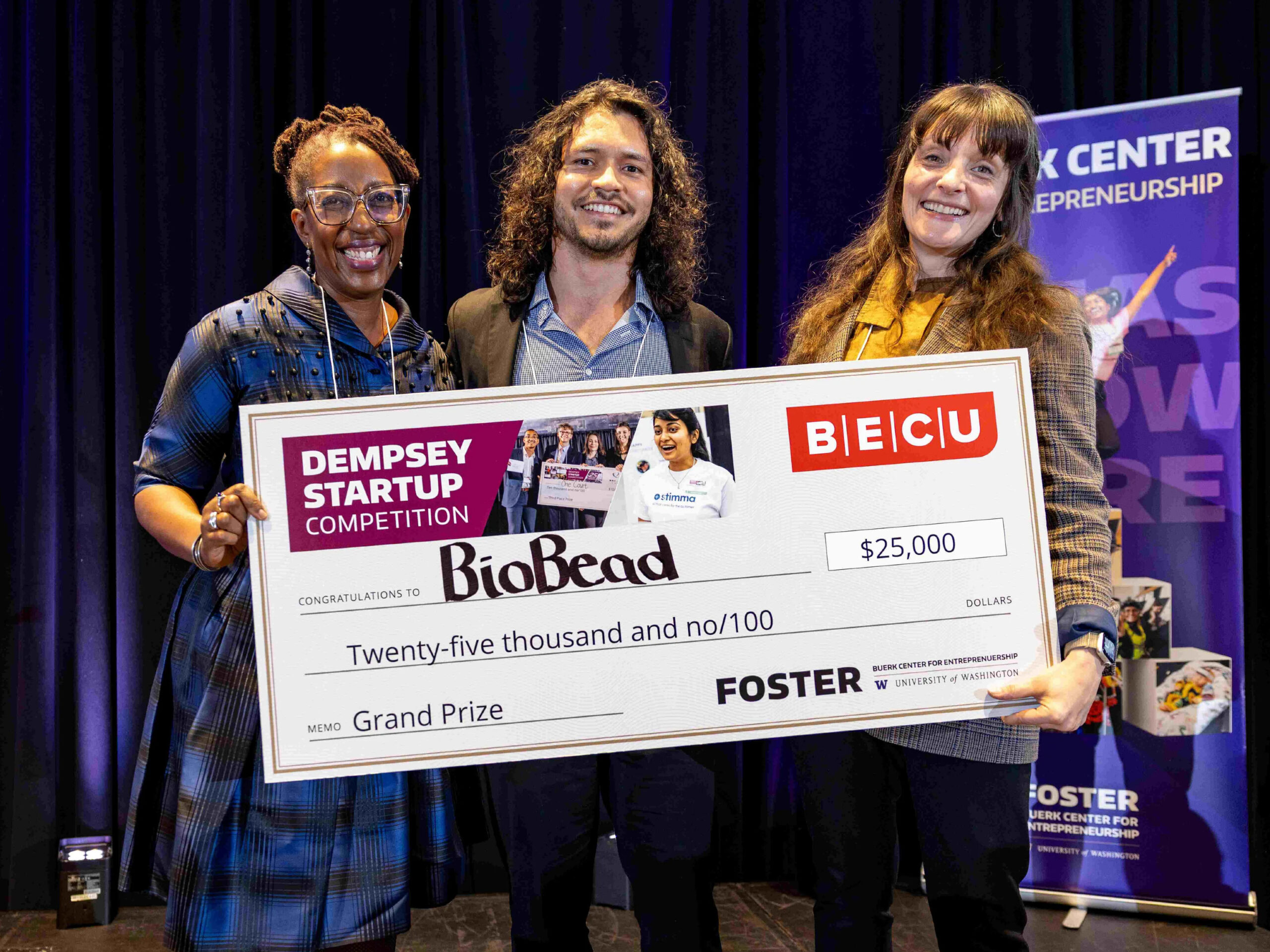
The big winner at the University of Washington’s 29th annual Dempsey Startup Competition was BioBead, a startup launched by a UW team with an ag tech solution for boosting soil health and crop production.
The company won $25,000 from BECU as well as the $2,500 Voyager Capital Best Business to Business Idea Prize.
A record 186 startups entered the competition, whittled down to 16 contenders who pitched before judges in mock boardroom settings. Winners took home a share of $92,500 in prize money.
The event is open to student entrepreneurs from across Washington, Oregon, Idaho, Alaska and British Columbia. Entrants range from very early-stage startups with a prototype to teams with minimum viable products or technologies ready for commercial production.
The competition runs over seven weeks, during which teams refine their strategies — recruiting business students to strengthen go-to-market plans, for example. Judges this year noted that AI is helping teams design more sophisticated technologies.
The awards were announced at a Seattle event on May 21.
Grand prize recipient BioBead is developing small, biodegradable pellets that bring together bacteria and fungi that have coexisted in soil for 400 million years, helping plants absorb essential nutrients including nitrogen and phosphorus.
“People seem to be quite disconnected from everything below our feet because we can’t see it,” said Korena Mafune, a BioBead co-founder and UW research scientist. But those organisms are what allow crops above ground to flourish, she added.
BioBead’s other co-founders are Renee Davis, who is finishing her doctoral degree at the UW, and Mari Winkler, a UW professor in civil and environmental engineering. Jared Espinosa, a recent MBA graduate from the UW’s Foster School of Business, joined the team for the competition.
The startup has been working with farmers growing lettuces, tomatoes, corn and wheat to test the benefits of the soil treatment. Initial results show higher crop yields while reducing the need for increasingly expensive fertilizers.
Mafune last month also won a $275,000 grant from the Washington Research Foundation to support commercialization of the technology.
The second to fourth prize winners were:
$15,000 WRF Capital Second Place Prize – CPRight (UW and Western University of Health Sciences in Oregon) is developing a low-cost patch that provides real-time information on compression depth and pace during cardiac emergencies requiring CPR. CPRight also won the $2,500 Chris and Barbara Petersen Best Health & Wellness Impact Idea Prize.
$10,000 iSpot.tv Third Place Prize – Kinnex Health (University of Idaho) is building a wearable sensor to provide continuous joint-movement data collected from patients after orthopedic surgeries and procedures. The team also won the $2,500 Amazon Best Consumer Product Idea Prize.
$7,500 Friends of the Dempsey Startup Fourth Place Prize – Alarmable (UW) is creating a wearable bracelet charm that also serves as an alarm that can be triggered in emergency situations.
Other winners:
- $5,000 Wilson Sonsini Social Impact Big Picture Prize – Osanwe Link (UW)
- $5,000 Kathryn Gardow & David Bradlee Climate Solutions Big Picture Prize – LEAF (UW)
- $5,000 Glympse Emerging Tech Big Picture Prize – Adam Biotech (UW)
- $2,500 Smukowski Family Best Sustainable Business Prize – Clubless Collective (UW)
- $2,500 eBay Best Marketplace Idea Prize – Kindred (UW)
- $2,500 Perkins Coie Best Innovation/Technology Idea Prize – Emerald Dynamics(UW)
- $2,500 Saara Romu Community Impact Prize – UWEMS (UW)
- $2,500 DLA Piper Best Idea with Global Reach Prize – GridGuard (UBC)
