
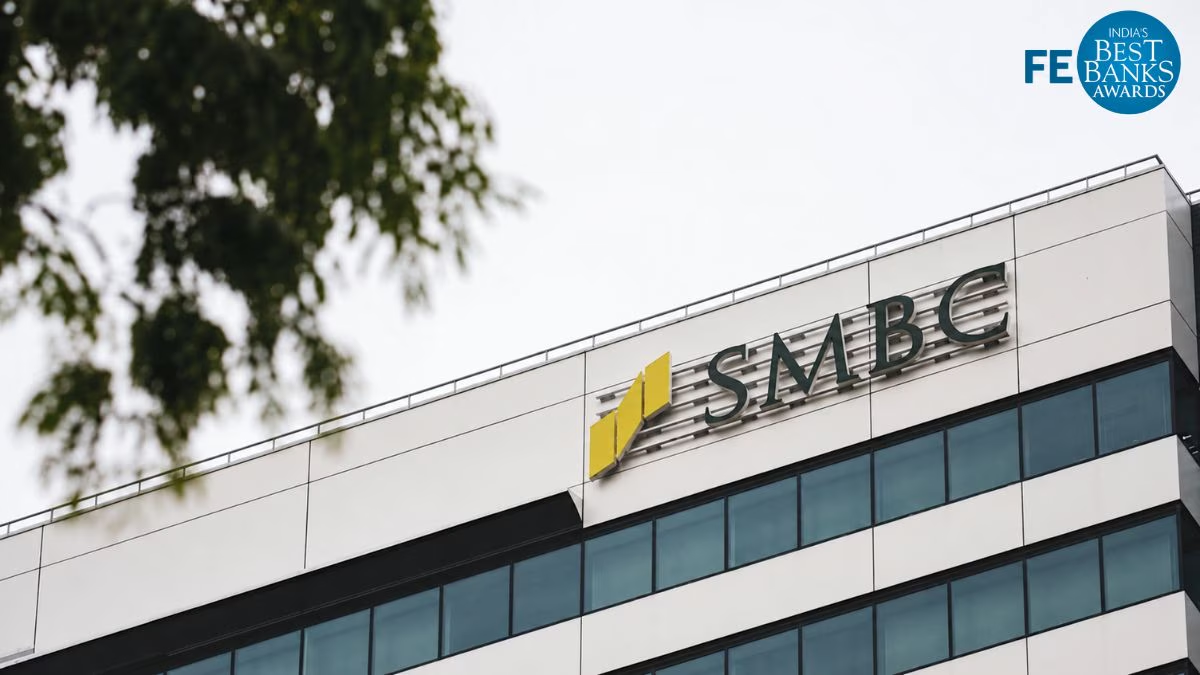
When Sumitomo Mitsui Banking Corporation (SMBC) picked up a 24.99% stake in YES Bank last September, it made headlines across India’s financial sector. But those watching SMBC closely knew this was not a sudden move — it was simply the most visible step in a long, deliberate march.
India, for SMBC, is no longer just another market. It is a strategic priority in a class of its own.
Earlier this fiscal year, the Japanese banking giant made that explicit by carving India out as a standalone regional division — separating it from the Asia-Pacific umbrella it had previously sat under. India now stands alongside the Americas, EMEA and APAC as one of SMBC’s four global regions. Crucially, it is the only single-country division in the entire group. No other nation gets that distinction.
For Hiroyuki Mesaki, former CEO of SMBC India, the reorganisation is as much about agility as it is about status. “When it is a separate business, decision-making is faster,” he says. In banking, that speed can make all the difference.
SMBC’s India story began in 2013, but the numbers today tell a far more ambitious tale. Across its various businesses — including SMFG India Credit, the YES Bank stake and direct capital infusion into SMBC India — the group has invested nearly $7 billion in the country. Its combined wholesale exposure to India exceeds $10 billion.
Onshore advances stand at roughly $3.1 billion, the GIFT City branch carries a loan book of over $5 billion, and Indian clients account for more than $2 billion of exposure through SMBC’s Singapore operations.
The bank has also received in-principle approval from the Reserve Bank of India to establish a wholly owned subsidiary — a relatively exclusive club that currently includes DBS Bank India and State Bank of Mauritius India. The transition will give SMBC considerably more room to expand its branch network and broaden its product suite, accelerating its push beyond traditional corporate banking.
The YES Bank investment is more than a financial bet — it is a strategic bridge. SMBC’s strength lies in serving large conglomerates and multinational corporations, but that focus has always left a gap: retail. “If a client wants employee banking or retail benefits for thousands of workers, SMBC cannot offer that — but YES Bank can,” Mesaki explains.
Beyond the partnership, SMBC is positioning itself to ride several of India’s most compelling long-term growth themes. Sustainable finance and energy transition are high on the agenda, as is the broader renewable energy value chain.— an area that aligns naturally with India’s targets on green capacity and carbon reduction. Data centres, semiconductors and the automotive sector round out a portfolio of priorities that reads, not coincidentally, like a map of where India’s economy is heading.
India’s economic expansion, rising infrastructure investment, manufacturing ambitions and deepening integration into global supply chains have made it an increasingly attractive destination for international banks with the patience to play a long game.
For SMBC, India is not a market to be managed from a distance. It is one to be built — carefully, substantially, and for the long term.