


There’s a lot of pride that comes with working hard for your money, but the ultimate goal should always be to make money in your sleep. There are many forms of passive income, but the easiest form for most people is through dividends. All it takes is purchasing shares of dividend-paying stock, regardless of the size of the purchase.
If you’re looking for two stocks that can provide a lifetime of passive income, the following two options are great choices. They both approach dividends differently, but have a track record of being shareholder-friendly and prioritizing dividend payouts.
Image source: Getty Images.
1. Realty Income
Realty Income (O +0.54%) isn’t your typical company; it’s a real estate investment trust, better known as a REIT. A REIT is a company that owns and operates income-producing real estate, ranging from office to residential to hospitality to healthcare to data centers, and more.
Realty Income owned 15,571 properties at the end of the first quarter (Q1), with most leased to grocery stores (11% of its collected rent), convenience stores (9.4%), and home improvement stores (6.4%).

Today’s Change
(0.54%) $0.32
Current Price
$59.87
Key Data Points
Market Cap
$56B
Day’s Range
$59.49 – $60.07
52wk Range
$55.52 – $67.94
Volume
152.6K
Avg Vol
5.9M
Gross Margin
50.46%
Dividend Yield
5.89%
The company’s business model is unique (and lucrative): It buys the real estate, rents it out to companies, and those tenants are responsible for paying the property taxes, insurance, and general maintenance. This contrasts with most other rental cases, where the landlord would be responsible for them.
Who Realty Income leases to matters a lot. Its tenants aren’t seed-round start-ups; they’re typically businesses in industries that thrive regardless of economic conditions, providing Realty Income with reliable rent income and keeping its vacancy rate low. Its top three clients are Dollar General, 7-Eleven, and Walgreens.
Because REITs are structured, Realty Income is required to return 90% of its taxable income to its shareholders. It has a monthly dividend, which works well for those who want their passive income more frequently. Depending on how much you eventually invest in it, its payouts can work somewhat like paychecks.
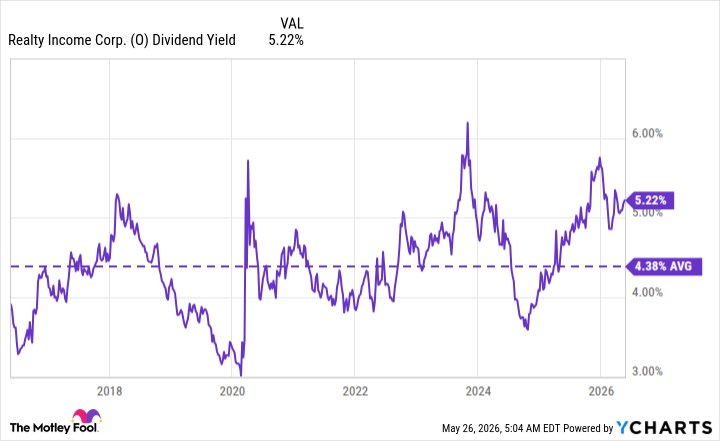
O Dividend Yield data by YCharts
Realty Income routinely has a high dividend yield, but its consistent increases make it a better long-term investment. In March, Realty Income announced its 114th consecutive quarterly dividend increase, and I expect this streak to continue for the long haul.
2. Procter & Gamble
Procter & Gamble (PG +0.23%) (P&G) is one of the more surefire dividend stocks on the market. It’s a Dividend King (a company with at least 50 consecutive years of dividend increases), having increased its dividend for 70 straight years — the fifth-longest streak on the market.
The key to P&G’s sustained success is selling products that sell regardless of economic conditions. It owns household-name brands such as Tide, Pampers, Crest, Bounty, Tampax, Gillette, Old Spice, and dozens of others. Regardless of whether the economy is flourishing or in a recession, people have to brush their teeth, wash their bodies, clean their clothes, clean their homes, and keep up with feminine care.

Today’s Change
(0.23%) $0.33
Current Price
$140.61
Key Data Points
Market Cap
$327B
Day’s Range
$139.03 – $141.07
52wk Range
$137.62 – $168.04
Volume
306.3K
Avg Vol
9.5M
Gross Margin
50.88%
Dividend Yield
3.04%
At its size, P&G won’t be a company that consistently grows revenue by double-digit percentages, but it’ll be a reliable cash cow. In its most recent quarter (ended March 31), P&G generated $21.2 billion in sales, up 7% year over year. Its operating cash flow (cash from its core operations) was $4 billion, more than enough to cover the $2.5 billion in dividends it paid out in the quarter.
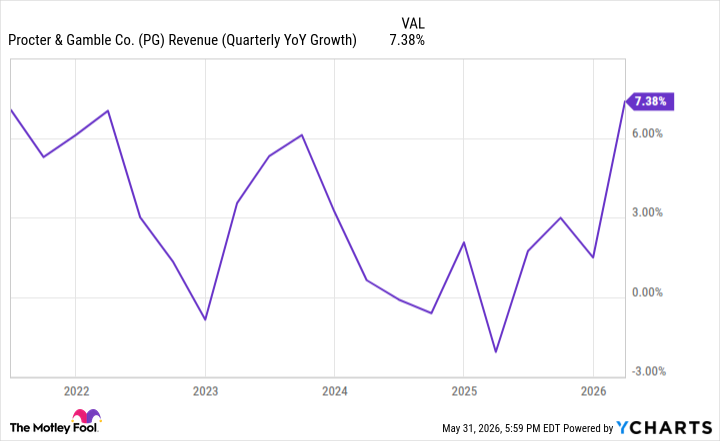
PG Revenue (Quarterly YoY Growth) data by YCharts
You don’t invest in P&G in hopes of “Magnificent Seven” stock-like returns; you do it because you know you never have to second-guess its attractive dividend. Its current dividend yield is nearly 3%, a bit above its 2.5% average over the past five years. It’s a two-for-one benefit: an above-average dividend yield and an all-but-guaranteed annual increase.
Part of having passive income is not having to think too much, and P&G’s stock (and dividend) lets you avoid just that.
