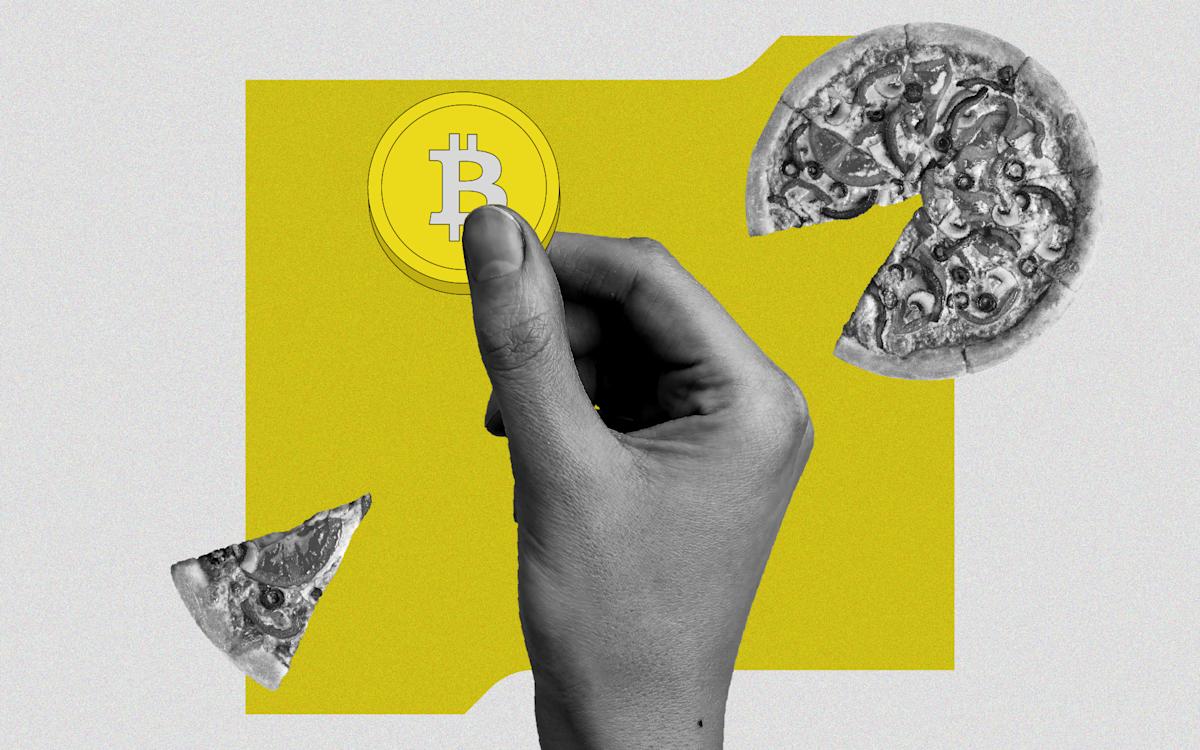
Laszlo Hanyecz’s 10,000 BTC would be worth approximately $772.1 million today, given Bitcoin’s current price of $77,209.86.
The famous 2010 pizza purchase remains the first widely recognized real-world Bitcoin transaction.
Despite the enormous unrealized value, Laszlo has repeatedly said he does not regret the transaction.
Sixteen years ago, a Florida programmer made what is now considered the most expensive food purchase in modern financial history.
On May 22, 2010, Laszlo Hanyecz famously spent 10,000 Bitcoin on two Papa John’s pizzas in what became the first widely recognized real-world Bitcoin transaction. At the time, the coins were worth roughly $41, and Bitcoin itself was little more than an obscure experiment discussed in online cryptography forums.
Today, Bitcoin Pizza Day has become a global crypto holiday celebrated across exchanges, conferences, and online communities. But every year, the same question resurfaces: what if Laszlo had simply held onto the Bitcoin instead of spending it?
With Bitcoin trading at $77,209.86 on Bitcoin Pizza Day 2026, the answer is almost incomprehensible.
Those 10,000 BTC would now be worth approximately $772.1 million.
The figure highlights not only Bitcoin’s meteoric rise over the last decade and a half, but also the extraordinary transformation of digital assets from internet curiosity to globally recognized financial instruments.
The $772 Million Pizza Order That Changed Bitcoin Forever
At today’s market price, Laszlo Hanyecz’s famous Bitcoin transaction has become one of the most iconic examples of unrealized gains in financial history.
The calculation means the two pizzas purchased in 2010 now carry an implied value of more than three-quarters of a billion dollars.
To put that into perspective, $772 million would be enough to:
Purchase multiple luxury real estate portfolios
Acquire a professional sports franchise stake (for instance, Europa League winner Aston Villa is worth $770 million)
Fund a major venture capital operation
Buy several private jets
Generate more than $30 million annually in passive income at conservative yield rates
Yet despite the enormous figure, the transaction remains celebrated rather than ridiculed within the Bitcoin community.
The reason is simple: without early real-world transactions like Laszlo’s pizza purchase, Bitcoin may never have evolved into the global asset it is today.
Back in 2010, Bitcoin had almost no commercial utility. Exchanges were primitive, institutional investors had no interest in digital assets, and very few merchants accepted cryptocurrency as payment.
By spending Bitcoin on an actual product, Hanyecz helped demonstrate that the technology could function as money.
In many ways, the pizza purchase became Bitcoin’s first major proof-of-concept.
Bitcoin’s Rise From Internet Experiment to Global Financial Asset
The appreciation of those 10,000 BTC mirrors Bitcoin’s broader evolution over the past 16 years.
When Laszlo bought the pizzas, Bitcoin traded for less than one cent per coin. Mining could be done on ordinary home computers, and the asset was viewed largely as an experimental project among developers and libertarian technologists.
Since then, Bitcoin has undergone one of the most dramatic price expansions ever recorded.
By 2013, Bitcoin briefly crossed the $1,000 mark, making Laszlo’s holdings worth $10 million in theory. During the 2017 crypto bull market, Bitcoin surged close to $20,000, pushing the value of the pizza coins to roughly $200 million.
The next major wave came in 2021, when institutional adoption accelerated rapidly. Public companies added Bitcoin to balance sheets, exchange-traded products emerged globally, and large asset managers began treating Bitcoin as a legitimate macro asset class. Bitcoin eventually climbed above $69,000 during that cycle.
Now, in 2026, Bitcoin trading above $77,000 has pushed the value of those original 10,000 BTC beyond $772 million.
The rise has been fueled by multiple structural developments, including:
Bitcoin’s market perception has shifted dramatically over the years. What was once dismissed as “internet money” is now discussed alongside gold, sovereign debt, and traditional reserve assets in institutional portfolios.
Why Laszlo’s Transaction Still Matters in 2026
Despite the staggering valuation, many longtime Bitcoin advocates argue that focusing only on the “lost millions” misses the true significance of Bitcoin Pizza Day.
Laszlo Hanyecz himself has repeatedly said he does not regret the purchase.
For early adopters, Bitcoin’s success depended on proving that it could actually be used in commerce. At the time, spending Bitcoin was essential for demonstrating its utility. Without transactions, Bitcoin would have remained merely a theoretical digital token.
The pizza purchase helped establish a real economic use case for decentralized currency.
That symbolic importance has only grown over time. Bitcoin Pizza Day is now celebrated globally with crypto meetups, exchange promotions, NFT launches, Bitcoin-funded pizza giveaways, and educational campaigns about crypto adoption.
The event has evolved into a reminder of how quickly disruptive technologies can reshape financial systems.
It also underscores one of the most difficult realities of investing: transformative innovations are rarely obvious in their earliest stages.
Very few people in 2010 could have realistically predicted that Bitcoin would eventually become a trillion-dollar asset class held by hedge funds, corporations, sovereign entities, and global financial institutions. Even among early believers, almost nobody held their entire Bitcoin position uninterrupted through years of extreme volatility, regulatory uncertainty, exchange collapses, and repeated bear markets.
In hindsight, holding 10,000 BTC appears obvious. In reality, surviving Bitcoin’s 16-year journey required extraordinary conviction.
That is ultimately why Bitcoin Pizza Day continues to resonate across the crypto industry. The story is not simply about a missed fortune. It is about the birth of an entirely new financial system — and the first real transaction that helped bring it to life.