

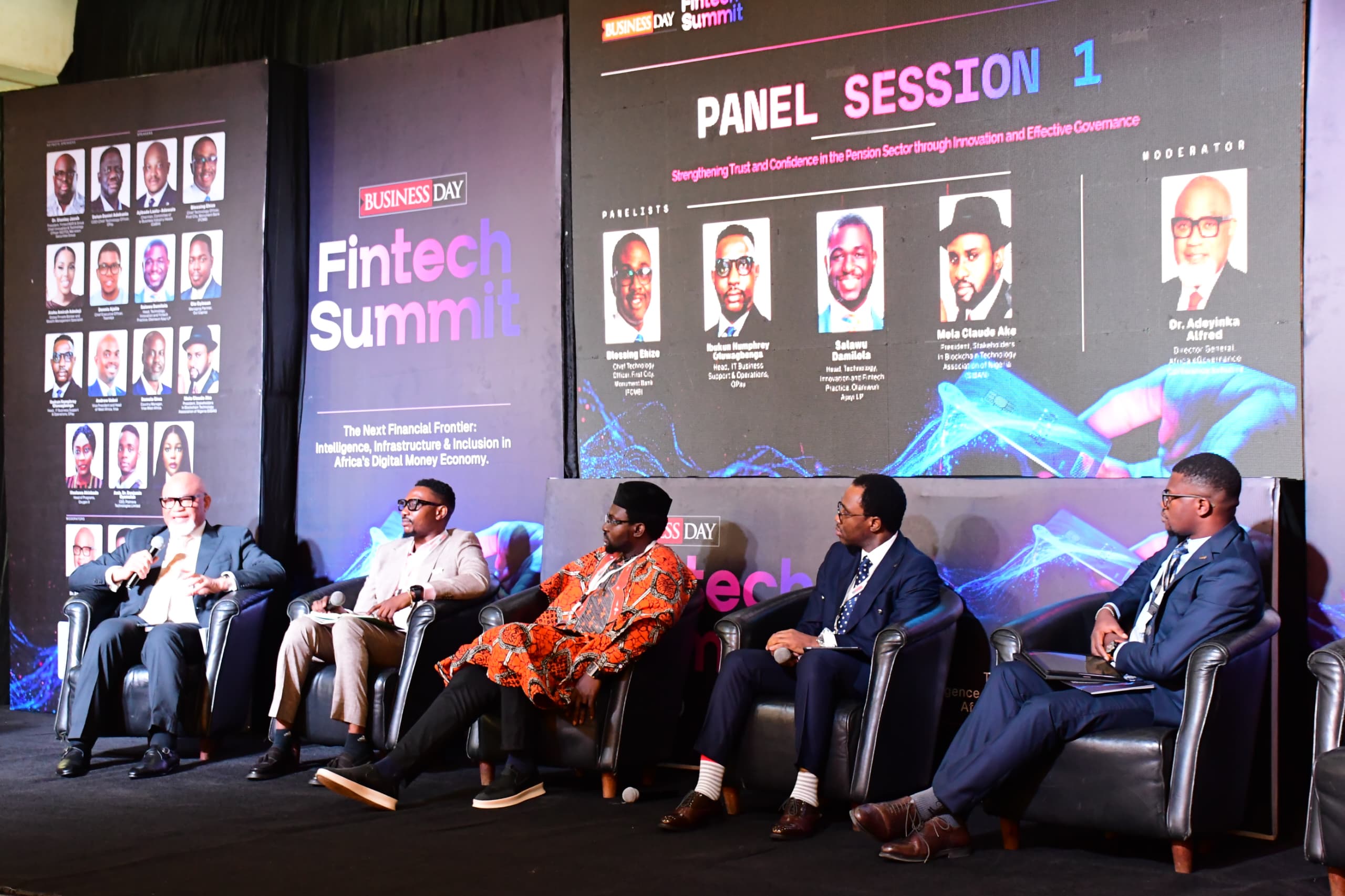
Artificial intelligence (AI), blockchain, and data are rapidly changing how financial services work in Nigeria, even as financial experts warned that governance and regulation are not keeping pace with the speed of innovation.
This was the focus of a panel discussion on “Intelligent Finance: How AI, Data and Automation Are Rewriting Financial Services” at the BusinessDay 2026 Fintech Summit on Wednesday in Lagos, where industry leaders from banking, fintech, law, and blockchain shared insights on the future of the sector.
They agreed that while technology is improving speed, efficiency, and decision-making, governance and regulation must also improve to keep the system safe and trusted.
Blessing Ehize, the chief technology officer of FCMB, said banks are carefully introducing AI into their systems because of the need to maintain stability, security, and compliance.
According to Ehize, banks are not rushing blindly into AI adoption but are embedding it within strong governance structures to ensure accountability.
“Banks are built for trust. So, while AI helps us move faster and make better decisions, it must operate within clear controls and frameworks,” he said.
Ehize explained that before deploying AI, financial institutions must understand the risks, define responsibilities and ensure proper monitoring systems are in place.
Mela Claude Ake, president of the Stakeholders in Blockchain Technology Association of Nigeria (SIBAN), said AI and blockchain are becoming key drivers of innovation in financial services.
He explained that while AI helps analyze data and improve decision-making, blockchain provides transparency and trust.
“AI gives intelligence, but blockchain gives trust. When you combine both, you get systems that are not just smart, but also reliable and verifiable,” he said.
Ake added that blockchain can also help solve one of the major concerns around AI, which is the lack of transparency in how decisions are made.
On governance, Salawu Damilola, head of technology, innovation and fintech practice at Olaniwun Ajayi LP, said financial institutions must rethink their leadership approach to AI.
Damilola noted that boards of companies need to understand how AI works, not just at a basic level, but deeply enough to manage risks such as bias and cybersecurity threats.
“Digital literacy is no longer enough. There must be a clear understanding of how algorithms work and how they affect decision-making,” he said.
Damilola stressed that governance must start from the top, adding that institutions must build strong internal structures to manage AI responsibly.
From the fintech side, Ibukun Humphrey Oluwagbenga, head, IT business support and operations, OPay, explained how AI is already being used in real-time financial operations, especially in payments.
Oluwagbenga said AI helps companies process transactions more efficiently and detect fraud by identifying unusual patterns.
However, he emphasized that AI cannot be left to make decisions on its own.
“You must balance automation with control. AI can guide decisions, but there must always be additional checks like OTP and biometric verification,” he said.
He added that customer trust remains the most important factor, noting that users only care that their transactions are successful and secure.
The panel also highlighted the importance of data as the foundation of intelligent finance. Experts agreed that without proper data strategy, AI and blockchain systems cannot deliver real value.
They noted that financial institutions must invest in building unified data systems that can identify customers accurately across different platforms.
The discussion also touched on regulation, with speakers pointing out that blockchain can help government agencies improve record-keeping and monitoring.
According to them, better use of technology could reduce inefficiencies and improve transparency in the public sector.
Overall, the panel agreed that while AI, blockchain and automation are transforming financial services in Nigeria, success will depend on how well institutions manage the risks.
They warned that without strong governance, the benefits of these technologies could be undermined, making it important for both industry players and regulators to act quickly.
The experts concluded that the future of finance in Nigeria will not just be defined by technology, but by the ability to balance innovation with trust.
