


The stock market can be a strange place.
One month, investors are chasing momentum. The next, they are looking for safety, steady cash flows, and businesses that can hold their ground when sentiment turns.
Thus, dividend-paying stocks come into focus. They may not be the loudest names in the market, but they can quietly do an important job in a portfolio: generate regular income while offering a degree of stability through market cycles.
High dividend stocks deserve a place on every long-term investor’s watchlist.
Companies that consistently pay out a healthy portion of their profits usually have something else working in their favour too: strong cash generation, disciplined capital allocation, and a business model that can weather uncertainty better than most.
In this editorial, we highlight 5 high dividend stocks to add to your watchlist.
Take a look…
#1 Coal India
First on the list is Coal India, a Public Sector Undertaking (PSU) and the largest coal producer in India, accounting for 74-79% of India’s domestic coal production.
The company operates across exploration, extraction, beneficiation, and distribution of diverse coal grades through its vast network of opencast, underground, and mixed mines across eight Indian states.
Currently, the stock has a dividend yield of 6.1%.
Also, it has an uninterrupted dividend track record since its listing, an investor-friendly payout policy, and an essential role in ensuring India’s energy security. The business has strong cash flows and highly stable demand due to long-term Fuel Supply Agreements (FSAs) with the power sector.
It also has a strong balance sheet with substantial cash, a low debt-to-equity ratio which has consistently been below 0.2.
Coal India Stock Price – 1 Year
Data Source: Ace Equity
Looking ahead, the company has an ambitious roadmap to reach 1 billion tonnes of coal production by FY29, rapid diversification into renewable energy with a 3 GW solar capacity target by FY28, and strategic expansion into critical minerals (like lithium and cobalt) and coal gasification.
Management’s focus on capacity expansion, logistical efficiency through mechanized First-Mile Connectivity (FMC) projects, and stringent cost control through the closure of unviable mines and annual workforce reduction should support earnings visibility and dividend sustainability.
#2 REC
Next on the list is REC, a ‘Maharatna’ Central Public Sector Enterprise and one of India’s largest Non-Banking Financial Companies (NBFCs) providing financial assistance across the power sector value chain.
The company operates in the power, renewable energy, and infrastructure & logistics financing sectors and is one of the major players in its space, accounting for an estimated 20-25% market share of the debt raised by state power utilities.
Currently, the stock has a dividend yield of 5.1%.
It has a track record of regular dividend payments, consistent profitability, and high sovereign-aligned credit ratings, ensuring institutional credibility.
The business benefits from stable demand for power infrastructure, strong cash flows, and a highly competitive cost of funds, which support consistent dividend payouts over time.
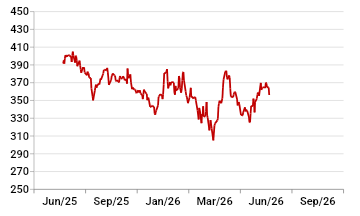
REC Stock Price – 1 Year
Data Source: Ace Equity
Looking ahead, the company is expected to benefit from aggressive expansion into green and renewable energy financing (targeting 30% of its total loan book by 2030), strategic diversification into non-power infrastructure and logistics sectors (such as roads, metro rail, and airports), and its pivotal role as a nodal agency for government initiatives like the Revamped Distribution Sector Scheme (RDSS).
Management’s focus on portfolio expansion, asset quality improvement (reducing Net NPAs to a low 0.38%), and efficient cost control (maintaining an annualised cost of funds at 7.11%) should support earnings visibility and dividend sustainability.
#3 Castrol India
Number three is Castrol India, an automotive and industrial lubricants manufacturer.
The company operates in the automotive, commercial mobility, and industrial lubricants sectors and is one of the leaders in its space, enjoying the #1 market share across automotive categories in India.
Currently, the stock has a dividend yield of 4.7%.
It has a track record of sustainable dividend payouts driven by internal cash accruals, robust operational controls, high capacity utilisation, and a resilient automotive business.
The business has strong cash flows, stable demand across mobility and industrial sectors as well as zero debt, which supports consistent dividend payouts over time.
Coming to its financial performance, the company has delivered a top-line growth of 14% compounded annual growth rate (CAGR) over 5 years and a net profit CAGR of 10%. The last 5-year average return on equity (ROE) has been 45%.
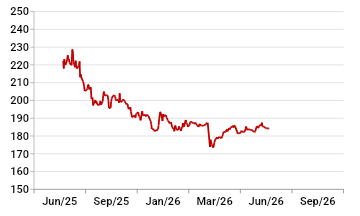
Castrol India Stock Price – 1 Year
Data Source: Ace Equity
Looking ahead, the company is expected to benefit from aggressive expansion in rural markets (targeting the next 50K outlets), broadening participation in industrial lubricants and data center cooling infrastructure, and adjacencies in auto care and Castrol Auto Service networks.
Management’s focus on disciplined execution, efficiency through supply chain cost control, and new product innovations (such as EV fluids and Re-Refined Base Oil engine formulations) should support earnings visibility and dividend sustainability.
#4 Infosys
Fourth on the list is Infosys, a global leader in AI-first business consulting and technology services.
The company operates in the information technology (IT) services sector and is one of the leaders in its space, ranking as the second-largest listed Indian IT services company.
Currently, the stock has a dividend yield of 4.5%.
It follows a robust Capital Allocation Policy to return approximately 85% of its free cash flows to shareholders, generates strong free cash flows, and maintains a highly liquid, AAA-rated balance sheet.
The business has from strong cash flows and zero debt, which supports consistent dividend payouts over time.
For Infosys, AI is both an opportunity and a risk. The risk is that more routine software development, maintenance, testing, support, and process work can be automated over time, which could put pressure on billing models and client budgets.
The bigger long-term concern is not that AI removes the need for IT services altogether, but that it changes the mix of work toward fewer low-end tasks and more outcome-based, higher-value work.
That means firms like Infosys will have to keep upgrading their offerings, pricing, and delivery model or risk slower growth and margin pressure.
This is an inference, but it follows directly from Infosys’s own commentary that clients are moving toward AI-led transformation and that AI is increasingly tied to process improvement, engineering, customer service, cybersecurity, and employee productivity.
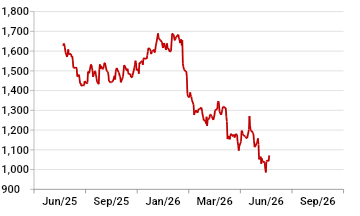
Infosys Stock Price – 1 Year
Data Source: Ace Equity
Looking ahead, the company is expected to benefit from rapid expansion in AI-first services through Infosys Topaz (tapping into an estimated US$ 300 bn opportunity), sustained momentum in large deal wins (recording US$ 14.9 bn TCV in FY26), and strong capabilities in cloud transformation via Infosys Cobalt.
Management’s focus on margin improvement through ‘Project Maximus’, expansion into generative AI and agentic platforms, and operational efficiency via cost control and optimised delivery mix should support earnings visibility and dividend sustainability.
#5 Crizac
Fifth on the list is Crizac, a B2B global education platform that offers international student recruitment by connecting students, recruitment agents, and universities.
The company operates in the global education services sector and is one of the leading players in its space, facilitating hundreds of thousands of applications worldwide.
Currently, the stock has a dividend yield of 4%.
It generates sustainable cash flows, operates on a highly scalable asset-light model, and has initiated a strong dividend payout policy (64% of its net profit in FY26).
The business has from low working capital intensity, strong cash flows, and a debt free balance sheet, which supports consistent dividend payouts over time.
Coming to its financial performance, the company has delivered a top-line growth of 56% CAGR over a 5-year period and a net profit CAGR of 60%.
The last 5-year return on equity (ROE) has been 48%.
Its massive distribution reach, connecting over 5,389 active agents, 400+ partner universities, and processing 3.94 lakh applications across 85+ source countries further adds to the stability of its earnings profile.
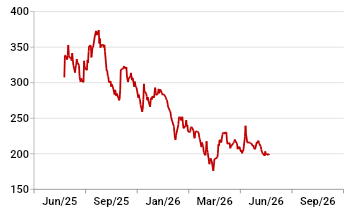
Crizac Stock Price – 1 Year
Data Source: Ace Equity
Looking ahead, the company is expected to benefit from destination diversification into markets like Australia and New Zealand, expansion into emerging source markets like Africa and Latin America, and the monetisation of ancillary services like student loans and accommodation.
Management’s focus on inorganic growth through strategic acquisitions, technological integration, and leveraging its platform for margin expansion should support earnings visibility and dividend sustainability.
Conclusion
In the end, high dividend yield stocks are not just about the income they generate today. They are about the kind of businesses that can keep generating cash through different market cycles and reward shareholders along the way.
That does not mean every high-yield stock is automatically a good investment. A large dividend can sometimes reflect genuine strength, but at other times it can also be a sign that the market is discounting slower growth or greater risk.
That is why dividend yield should always be viewed alongside business quality, balance-sheet strength, payout sustainability, and the company’s long-term growth outlook.
The five companies discussed above may not always lead the rally, but they have the financial strength and cash-generating ability that tends to hold up when conditions become uncertain.
Staying invested across cycles often matters more than chasing the fastest returns in a single phase.
Investors should evaluate the company’s fundamentals, corporate governance, and valuations of the stock as key factors when conducting due diligence before making investment decisions.
Happy investing.
Disclaimer: This article is for information purposes only. It is not a stock recommendation and should not be treated as such. Learn more about our recommendation services here…
The website managers, its employee(s), and contributors/writers/authors of articles have or may have an outstanding buy or sell position or holding in the securities, options on securities or other related investments of issuers and/or companies discussed therein. The content of the articles and the interpretation of data are solely the personal views of the contributors/ writers/authors. Investors must make their own investment decisions based on their specific objectives, resources and only after consulting such independent advisors as may be necessary
