

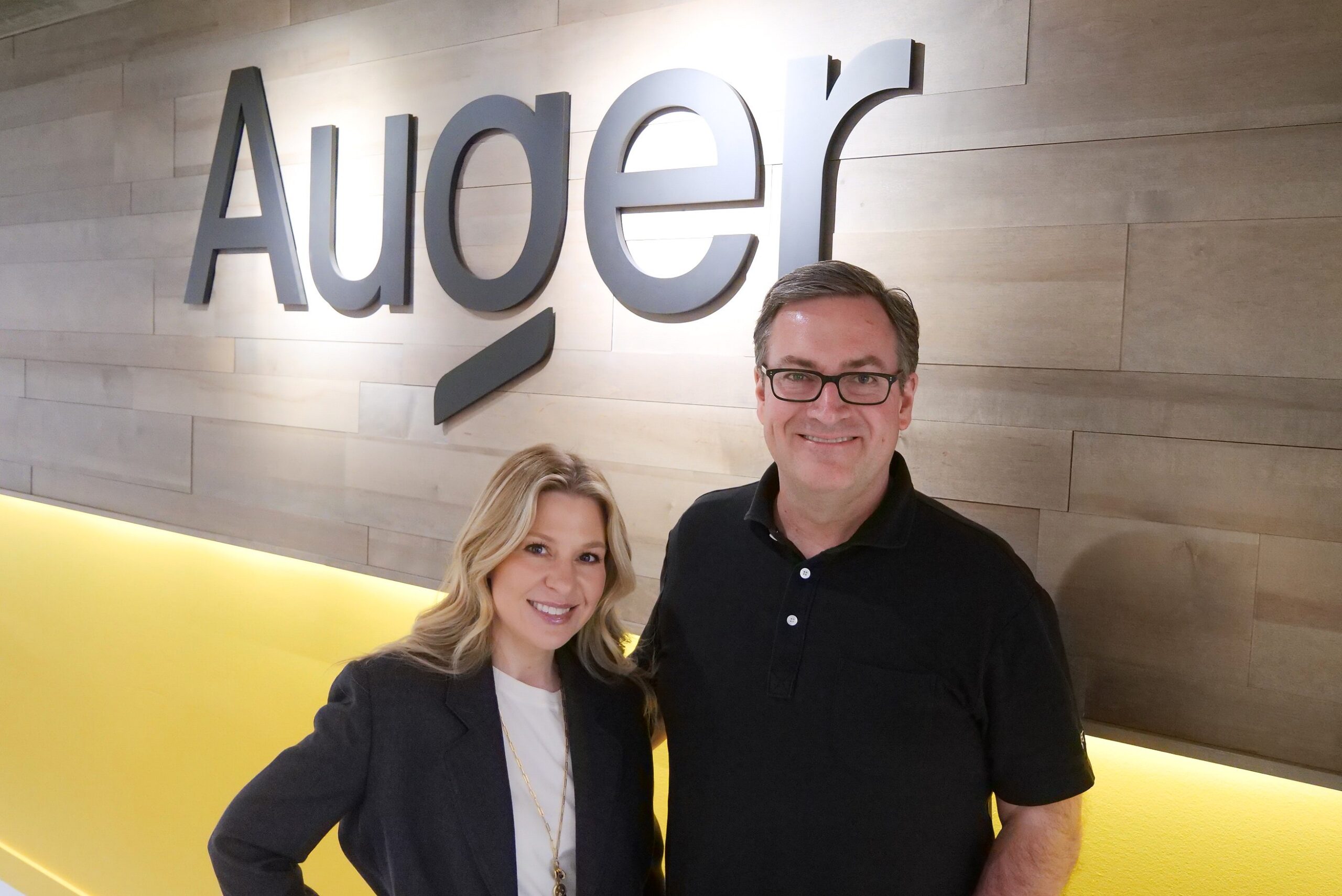
While investors spent much of the spring concerned that frontier AI models from companies like Anthropic and OpenAI would consume the software industry, Dave Clark was closing a funding round for exactly the kind of enterprise software those models are supposedly going to replace.
Auger, the supply chain technology startup founded in Bellevue, Wash., by the former Amazon executive, has raised $50 million in Series B funding led by Eclipse, with existing investor Oak HC/FT also participating in the new round.
The round brings total funding to $150 million for the company, which has grown to about 130 employees and counts Meta’s virtual and augmented reality division, sports merchandise giant Fanatics, and consumer products maker Kimberly-Clark among its customers.
Clark’s view is that general-purpose AI can generate insights but can’t handle deeply specialized domains like running a supply chain. Making financial and operational decisions and executing them at the scale of big companies requires systems built on strong supply chain expertise — what Auger calls its ontology, essentially a detailed map of how supply chains actually work.
“Many a pure technology company died on the hill of supply chain over the last decade,” said Clark, the company’s CEO, in an interview this week. “You really need to understand the complexity and the contextual requirements.”
Auger sits on top of a company’s existing systems — ERP, warehouse management, transportation management, and demand planning tools — and unifies the data into a single operating layer. Rather than replacing those systems, it connects them, using AI agents and traditional optimization models to make decisions and execute them automatically, as much as possible.
For example, in a recent demo at the company’s Bellevue office, Clark showed how the system would handle a supplier missing a delivery commitment when there isn’t enough product to go around. Auger identifies the shortfall, determines which customers get priority, reallocates inventory, and pushes the updated plan back to the company’s existing systems.
Most supply chain software, Clark said, generates alerts and waits for a person to act. Auger is designed to make routine decisions on its own and flag the exceptions for human review.
“We’re not really a tool,” he said. “We’re really the new employee.”
At Fanatics, the sports merchandise company, Clark said about 85% of decisions in the process Auger manages are happening autonomously, with a goal of reaching the mid-90s soon. In addition to the customers it has named so far, Clark said another eight to 10 companies are in contract negotiations or pilot programs.
Clark spent 23 years at Amazon, rising to lead the company’s worldwide operations and later its worldwide consumer business. He left in 2022 and became CEO of Flexport, the freight forwarding startup, but that tenure lasted less than a year amid a turbulent period for the company.
He launched Auger in 2024 with a team that includes Leigh Anne Clark, his wife, who serves as co-founder and president of the company’s fashion and beauty division, focused on an industry Clark describes as one of the most wasteful supply chains outside of groceries.
Clark moved back to the Seattle area from Texas to tap the region’s talent pool, and raised a $100 million Series A from Oak HC/FT. The company quickly assembled a C-suite drawn heavily from Amazon’s senior ranks, along with leaders from Johnson & Johnson, Microsoft, and Salesforce, spanning supply chain operations, AI, data science, and product development.
In March, Auger was named a premier supply chain partner on Microsoft Fabric, the tech giant’s data platform. Auger’s product is built on Azure, and Microsoft sales reps can earn commission on Auger deals. Clark said the partnership has generated engagement but is still early.
Clark said Auger went out for the Series B early, before the company needed it, to avoid the distraction of fundraising during what he expects to be a busy fall of customer onboarding.
With the investment, Eclipse partner Jiten Behl joined the Auger board, which also includes Clark, president and CFO Alex Ceballos, and Oak HC/FT’s Matt Streisfeld.
Auger hasn’t disclosed revenue or other financial metrics, but Clark said the valuation was roughly double the level set by Auger’s initial round. “We didn’t shoot for the crazy astronomical valuation,” he said. “We sat at a place that we felt really comfortable with.”
That pragmatic approach extends to how Auger operates. In Bellevue, the company works out of an office it subleased after Microsoft vacated the space. Auger kept the desks, monitors, and chairs the tech giant left behind, furnishing its new offices for next to nothing.
But Clark’s ambitions for the company are anything but modest. He said Auger’s goal is to have half of U.S. GDP flowing through its platform by 2030, with revenue exceeding $1 billion.
“That requires a pretty steep curve to get there,” he said. “We’re not playing small.”
