

By CHRISTOPHER RUGABER, AP Economic Writer
WASHINGTON (AP) — The Federal Reserve has for decades moved steadily from a remote, opaque government agency that shared little about what it did or why to a more transparent institution willing to explain how it makes decisions and what it thinks about the economy.
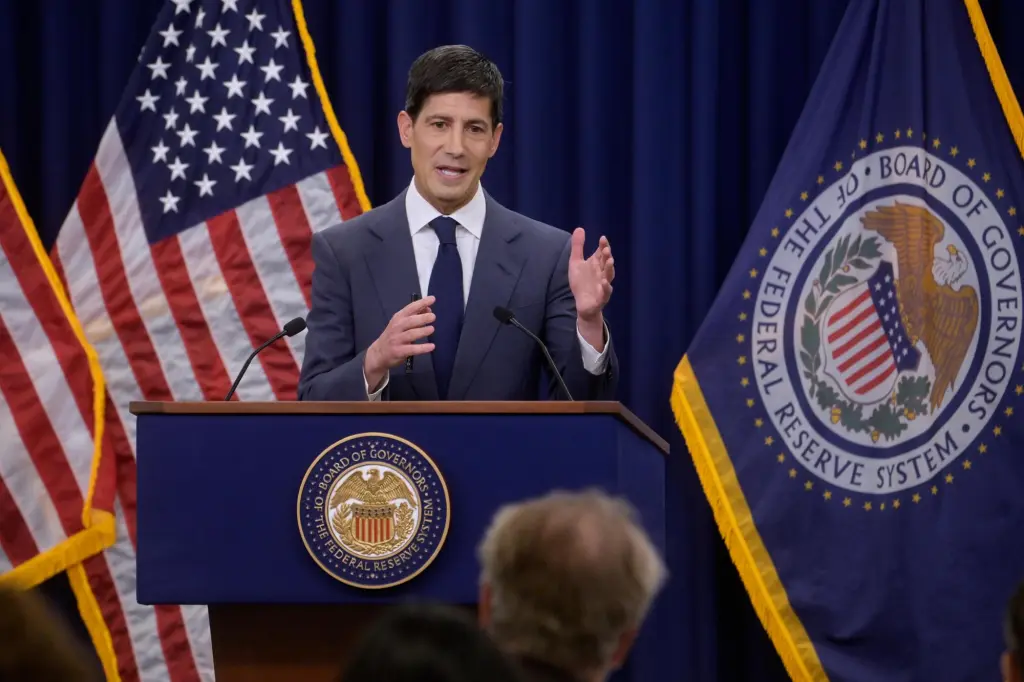
But in his first news conference last Wednesday, new chair Kevin Warsh began to reverse some of those steps. Warsh, like many economists, thinks the financial markets have become too dependent on Fed guidance, and that such direction is more effective in financial crises or economic downturns.
Warsh’s changes to the Fed’s communications represent something of a return to former chair Alan Greenspan’s circumspect approach. Greenspan died at 100 on Monday. He is the only former chair Warsh praised at his swearing-in last month.
As chair, Warsh has rapidly delivered on his promise to slash the Fed’s communications. He sharply cut the central bank’s post-meeting statement and underscored at the news conference the removal of the guidance it formerly gave to financial markets about the Fed’s next interest-rate moves. Yet such an approach carries the risk of more violent swings in stock and bond prices, analysts say, and ultimately could lead to higher interest rates for consumers and businesses.
“Forward guidance in general has served to suppress volatility and anchor market expectations,” said George Pearkes, global macro strategist at Bespoke Investment Group. “And that has led to lower borrowing rates, relative to alternatives.”
Still, the impact on consumers is likely to be modest, Pearkes added, with mortgage rates perhaps a quarter-point higher than they would be otherwise.
Warsh may be headed back to 1990s
Such swings could be a sign of things to come. Previous chairs have signaled the Fed’s next moves clearly enough that financial markets have largely anticipated the central bank’s actions. But Warsh appears to be following Greenspan, whose oracular comments often kept investors guessing.
Yet Greenspan, who served as chair from 1987 to 2005, also ushered in several changes that made the Fed more transparent. He began the practice of issuing statements after each Fed meeting to announce its interest-rate decision. He also began publicly releasing the minutes of each meeting and the full transcripts, after a five-year delay, though those moves came in response to pressure from Congress.
The first statement was issued Feb. 4, 1994, and said the Fed would increase its key rate for the first time in five years. The move caught investors off-guard and the Dow Jones Industrial Average plunged 2.4% that day.
The paring back of Fed communications is part of a larger package of potential reforms to the central bank’s operations that Warsh signaled Wednesday. He announced that the Fed will set up five task forces to examine the Fed’s communications, its balance sheet, how it analyzes and gathers economic data, the impact of AI on productivity and jobs, and the frameworks it uses to analyze inflation.
Warsh said the communications task force would consider changes to the quarterly economic projections the Fed issues as well as look at other recent innovations, including press conferences. Former chair Ben Bernanke was the first to hold them, though he did so only after every other Fed meeting. Warsh’s predecessor, Jerome Powell, shifted to holding them after every meeting.
Such steps were a sharp contrast with the 1990s, when Greenspan never explained a Fed decision, on the record, to reporters. Warsh could ultimately dial back some of the Fed’s increased transparency.
“This is a big change in how the Fed has conducted itself since the (2008-2009) global financial crisis,” Matthew Luzzetti, chief U.S. economist at Deutsche Bank, said. “Since then there has been a one-way train to greater communication, more transparency, and more forward guidance. Warsh has now put that train in reverse.”

Fed chairs have seen benefits to forward guidance
Previous Fed chairs, starting with Bernanke, have seen a clear benefit to more communication: It helps guide the markets in the direction the Fed wants. Fed officials control a short-term interest rate, but the rates that affect the economy — such as the yield on the 10-year Treasury — are heavily influenced by investors’ expectations for inflation and economic growth. By telegraphing their next moves, policymakers can cause those longer-term rates to change even before the Fed adjusts its own benchmark rate.
Yet Warsh’s view is that financial markets have become too dependent on Fed guidance. Instead, he wants investors to gauge where the Fed may move next by examining economic data and making their own judgments, which the Fed can then consider as part of their assessments of where the economy is headed.
“Financial market prices are probably the most important source of information to guide central bankers,” Warsh said at Wednesday’s news conference.
Guidance can help with unexpected events
David Andolfatto, an economics professor at the University of Miami and former economist at the St. Louis Fed, said he agreed with Warsh that forward guidance has flaws. It can be easily upended by unexpected events, he said, such as Russia’s invasion of Ukraine or the Iran war.
But the chair should set out guidelines for how the Fed will react to unexpected events, Andolfatto said, or to challenges such as the persistent inflation it is grappling with now, yet Warsh so far hasn’t done so.
“I’m with him on dispensing with forward guidance, but you have to replace it with a contingency plan,” Andolfatto said. “It’s not enough to say, trust me, we’ll keep inflation at target.”
Ironically, Warsh’s decision to drop forward guidance may empower the other 18 members of the Fed’s rate-setting committee, Pearkes said. Those officials — six members of the Fed’s governing board, plus the presidents of the 12 regional Fed banks — frequently give public speeches, and their remarks will get even more attention as financial markets seek clues about what the Fed may do next.
A big challenge to Warsh’s approach will come if there is a sharp financial downturn or economic crisis, as occurred during the COVID pandemic. In those circumstances, economists said, forward guidance can play an important role calming markets.
“Whether it will stand the test of time and he will behave this way for five years is a very different question, but one that we’re going to have to wait for events to unfold to get an answer to,” Pearkes said.
