Below is a recap of Blockspace Live, a daily livestream on AI/HPC, data centers, Bitcoin and more.
On today’s Blockspace Live, Colin Harper and Charlie Spears discuss the SpaceX IPO mania, CoreWeave’s planned $3.5 billion senior unsecured note, OpenAI’s ban on China-linked influence accounts targeting U.S. data center debates, and falling AI token prices. The main conversation focused on longtime data center journalist Rich Miller, who joined the show after touring TeraWulf’s Lake Mariner facility in New York.
AI and Bitcoin’s daily show: Subscribe to Blockspace Live here, on Apple, Spotify, YouTube, or anywhere you listen to podcasts.
Miller, who has covered the data center industry for roughly 25 years, said the sector’s center of gravity changed after Northern Virginia’s Data Center Alley ran into power constraints in 2022. For years, data centers followed network connectivity and built near major internet hubs. Once the industry began running out of power in its most important market, Miller said the strategy shifted toward following power instead.
That change helped explain why bitcoin miners suddenly became relevant to AI infrastructure. Miners had spent years finding cheap land, large power positions and non-traditional sites that were not necessarily close to major network markets. As AI companies began looking for massive blocks of capacity, those same sites became far more valuable.
Miller said the emergence of ChatGPT in late 2022 added another layer to that shift. By mid-2023, it was clear that AI customers would need large amounts of capacity, and many crypto mining companies were already sitting on the type of power access that traditional data center developers were chasing.
TeraWulf’s Lake Mariner
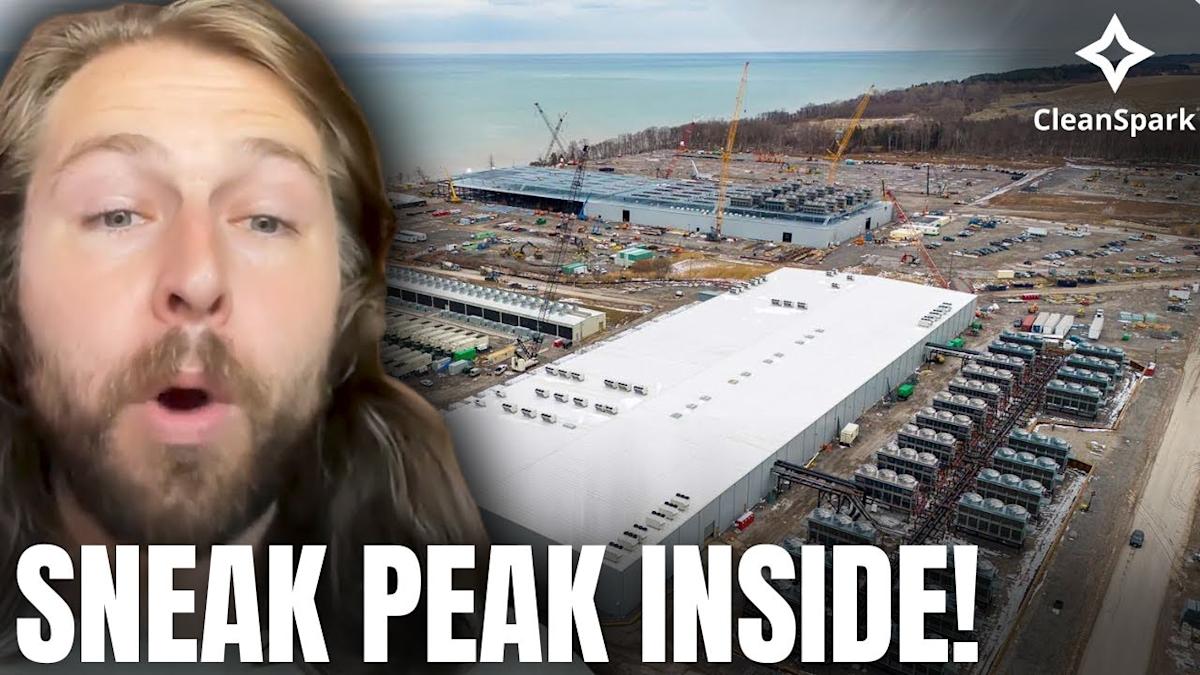
The clearest example from Miller’s recent reporting was TeraWulf’s Lake Mariner campus along Lake Ontario. Miller said the former coal plant site shows how companies are using legacy industrial infrastructure to build new AI capacity. The site already had a substation and transmission lines because it had previously sent power onto the grid, giving TeraWulf a head start compared with developers trying to secure new utility connections from scratch.
AI and Bitcoin’s daily show: Subscribe to Blockspace Live here, on Apple, Spotify, YouTube, or anywhere you listen to podcasts.
Miller described Lake Mariner as a construction site operating at a scale and pace he does not typically see in traditional data center tours. TeraWulf and Fluidstack are building two large data centers at the same time, each roughly 330,000 square feet. He said the project is running around the clock, with about 300 staff between TeraWulf and Fluidstack and another 1,200 to 1,600 contractors on site on a given day.
The discussion also covered the labor bottleneck facing the data center industry. Miller said many workers on major data center projects are brought in from outside the local area because there are not enough qualified construction workers to meet demand. He said the issue is becoming more important as hyperscalers and AI infrastructure developers build larger campuses over longer periods, sometimes keeping workers in a community for several years.
Miller said community relations have become one of the industry’s biggest challenges. Data centers can bring major tax benefits, but they do not create as many permanent jobs as other large industrial projects because the facilities are highly automated. During construction, however, they bring large numbers of workers into a community, creating a complicated economic development tradeoff.
At Lake Mariner, Miller said early concerns around TeraWulf’s crypto mining operations focused on noise. As the site has shifted toward AI, he said the main concern has become water use. TeraWulf has said it uses a closed-loop system, which is designed to recirculate water rather than continuously draw and evaporate it, but Miller said water remains a flashpoint for data center opposition more broadly.
Bitcoin miners to AI
Miller also said the crypto-to-AI pivot is not automatic. Bitcoin miners have an advantage if they control power, but AI data centers require different operating standards, more sophisticated customer relationships and specialized talent. He said companies making the transition need to understand not just mining infrastructure, but the additional requirements that come with serving AI and hyperscale customers.
Still, Miller said the gap between bitcoin miners and traditional data center operators has narrowed quickly because so many companies are aligned around bringing new AI capacity online. He pointed to vendors, customers and infrastructure partners helping former mining companies move up the value chain faster than many expected.
The show closed the data center discussion with the broader political and social backlash against AI infrastructure. Colin and Charlie noted that opposition to data centers is increasingly bipartisan and cuts across different communities, while Miller said the industry has to listen more carefully as local conversations become more difficult. His takeaway was that developers can no longer rely only on local officials; they need to convince communities that they plan to be long-term, responsible neighbors.