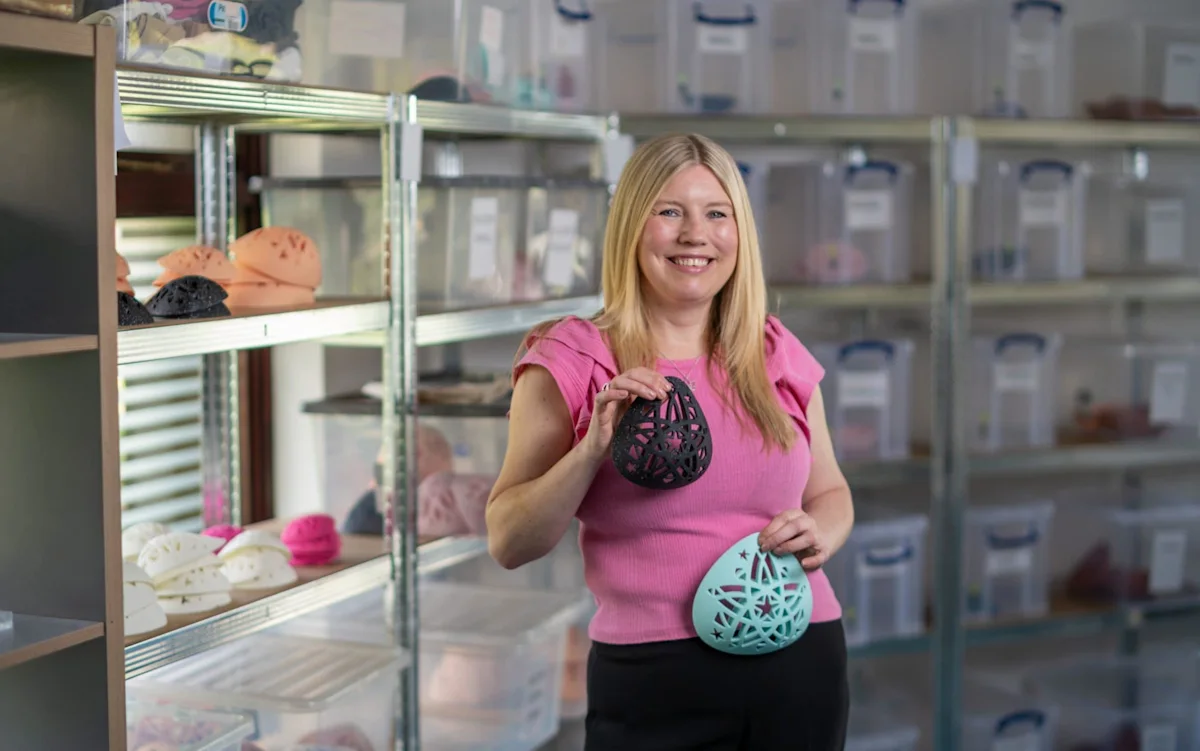
Samantha Jackman’s company Boost, a breast prosthesis business, started off as a side hustle but now makes £30,000 a month – Jim Wileman
Have you made a drastic career change? Share your story by emailing money@telegraph.co.uk
Samantha Jackman was working in education and the arts when she first had the idea for Boost, a breast prosthesis business inspired by her mother’s experience after breast cancer.
Her mother, Sue, had her left breast removed as part of her treatment 18 years ago and was given a prosthesis by the NHS, but it did not work for her.
“The prosthesis that they’d given her was hot, heavy, sweaty and uncomfortable for her to wear,” says Jackman, 42, from Cornwall.
Sue said: “I’m not replacing the breast I’ve lost. I just need something under my clothes to give me the shape. I don’t need it to remind me of the flesh of the breast that I’ve lost every time I put it on.”
Samantha Jackman’s company supplies breast prostheses to woman – Jim Wileman
Jackman began speaking to breast cancer support groups across Devon and Cornwall, consulting around 160 women. The general consensus was that they wanted more options, and many said they wanted something similar to what her mother had described.
At the time, she was working full-time at an art college. But she soon moved into part-time museum consultancy so she could develop the business while still earning enough to pay the bills.
Now, Boost makes as much as £30,000 a month, and Jackman is looking at an international expansion.
She is one of a growing number of people who have turned their so-called “side hustle” into a successful business.
Side hustles boomed during the pandemic, when many people were looking for supplemental income and something to fill the time during successive lockdowns.
To get the company off the ground, Jackman worked multiple jobs during lockdown and raided her savings, using the money to fund patents and legal costs.
The business later secured investment from the British Design Fund in late 2021, allowing Jackman to make Boost her full-time job. “That was the turning point when I was able to get an income from doing this,” she says.
She initially paid herself just below £40,000 a year, similar to her museum salary.
Samantha Jackman is looking to take Boost global – Jim Wileman
Today, Boost has moved into its first proper premises in Liskeard, Cornwall, and Jackman employs five staff. The company is now looking at NHS partnerships and expansion, including into Australia and the United States.
“Now we can make £15,000 to £30,000 a month. Our products sell better when the weather is warmer so some months are quieter than others,” she says.
Despite the pressure, she says the work has transformed her life. “I don’t have to have a proper job any more. I can bring my dog to work.”
Her proudest achievement is spotting a gap in the market and creating something that did not previously exist. Her advice to others considering starting a side hustle is to take the leap, but carefully.
“Take the risk, but make sure they’re calculated risks and they work for you,” she says.
A huge 46pc of British adults have a side hustle as an additional source of income, according to comparison site Finder, making an average of £872 a month.
And it is much more popular with younger people, with two thirds of Gen Z and three in five millennials doing extra work on the side, compared to just 23pc of baby boomers.
Amid higher living costs and stagnant wage growth, many households are looking for inventive ways to boost their income.
But for some, an idea simply comes from spotting a gap in the market.
‘I earned £200 some weeks’
Richard Dyer, 43, and Ben Sebborn, 45, founders of Skiddle, first met online in the early 2000s. Their idea was very simple – a “what’s on” guide for events, which users could add to themselves, paired with a ticket-buying platform.
In the early days, money was tight. “I earned £200 some weeks. It wasn’t a lot,” Dyer says. Sebborn was still working his full-time job in web design earning around £20,000 a year, using it to fund the business and pay his mortgage.
“Every month we’d take a look and see if there was enough for me to finish my job and start doing Skiddle as well,” says Sebborn.
Then in 2009, he took the leap and quit his job. “It was becoming so popular and I took a chance. It was a risk and I took a bit of a pay cut to do it. I thought, ‘If we don’t do it now, when are we going to do it?’ And we’ve not looked back.”
Richard Dyer (L) and Ben Sebborn have been in business together for decades – Mark Waugh
They were given help by a government-funded service which no longer exists, called Business Link, to help write a business plan and they were using credit cards to fund the expansion, without help from investors.
Sebborn admits they have been envious seeing other ticketing start-ups receive money from venture capital firms to recreate what they did 20 years ago.
“It’s always been mine and Rich’s money, and we’ve been very cautious about spending it. And although we’ve had a slower route to where we are now, it’s probably been a lot steadier. Plus, many of those competitors aren’t here anymore.”
Today, Skiddle sells around 10 million tickets a year, with total ticket sales reaching £181m in 2025.
Their advice to others starting out? For Sebborn, the key is instinct. “You very quickly work out if there’s a fit between what you’re doing and what people want,” he says.
‘If you don’t try, you don’t know’
For Ryan Lord, from Waltham Forest, London, his business started after he was laid off from a low-paid job in sales.
The 29-year-old was living off savings and had around three or four months’ worth of cash in the bank.
At the time, he had a podcast where he would interview entrepreneurs and founders, and he filmed street-style videos asking people what they did for a living, which he paid for out of his own savings.
His first break came from a contact he had interviewed, who was launching a new fragrance line. He asked Lord to go out with his fragrances and ask people for their opinion. “He was my first client,” Lord says.
Initially he did not earn very much – around £150 for the day. But as demand grew for the bespoke marketing service, so did his rates. He now charges around £5,000 for a shoot, depending on the project.
Ryan Lord started his business after he was laid off – Christopher Rogers
He uses freelance platform Fiverr to connect with clients, helping to grow his business into a full-time job.
Fiverr helps connect businesses with clients, charging a 20pc fee on jobs which are sold through the platform.
Lord uses it to run his street interview agency, Saint Lord Media, with a network of over 40 freelancers, and has worked with brands including Amazon Prime.
Since starting on the platform in July 2024, he has made around £75,000, and has plans to keep growing and expanding the business, potentially signing clients up to retainer-style contracts.
For Lord, the key is that he now has time, freedom and creative control over his work.
His advice to others is simple: “Do something that you’re passionate about … and think about how you can bring value to the marketplace.