

You can find original article here WealthManagement. Subscribe to our free daily WealthManagement newsletters.
In spite of recent geopolitical volatility, driven by the wars in Ukraine, Gaza and Iran, global financial markets have proven remarkably resilient to the impacts of various destabilizing events of the past several years, according to Robert D. Kaplan, a long-time Atlantic reporter and author of 24 books on foreign affairs.
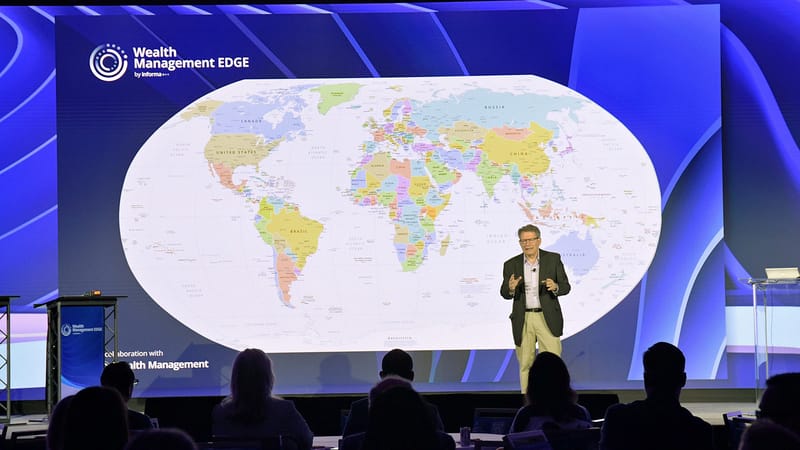
Yet if U.S. and China were to get into a military conflict over Taiwan, it would likely be akin to an “extinction event” for the global financial world, the effects of which the Federal Reserve would struggle to alleviate, Kaplan warned during a keynote address at the Wealth Management EDGE conference at The Boca Raton resort in Boca Raton, Fla., this week.
Thanks to technological advancements, including easy air travel and social media, which spreads news from distant places in a matter of minutes, often with more passion than accuracy, the world has become more anxious and claustrophobic than it’s ever been, Kaplan said.
“Stock market movement in one part of the world can affect the stock market in another,” he said. Yet neither the COVID-19 pandemic nor the major unexpected wars in Europe and the Middle East has had much impact on how well U.S. financial markets have performed.
“It’s impressive the ways that financial markets have priced in these wars,” Kaplan said.
But given the importance of semiconductors to the global economy and all the commercial traffic that passes through the South China Sea, a U.S. war with Taiwan would be an exception to that pattern.
“You will be affecting the world’s most important lines of communication,” Kaplan said.
In his view, neither the U.S. nor the Chinese leadership has an interest in seeing that scenario come to pass. But he cautioned that the desire to avoid a war alone is not enough to prevent it from happening, pointing to the example of World War I, which was driven by Germany’s miscalculation that Great Britain wouldn’t come to the aid of France and Belgium. That’s why U.S. needs “policy discipline,” with the U.S. government sending a consistent message to China, whether it takes a hard or a soft line on China’s potential aggression toward Taiwan, avoiding any room for a similar miscalculation.
“We don’t want to confuse the Chinese,” Kaplan said. Against that backdrop, President Donald Trump’s comments suggesting that U.S. might use Taiwan as a bargaining chip set a dangerous precedent.
