


Bitcoin (BTC) trades slightly lower on Tuesday after encountering resistance near $64,000, a key technical barrier that is capping its recovery. Institutional demand remains subdued, with spot Bitcoin Exchange Traded Funds (ETFs) continuing to record net outflows, while Strategy (MSTR) added 1,550 BTC to its reserves on Monday. Meanwhile, market sentiment improved slightly after Iran and Israel halted a military escalation following an exchange of strikes, but it failed to lift BTC’s near-term recovery.
Institutional selling continues
Institutional demand continues to fall as the week begins. SoSoValue data shows that spot BTC ETFs recorded an outflow of $91.37 million on Monday, following their fourth consecutive week of billions in weekly outflows. If this trend continues, BTC could see further correction this week.
As explained in the previous report, on Sunday, Michael Saylor posted “32?” on his X account, a cryptic message hinting at the recent sale of exactly 32 BTC, continuing his long-standing accumulation strategy. Then, on Monday, Strategy announced it had acquired 1,550 BTC, bringing total holdings to 845,256 BTC.
In an exclusive interview, Nicolai Sondergaard, Research Analyst at Nansen, told FXStreet that “It is too soon to tell whether Strategy’s 1,550 BTC purchase at $65,332 signals a clean resumption of the flywheel, or a response to a balance sheet that is tighter than it looks.”
Sondergaard continued that the company carries roughly $22 billion in total obligations, convertible debt and perpetual preferred, against software revenue of around $500 million a year. The STRC dividend burden alone runs approximately $1.2 billion annually. The 32-coin sale confirmed that the gap is now occasionally funded by Bitcoin. The buyback was the right tactical move, and the mNAV flywheel holds as long as STRC issuance continues, but that requires the premium to hold, and the premium requires Bitcoin to hold.
Easing Middle East tensions fail to lift BTC price
Iran announced on Monday that it had ended its military operations against Israel after both sides exchanged attacks across multiple fronts over the weekend.
However, the de-escalation appears fragile as Iran’s central military command warned that if Israel continued to attack, including in southern Lebanon, “much harsher and more crushing actions than before will be on the way,” the semi-official Fars news agency reported.
Adding to the uncertainty, the Israeli military “issued an evacuation alert in southern Lebanon on Tuesday, warning people in one of the area’s largest cities of imminent strikes against the Iran-backed militia Hezbollah, a day after Israel and Iran pulled back from direct confrontation,” as per The New York Times.
Meanwhile, US President Donald Trump said on Tuesday that a proposal for a potential agreement with Iran could be presented within days, according to Reuters.
These developments have marginally eased concerns about a broader regional conflict. However, the geopolitical risk remains uncertain. As a result, the improvement in risk sentiment has been insufficient to spark a recovery in risky assets such as Bitcoin, which continues to face pressure, trading below $64,000 as of Tuesday.
Bitcoin Price Forecast: Faces rejection from key resistance zone
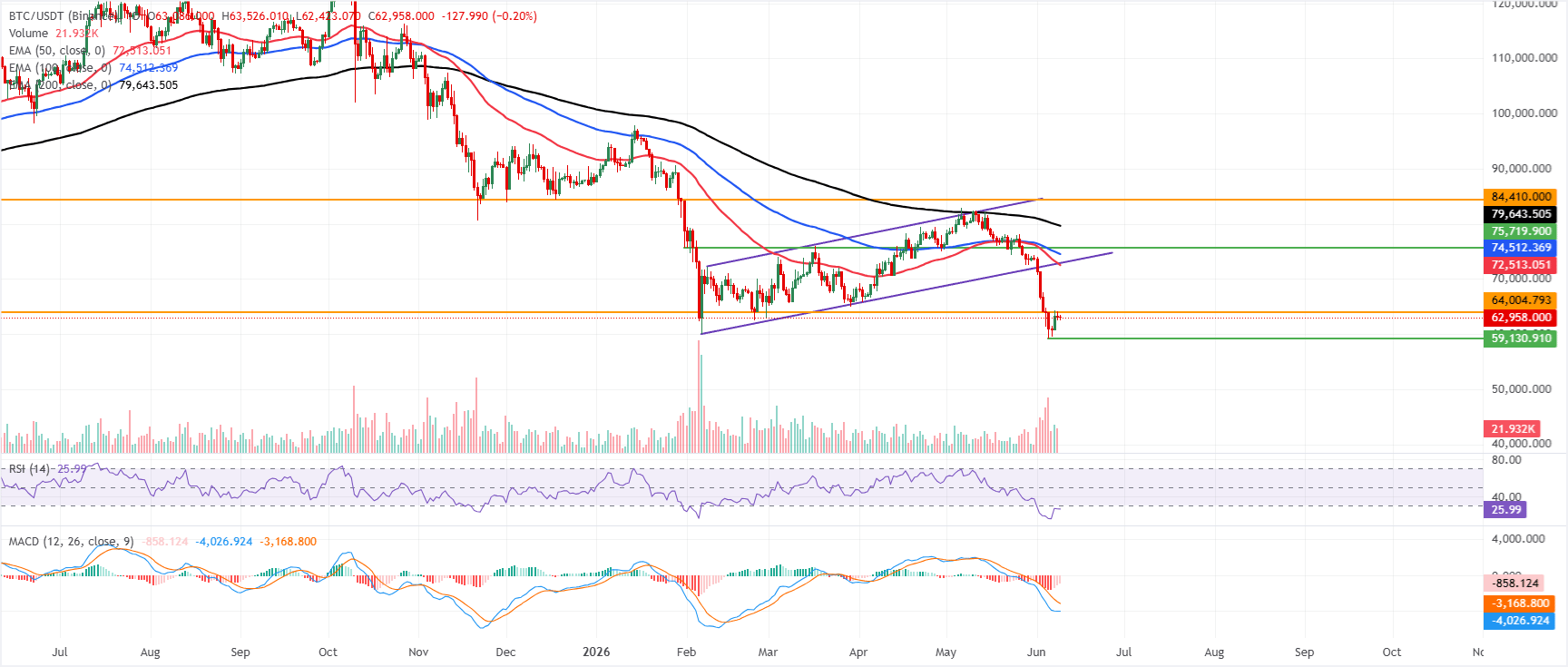
Bitcoin price trades below $62,950 on Tuesday, maintaining a clear bearish near-term bias as it remains well below the 50-day, 100-day, and 200-day Exponential Moving Averages (EMAs), clustered between roughly $72,500 and $79,600.
The Crypto King has also slipped back under the prior horizontal barrier at $64,000, while the earlier upward support trend line — now broken around $72,903 — has flipped into an additional layer of overhead supply.
Momentum readings reinforce the weak tone, with the Relative Strength Index (RSI) on the daily chart hovering near oversold territory at around 25 and the Moving Average Convergence Divergence (MACD) deeply negative, suggesting persistent downside pressure despite intermittent short-covering bounces.
On the topside, initial resistance is seen at the reclaimed horizontal level near $64,004, a close hurdle that needs to be overcome to ease immediate selling pressure. Above that, the 50-day EMA at $72,513 and the broken uptrend line around $72,903 form a key confluence zone, followed by the 100-day EMA at $74,512 and the 200-day EMA near $79,643, which together define a broad medium-term supply band. Higher still, a horizontal cap looms at $84,410.
With no clear structural supports mapped below the current price, any further decline would leave BTC vulnerable to discovering fresh demand at lower, yet-unmapped levels until buyers show evidence of regaining control.
(The technical analysis of this story was written with the help of an AI tool.)
Bitcoin, altcoins, stablecoins FAQs
Bitcoin is the largest cryptocurrency by market capitalization, a virtual currency designed to serve as money. This form of payment cannot be controlled by any one person, group, or entity, which eliminates the need for third-party participation during financial transactions.
Altcoins are any cryptocurrency apart from Bitcoin, but some also regard Ethereum as a non-altcoin because it is from these two cryptocurrencies that forking happens. If this is true, then Litecoin is the first altcoin, forked from the Bitcoin protocol and, therefore, an “improved” version of it.
Stablecoins are cryptocurrencies designed to have a stable price, with their value backed by a reserve of the asset it represents. To achieve this, the value of any one stablecoin is pegged to a commodity or financial instrument, such as the US Dollar (USD), with its supply regulated by an algorithm or demand. The main goal of stablecoins is to provide an on/off-ramp for investors willing to trade and invest in cryptocurrencies. Stablecoins also allow investors to store value since cryptocurrencies, in general, are subject to volatility.
Bitcoin dominance is the ratio of Bitcoin’s market capitalization to the total market capitalization of all cryptocurrencies combined. It provides a clear picture of Bitcoin’s interest among investors. A high BTC dominance typically happens before and during a bull run, in which investors resort to investing in relatively stable and high market capitalization cryptocurrency like Bitcoin. A drop in BTC dominance usually means that investors are moving their capital and/or profits to altcoins in a quest for higher returns, which usually triggers an explosion of altcoin rallies.
