

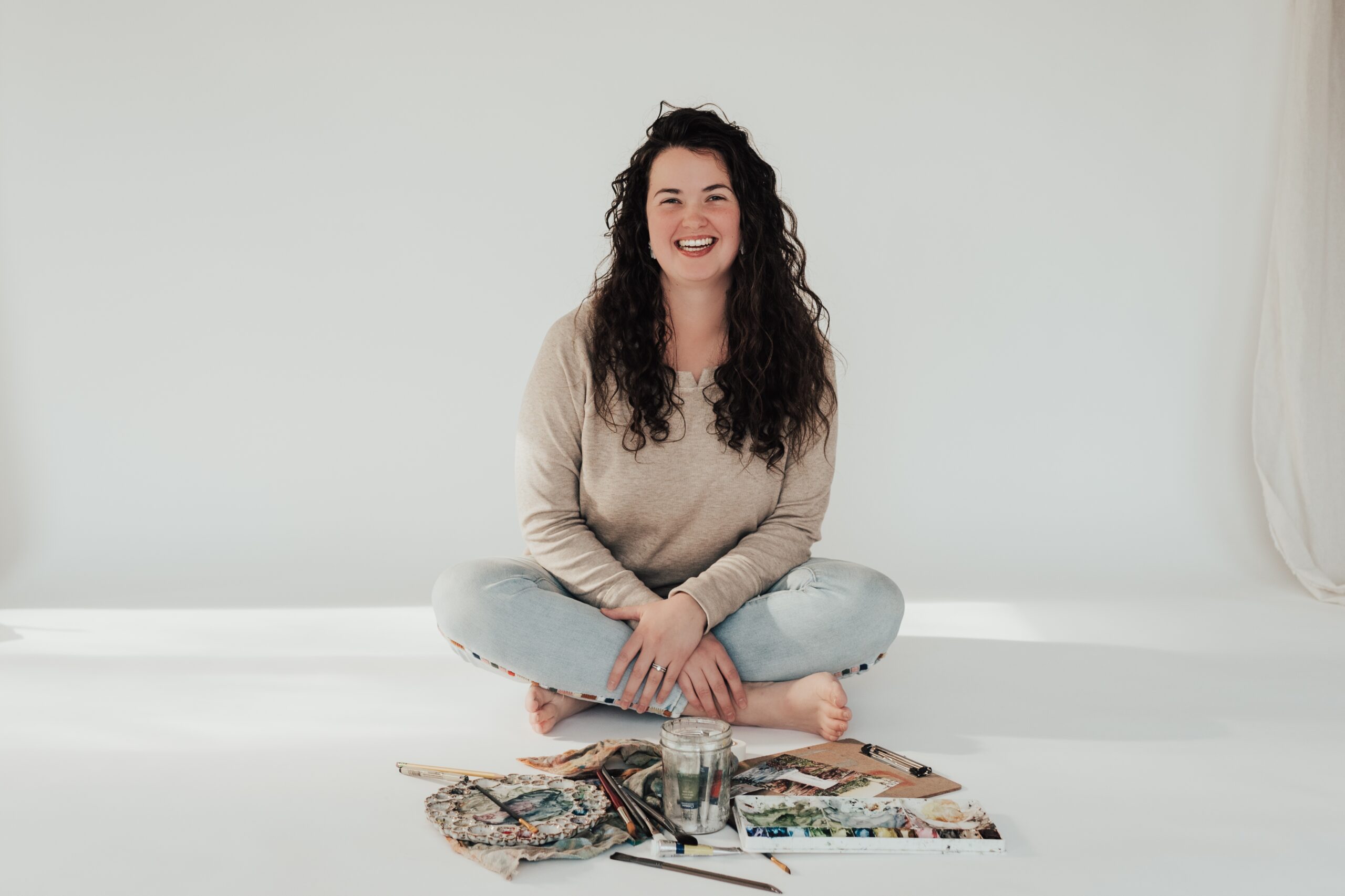
Whetstone’s major split her time between two worlds.
In one set of classes, she studied ceramics, printmaking, painting, and drawing. In the other, she explored psychology, lesson planning, pedagogy, and communication skills that prepared her for the classroom.
“Bethel gave me a space to explore and play with my craft and the opportunity to learn how to teach through a Christian lens. Having that sort of environment is unique, and I am thankful for it,” she says.
Years later, those two halves of her education would begin to overlap in unexpected ways.
A blank canvas
After graduating from Bethel, Whetstone taught kindergarten through fifth grade in Lakeville, Minnesota. She was the only art teacher at her school, so she taught every student.
“Kids love art, so art class is a space they want to learn. That made it really fun,” she says. “I loved coming up with fun projects, hanging art in the hallway, and meeting kids where art was their thing, because that was me.”
Whetstone’s teaching philosophy took shape in the classroom, but its roots stretched back to her childhood.
“While growing up, I noticed something: My friends began deciding whether or not they were ‘an artist,’” she says, “And once they made that decision, it stuck. Some kept creating. Others never picked up a pencil or paintbrush again.”
Whetstone’s goal in the classroom was to encourage enjoyment regardless of ability.
“To quote Bob Ross, ‘Talent is a pursued interest. Anything that you’re willing to practice, you can do,’” Whetstone says of the American painter. Her classroom was a place where students could get messy. There was no right or wrong way to tackle a project, and the goal was to just play.
“We even had a very cheesy greeting in class to start our day,” Whetstone says. “I would start with ‘Hello, my most amazing artists,’ and they would respond ‘Hello, my most amazing art teacher.’”
When you were in Whetstone’s classroom, you were an artist, and it never depended on how good you were at art.
Halfway through her first year teaching, Whetstone began experiencing severe back pain—later diagnosed as an autoimmune disease. She was in and out of urgent care, sometimes on crutches, searching for answers. Then the COVID-19 pandemic hit, and like millions of teachers, she suddenly found herself teaching from home.
“I never thought I’d be teaching from my desk at home. But honestly, it ended up being a blessing in disguise because I was in my worst pain, where I couldn’t physically walk,” she says.
Confined to a chair for much of the day, Whetstone returned to watercolors almost by accident. Acrylic painting required too much movement—walking to wash brushes, cleaning supplies, managing heavier materials.
“I decided to just grab watercolors because the paint isn’t permanent. I can’t ruin a paintbrush if I don’t wash it off,” she says.
Whetstone pulled out her watercolor sets from college, combined them with her pen-and-ink drawing skills, and spent the summer painting Minnesota scenes. When she tried selling them, they were a hit.
